How fast should contractors respond to a new lead?
Learn how fast contractors should respond to a new lead, prioritize urgent requests, assign each inquiry, and track lead response time while staying safe.
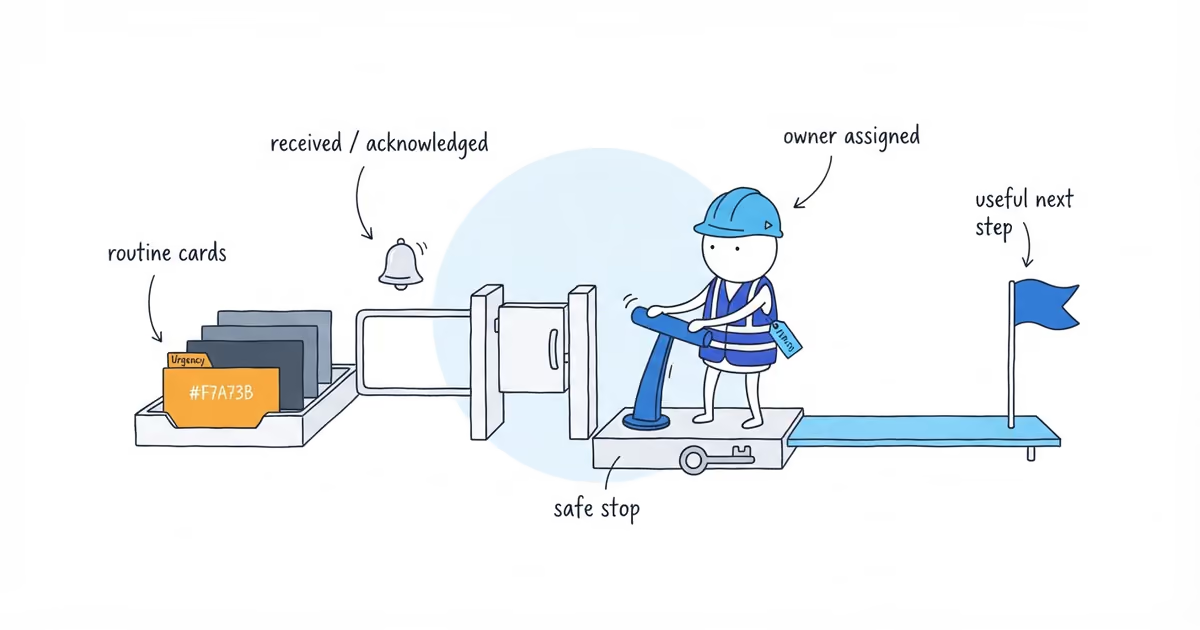
Contractors should respond to a new lead as soon as they can safely give the customer a useful next step. That may be a live answer, an automatic receipt followed by a call at the next safe break, or a reply in the next staffed window. Put possible hazards and same-day requests ahead of routine work. Do not promise a five-minute response if you cannot deliver it.
Track three different times:
- Received: The inquiry reaches a channel your business says it monitors.
- Acknowledged: The customer is told the inquiry arrived. This may be automatic.
- Useful human response: A person takes ownership and moves the inquiry to a call, information request, scheduling, or a clear not-a-fit answer.
An automated confirmation is useful, but it is not a completed response.
How fast should contractors respond by lead type?
| Inquiry | Response goal | First action | Owner or backup | Escalate when |
|---|---|---|---|---|
| Possible immediate hazard | Review first | Flag for human review; do not diagnose or promise arrival | On-duty owner; emergency backup | Nobody accepts it, or it exceeds your capability |
| Same-day service need | Next safe opportunity | Check service, area, and possible timing | Lead owner; office backup | Unassigned after the current lead block |
| Live call in advertised hours | Answer live when safe | Answer or create a missed-call queue item | Phone owner; phone backup | The call is missed without a queue item |
| Missed call or voicemail | Return within the stated window | Acknowledge where configured; queue a callback | Phone owner; shift backup | The callback window passes |
| Ready-to-schedule estimate | Give a scheduling next step | Acknowledge and assign it | Estimator; office backup | Still New at the next lead block |
| Routine future project | Use the published business window | Queue behind time-sensitive work | Estimator; next staffed owner | Still untouched at the daily cutoff |
| After-hours inquiry | State the next contact window | Route only verified after-hours work | On-call person or next staffed owner | The message promises unstaffed coverage |
How to set contractor lead response time
List every place an inquiry can arrive: phone, voicemail, text, form, email, social inbox, booking request, and marketplace. Record when each is monitored and who sees the alert.
The response clock starts when the inquiry reaches that monitored channel, not when someone eventually opens the app. If a social inbox is checked once a week, either stop presenting it as a contact route or change the coverage.
For a solo owner, a starting schedule might be three safe lead blocks plus an end-of-day check. That is an illustrative internal schedule, not an industry benchmark. Test whether you keep the window you state before making it tighter.
A 2011 Harvard Business Review study of online sales leads reported an audit of 2,241 US companies and a separate analysis of 1.25 million web leads at 42 B2B and B2C companies. Faster contact was associated with more qualifying conversations. This old, cross-industry research measured qualification, not booked contractor jobs. It supports prompt follow-up, not a universal five-minute rule.
A lead response SOP for a solo contractor
- Collect alerts. Route monitored channels into one queue or notification view.
- Acknowledge receipt. Send a basic confirmation where supported. Do not count it as the human reply.
- Set priority. Mark the inquiry as hazard, same-day, ready to schedule, routine, or after hours.
- Work the queue safely. Use planned breaks, with the vehicle parked and the job task secure.
- Record the result. Move the lead from new to acknowledged, contacted, then booked or closed.
- Escalate overdue work. Send high-priority items to a named backup. Without one, correct the response expectation instead of pretending there is coverage.
When the useful response reaches the screening step, the lead qualification guide helps you check service fit, area, timing, access, and any missing detail before booking a free visit.
Do not answer while driving to protect a metric. OSHA’s distracted-driving guidance says phone use can take a driver’s eyes, hands, and attention from driving; texting combines all three distractions. Pull over safely or wait for the next stop.
Lead response ownership for small teams
A team needs one first owner for each staffed period and one backup. “The office handles leads” is not ownership.
Use a short status path:
New -> Acknowledged -> Assigned -> Contacted -> Booked or ClosedOnly the assigned person moves the lead. The backup takes over on an observable trigger, such as a lead remaining unassigned at the end of a response block. This stops the field and office from each assuming the other replied.
How contractors should respond to after-hours leads
An after-hours confirmation should state the next staffed contact window. Route it to an on-call person only when that coverage exists. A possible hazard deserves first review, but the message should not diagnose it, claim 24/7 service, or promise arrival before availability is confirmed.
Contractor lead response examples
At 10:20 a.m., a customer reports a same-day leak. The driving owner lets the system acknowledge it, then reviews it at the next safe stop before a future-project request.
At 10:25 a.m., another customer requests an estimate for next month. It is acknowledged, assigned to the afternoon lead block, then given a scheduling next step.
At 8:40 p.m., a third inquiry arrives after closing. It receives the next staffed window and goes to the morning owner because nobody is on call.
How to measure contractor lead response time
Review one consistent period with this scorecard:
| Field | What to record |
|---|---|
| Received | Date and time the monitored channel received the inquiry |
| Acknowledged | Date, time, and whether it was automatic or human |
| Useful human response | Date, time, and next step given |
| Priority and channel | Matrix row and source channel |
| Owner | Person responsible for the response |
| Outcome | Contacted, booked, not a fit, unreachable, or closed |
| Reason for delay | Missed alert, no owner, unsafe to respond, after hours, or another specific cause |
Compare the same priority and channel. Do not judge an after-hours form against a staffed live call. Fix missed alerts, unclear ownership, or weak coverage before setting a faster target. Aim for fewer leads left in New without an owner, not a perfect average.
Once paid leads have a consistent response process, the lead source ROI guide helps you compare collected revenue and job gross profit with source spend before judging the channel.
Frequently asked questions about contractor lead response
How fast do I need to respond to paid leads?
Give paid leads their own tracked target based on the channel’s operating conditions, but do not copy a universal minute rule. Record received, acknowledged, and useful human response times, then compare results under the same staffing and follow-up process.
Should I text back missed calls?
Use a text acknowledgment only if your business monitors replies and can deliver the next step it states. The text can confirm receipt, but a person still needs to own the callback or other agreed follow-up.
Sources
- pricing
- how-fast-should-contractors-respond-to-a-new-lead
- contractor-lead-response-time
- lead-response-priority
- after-hours-lead-response