How Do I Calculate Lead Source ROI?
Calculate lead source ROI with gross profit, a simple formula, and a dollar example. Attribute revenue and spend correctly, then compare ROI with ROAS.
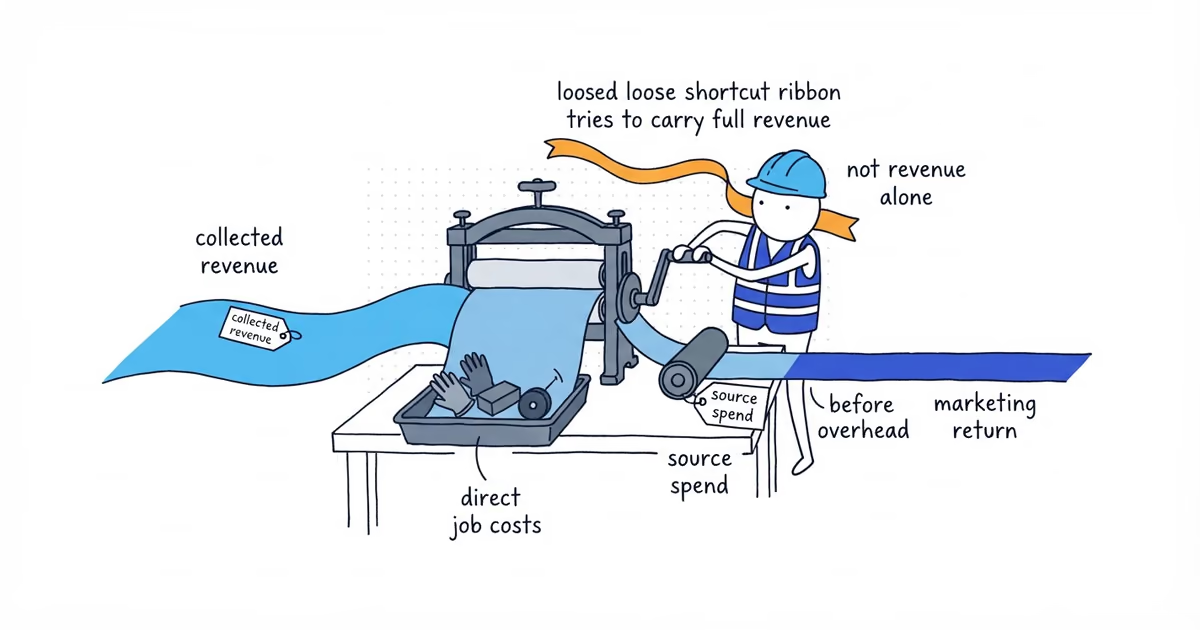
Use gross profit, not sales, to calculate lead source ROI:
Source job gross profit = collected revenue - direct job costs
Marketing return = source job gross profit - source marketing spend
Lead source ROI = marketing return / source marketing spend x 100
If a lead source produced $4,000 in job gross profit and cost $2,400, its ROI was 66.7%. That is a different answer from dividing $10,000 in revenue by the same $2,400 spend.
What Is Included in Lead Source ROI?
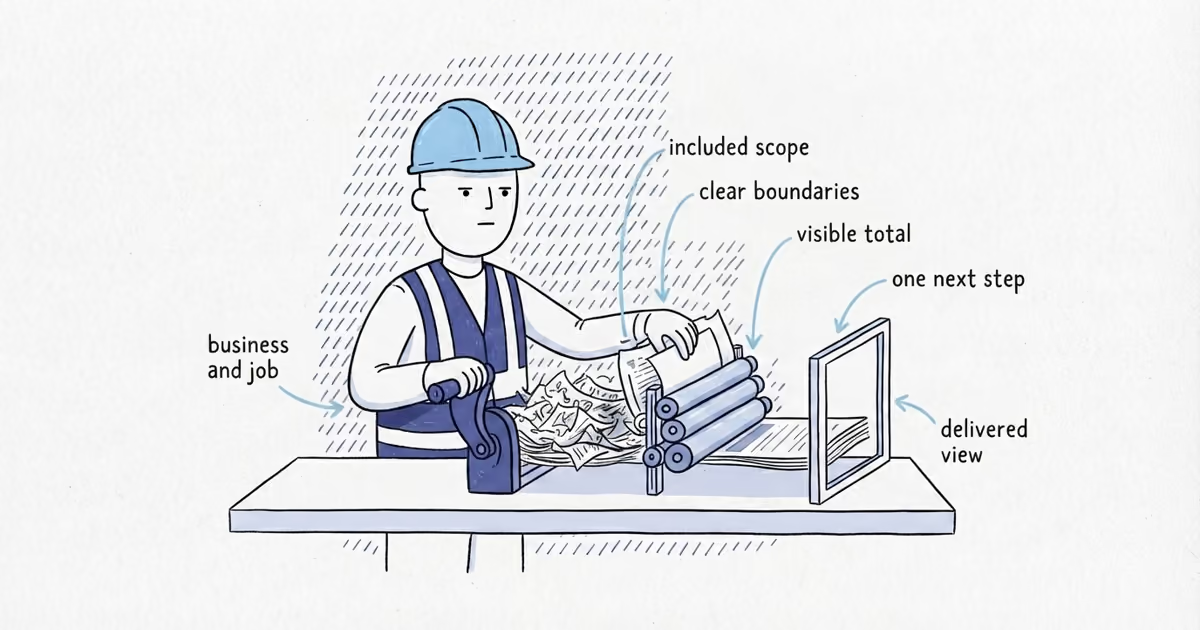
The calculation works only when these four lines stay separate:
| Line | What belongs here |
|---|---|
| Collected revenue | Customer payments received for completed jobs attributed to the source |
| Direct job costs | The costs required to deliver those jobs |
| Job gross profit before marketing | Collected revenue minus direct job costs |
| Source marketing spend | The cost of acquiring leads from that source |
Direct job costs can include field labor, payroll burden, materials, subcontractors, permits, disposal, job-specific equipment or travel, payment fees, refunds, and callback costs. Include a reasonable labor cost for the owner’s field time. Treating owner labor as free makes a source look better than it is.
This job gross profit is a management number for comparing lead sources. It is not net business profit or a tax definition. General overhead, taxes, debt payments, and owner distributions may still come out later.
Source marketing spend includes charges that belong to that source: ad spend, lead fees, referral incentives, management, creative work, a source-specific landing page, or call tracking. Decide whether the comparison will use cash cost only or fully loaded cost, including time. Use the same method for every source.
Assign an exclusive charge directly to its source. If one agency, tracking, or creative bill supports several sources, split it with one written rule, such as actual hours or each source’s share of managed ad spend. Do not charge the full shared bill to every source.
How to Attribute Revenue and Spend to a Lead Source
Do not compare one month’s marketing bill with whatever customer payments happened to arrive that month. A lead can arrive in April, approve the estimate in May, and pay after the job finishes in June.
Use a lead cohort instead:
- Choose one source and a lead window, such as April 1–30.
- Record all source spend for that window.
- Follow only the leads first received during that window.
- Set a closeout date, such as June 30.
- Count revenue only from jobs completed and paid by that date.
Keep open estimates, scheduled jobs, canceled work, unpaid invoices, and hoped-for repeat work out of realized ROI. They may become real later, but they are not collected revenue yet.
Give every lead one primary source. Set the evidence order before running the numbers: a source-specific phone number, form or booking field, campaign tag, or platform record may come first; the customer’s answer to “How did you hear about us?” can fill a gap. Keep assisting sources in a separate note. Crediting the same job to Google, a referral, and an email produces three good-looking reports from one payment.
Google Analytics also separates source, medium, and campaign, and defines attribution as assigning event credit. You do not need a complicated setup to use the rule: label sources consistently and do not count one result twice.
If website calls and forms are not tied to lead and job records yet, use the website lead-tracking guide to connect each inquiry to qualification, estimates, won jobs, and revenue before calculating source ROI.
Lead Source ROI Calculation Example
The numbers below are fictional, not a trade benchmark.
| Source cohort waterfall | Amount |
|---|---|
| Collected revenue from completed, paid jobs | $10,000 |
| Direct job costs | -$6,000 |
| Job gross profit before marketing | $4,000 |
| Source marketing spend | -$2,400 |
| Marketing return | $1,600 |
Now calculate ROI:
$1,600 / $2,400 x 100 = 66.7% ROI
The source returned about $0.67 after direct job costs and source spend for each $1 spent on that source. That $0.67 is still before general overhead and taxes.
The same source has a revenue return on ad spend, or ROAS, of:
$10,000 / $2,400 = 4.17x revenue ROAS
ROAS says the source collected $4.17 in revenue for every $1 of marketing spend. It does not say how much of that revenue survived labor, materials, and the other costs of doing the work.
Calling this result 316.7% ROI would make that mistake:
($10,000 revenue - $2,400 spend) / $2,400 spend x 100 = 316.7%
That shortcut treats the $6,000 spent completing the jobs as if it never happened. The 4.17x ROAS can be useful, but it cannot replace the 66.7% gross-profit ROI.
Lead Source ROI Formula Template
Use the same waterfall for each source:
$_____ collected revenue
- $_____ direct job costs
= $_____ job gross profit before marketing
- $_____ source marketing spend
= $_____ marketing return
/ $_____ source marketing spend
x 100
= _____% lead source ROI
Check the entries before trusting the result. The most common errors are counting booked work as paid work, mixing leads and spend from different periods, deducting marketing once in direct costs and again below gross profit, or using fully loaded cost for one source and cash cost for another.
If recorded source spend is $0, percentage ROI is undefined, not infinite. Report the realized job gross profit and improve the cost record instead of forcing a percentage.
This calculation gives you one comparable result. It does not decide whether a source deserves more time, needs a repair, or should be stopped. That requires a separate keep, fix, or stop review using lead quality and the rest of the sales path. Cost per estimate is also a separate calculation; do not fold it into this formula.
Frequently Asked Questions
What Is the Difference Between Lead Source ROI and Cost per Estimate?
Lead source ROI measures the profit return from completed, paid jobs after source spend. Cost per estimate measures what the source spent for each estimate actually delivered. Keep the metrics separate; an inexpensive estimate can still produce no paid work or little gross profit.
Should Repeat Jobs Count Toward Lead Source ROI?
Count repeat work only after it is completed and paid, and only when it belongs to the original lead cohort under the same closeout rule. Do not add projected lifetime value or hoped-for bookings to realized ROI.
Can I Compare Lead Source ROI Across Marketing Channels?
Yes, if every source uses the same revenue cutoff, direct-cost treatment, spend method, and attribution rule. The comparison shows which sources returned more gross profit per dollar; it does not by itself tell you which one to keep or stop.
Sources
- pricing
- how-to-calculate-lead-source-roi
- lead-source-roi-formula
- marketing-roi-for-contractors
- lead-source-attribution
- roi-vs-roas