How many bad reviews is too many?
Work out what one bad review actually cost you, how many five-star reviews it takes to get back, and why your rating has not moved since you started asking.

There’s no number. It’s a ratio, and you can work out yours in about a minute.
One bad review against 20 is a problem. The same review against 200 is noise. What matters is how many ratings you already have, because Google’s score is a plain average — “the average of all ratings published on Google for that place or business,” with no weighting for recency, reviewer, or anything else. That’s why the arithmetic below actually works.
Google documentation checked: August 10, 2026 (United States).
How much one bad review actually hurts
The same 1-star review, against two profiles that both average 4.8:
- 20 reviews. Total stars 96. Add the 1-star: 97 ÷ 21 = 4.62. You dropped 0.18.
- 200 reviews. Total stars 960. Add the same review: 961 ÷ 201 = 4.78. You dropped 0.02.
Same review, nine times the damage. That is the answer to “how many is too many” — nobody can give you a count, because the count that hurts depends on the pile it lands on. Do that division on your own numbers and you’ll know inside a minute whether you’re looking at a bad afternoon or a real problem.
The rough shape of it: while you’re still in your first couple of dozen reviews, one bad one is an event you can feel. Past a couple of hundred, individual reviews barely move the number at all. Those are our rules of thumb read off the arithmetic, not thresholds Google publishes.
How many 5-star reviews to cancel out a 1-star
Reviews needed = (target average × current count − current total stars) ÷ (5 − target average)
Your current total stars is your displayed average multiplied by your review count.
Say you’re sitting at 4.3 with 41 reviews, and you want to be back at 4.5.
- Current total stars: 41 × 4.3 = 176.3
- Target total: 4.5 × 41 = 184.5
- Shortfall: 184.5 − 176.3 = 8.2
- Each new 5-star adds 5 but also adds 1 to the count, so each one closes the gap by 5 − 4.5 = 0.5
- 8.2 ÷ 0.5 = 16.4, so 17 five-star reviews
Check it: (176.3 + 85) ÷ 58 = 4.505. That clears 4.5.
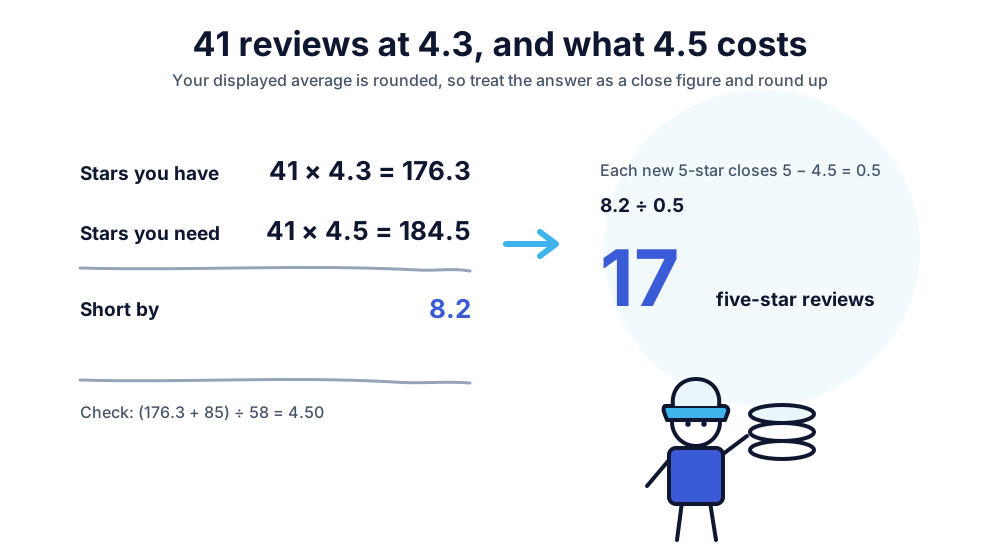
One caveat the calculators skip: your displayed average is rounded, so the total stars you started from is an estimate. Treat the answer as a close figure to aim at rather than an exact count, and round up.
Why your Google rating hasn’t updated
You get five good reviews in a week, check the profile, and the number hasn’t moved. Two things are going on, and only one of them is arithmetic.
The arithmetic: if you already have 150 reviews, five new 5-stars move your average by a couple of hundredths. That’s expected — the more reviews you have, the less any single one shifts the number.
The other one is timing, and it catches almost everybody. Google says that after someone leaves a new review, “it may take up to 2 weeks to get an updated review score.” So a rating that hasn’t moved this morning may simply not have been recalculated yet. Don’t judge a review push after four days.
How Google decides which reviews show first
Here’s the part that gets missed. Your average can be perfectly healthy while your profile still reads badly, because the average and what a customer actually sees are two different things.
Google’s reviews are sorted by “Most relevant” by default, not newest. Which reviews that surfaces isn’t documented — the signals aren’t published, and this is inference from Google’s help community and people who watch the platform closely, not something Google states. What is clear is that there’s no setting on your end to change it. Sorting is a control for the person reading, not for you.
So “bury the bad one” isn’t really available as a strategy. You can’t push it down; you can only make sure that a customer who scrolls finds plenty of recent, detailed, obviously genuine reviews around it. That’s the same work as collecting reviews normally, and our review request templates give you the wording to send after each type of job.
Why you can’t bury bad reviews with good ones
Search this topic and half of what comes back breaches Google’s policy. Worth knowing which half, because the penalties land on your profile, not on the person who gave you the advice.
Off the table, all of it from Google’s content policy:
- Any incentive — payment, discount, free work — in exchange for a review
- Pressuring customers to leave a review while they’re still on the premises, including review stations and shared tablets
- Asking for reviews that include specific content, or that name a particular member of your crew
- Selectively asking only the customers you think are happy
That last one matters most: it’s the most commonly recommended tactic in this entire category, and it’s explicitly prohibited. Ask every finished job the same way, or don’t ask.
How to recover from a bad review
Run the formula, get your number, and then be realistic about the rate. Seventeen reviews is a couple of months of asking every completed job — it is not a weekend project, and treating it as one is how owners end up buying reviews. If asking after every completed job is the part that keeps slipping, ShiftFlow’s Google review management sets the request process up and keeps it running.
Then leave the bad review alone except for your reply. The reply is visible whatever the sort order does and whatever the average says, and it’s the part a careful reader weighs most — our guide to replying or reporting covers what that reply should and shouldn’t contain.
And don’t chase a 5.0. Research from Northwestern’s Spiegel Research Center found purchase likelihood peaks somewhere around 4.0 to 4.7 and falls off as ratings approach a perfect 5.0 — in no category was 5.0 the optimum. That study looked at online retail products rather than local service businesses, so don’t treat the exact band as your target. The direction is the useful part: a spotless score isn’t the goal, and the effort to protect one is better spent elsewhere.
Frequently asked questions
I collected five new reviews and my rating didn’t change. What went wrong?
Probably nothing. If you already have a lot of reviews, five moves the average by hundredths. And Google says an updated score can take up to two weeks to appear, so give it longer than a few days before you conclude anything.
Can I make my newest reviews show first?
No. The default is “Most relevant” and the sort control belongs to the person reading the profile, not to you. There’s no owner setting for it.
Is there a rating where customers stop calling?
Nobody can give you a sourced number for that, and the ones you’ll find quoted are invented. What the evidence supports is narrower: a perfect score isn’t what maximises interest, and volume matters more than the last decimal when you’re starting out.
Sources
- google-reviews
- star-rating
- review-recovery
- negative-reviews
- home-services