
How Much Should I Mark Up Materials?
There is no fair markup percentage for every contractor. Your material price has to recover the full cost of buying, moving, stocking, and standing behind the item, then leave enough room for the required margin.
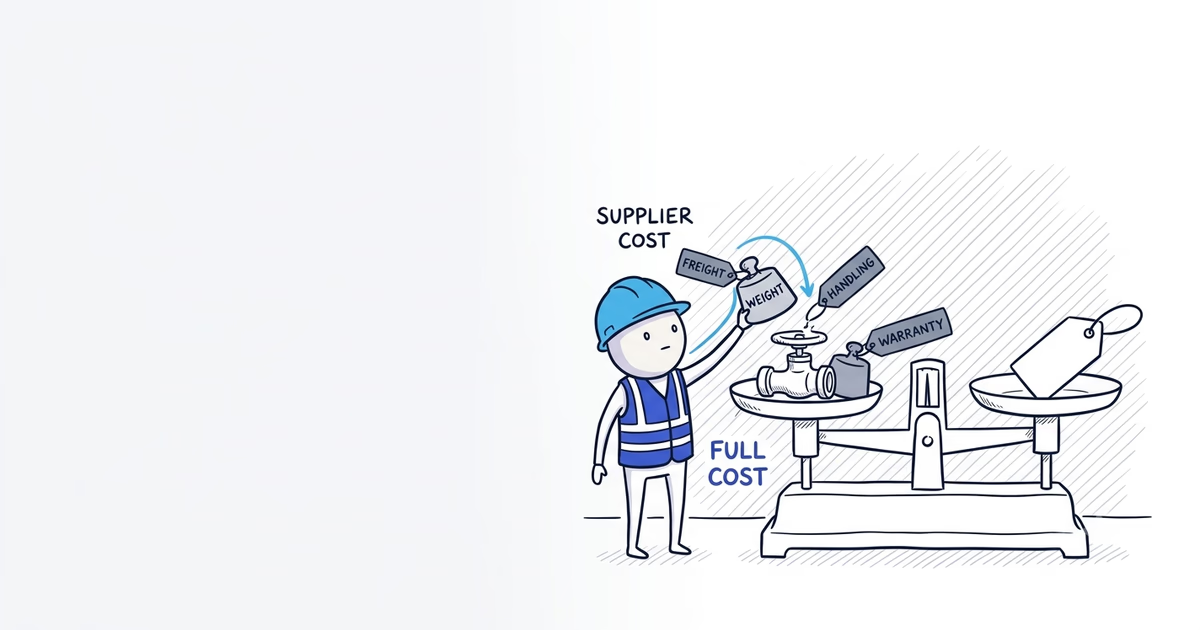
There is no fair markup percentage for every contractor. Your material price has to recover the full cost of buying, moving, stocking, and standing behind the item, then leave enough room for the job’s required margin. A percentage copied from another trade cannot do that math for you.
This is why online advice looks contradictory. General-contractor guides may discuss material markups around 7–20%, while flat-rate plumbing and electrical guides discuss multipliers from 2x to 6x. Those numbers describe different jobs, parts, risk, and pricing models. They should not be averaged.
Material markup vs. profit margin
Markup is calculated from your cost. Margin is calculated from the selling price.
Markup % = (selling price - material cost) / material cost x 100

Gross margin % = (selling price - material cost) / selling price x 100

Selling price = material cost x (1 + markup as a decimal)
If an item costs $100 and you apply a 50% markup, the selling price is $150:
($150 - $100) / $100 = 50% markup

($150 - $100) / $150 = 33.3% gross margin
A 50% markup does not create a 50% margin. To produce a 50% material margin on a $100 cost, the selling price must be $200, which is a 100% markup.
| Markup on cost | Selling price on $100 cost | Resulting gross margin |
|---|---|---|
| 20% | $120 | 16.7% |
| 30% | $130 | 23.1% |
| 50% | $150 | 33.3% |
| 100% | $200 | 50% |
| 200% | $300 | 66.7% |
Write down which measure you are targeting before adjusting a pricebook. Confusing the two can leave a large gap between the profit you expect and the profit the job produces.
What costs should material markup cover?
The supplier invoice is only the first line. Depending on how your business works, supplying the material may also involve:
- Freight and delivery
- Time spent selecting, ordering, and collecting items
- Receiving and stock handling
- Shelving, storage, and inventory loss
- Normal waste and consumables
- Price changes between estimate and purchase
- Warranty processing and replacement risk
Decide where each cost lives. If purchasing time and warehouse payroll are already inside your overhead rate, do not add them again to every part. If your material price is supposed to recover those costs, do not also bury them in a second line on the same job.
Use one list for the whole business. An expense should be recovered through material price, labor, overhead, or another defined charge. It should not disappear, and it should not be counted twice.
Why contractor material markup percentages vary
A general contractor buying $40,000 of project materials has different economics from a plumber carrying a $15 valve on a service truck.
The large project may have:
- A high invoice value
- Delivery directly to the job
- A lower handling cost as a percentage of material value
- A contract that exposes or limits markup
- Less inventory risk per individual item
The service part may have:
- A low purchase price
- Months of truck or warehouse storage
- Technician time spent identifying and stocking it
- A high chance that the first visit or diagnosis produces no larger sale
- Warranty and callback responsibility far greater than the item cost
ServiceTitan’s plumbing guidance discusses multipliers from 3x to 6x in the context of flat-rate plumbing and a stated gross-margin goal. Its electrical guidance discusses 2x to 6x in a similar service-pricebook context. Method’s general-contractor guide discusses much smaller project-material percentages. These are examples of business models, not three answers to the same question.
Material markup examples for service and project work
The same supplier invoice can carry different work behind it.
A stocked service part
Suppose a group of small parts costs $100 from the supplier. The business assigns these additional material-handling costs:
| Cost | Amount |
|---|---|
| Supplier invoice | $100 |
| Freight and receiving | $12 |
| Stock handling and normal loss | $10 |
| Warranty administration allowance | $8 |
| Full material cost | $130 |
At a 100% markup on full material cost:
$130 x 2.00 = $260 selling price

($260 - $130) / $260 = 50% material margin
That does not mean every $100 service part should sell for $260. It shows why marking up only the supplier invoice can miss the work required to keep the part available and stand behind it.
A project material delivered to site
Now suppose a project material also costs $100, but it is ordered once, delivered to the job, and carries little storage or warranty administration:
| Cost | Amount |
|---|---|
| Supplier invoice | $100 |
| Delivery | $10 |
| Purchasing and handling | $5 |
| Full material cost | $115 |
At a 20% markup on full material cost:
$115 x 1.20 = $138 selling price

($138 - $115) / $138 = 16.7% material margin
The second markup is lower because the cost and operating model are different. Whether that margin is enough depends on the complete job, not the material line alone.
Should you use one material markup or price bands?
A single multiplier is easy to maintain and produces a consistent material margin when the full cost base is accurate. It can work well for a narrow group of similar parts.
Price bands can better reflect a mixed catalog. Small stocked items may need a higher percentage to recover handling, while expensive equipment may produce enough gross profit dollars at a lower percentage. Bands also create more room for errors and inconsistent margins.
Choose based on the parts you actually sell:
- Group materials by cost, handling, inventory, and warranty profile.
- Calculate the full cost for a typical item in each group.
- Apply the proposed multiplier or band.
- Check both gross margin percentage and gross profit dollars.
- Put the material result back into the complete job price.
Do not choose the method because the percentages look familiar. Choose it because completed jobs repeatedly produce the intended result.
How to test your material markup
Pull ten recently completed jobs and compare:
- Estimated supplier cost versus the invoice paid
- Freight and delivery allowed versus actual
- Waste, replacement, or unused stock
- Material selling price
- Actual material margin
- Complete job margin after labor and overhead
If material margin looks healthy but the job loses money, material markup is not the only problem. Labor, overhead, scope, or callbacks may be wrong. If supplier costs have moved and the pricebook has not, update the cost before changing the multiplier.
Review supplier prices when they change materially and on a regular monthly or quarterly schedule. A correct percentage applied to an old cost is still a wrong price.
How to explain material pricing to customers
The customer is buying a supplied and supported part, not reimbursing your supplier receipt. Keep the explanation on the work your business owns:
Our material price includes sourcing the correct item, getting it to the job, handling normal supplies and waste, and standing behind the installed work. The quote shows the price you will pay before we order or install it.
That is more accurate than arguing over an internal markup. The fair number is the one built from real cost, checked against the job’s required margin, and stated before the customer commits.
Frequently asked questions
Should I mark up customer-supplied materials?
Not when the customer buys the material directly. Charge only for handling, inspection, pickup, or added risk that your business actually accepts, and agree on that price before the job.
How do I price normal material waste?
Include the expected waste once in the estimated quantity or full material cost before markup. Treat unusual waste caused by a scope change as separate additional work.
Should I charge for a warranty replacement part?
Follow the written warranty. When it covers the replacement, recover expected warranty cost through the original pricing rather than adding a new material charge; quote only work outside that coverage.
Sources
- pricing
- material-markup
- contractor-material-markup
- markup-vs-margin
- material-pricing
- gross-margin