

How Do I Bid a Commercial Cleaning Job?
Build a commercial cleaning bid from a site walkthrough, task schedule, labor hours, full account costs, and profit, with a worked monthly example.
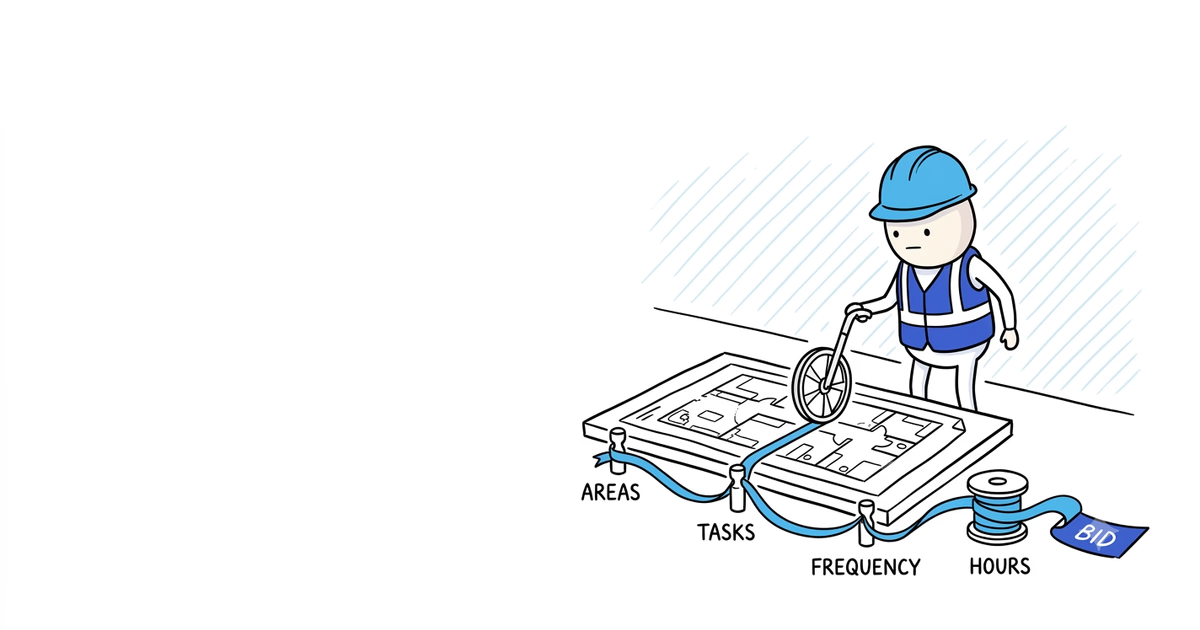
Build the bid from the work the building requires, not from square footage alone. Walk the facility, write a task-and-frequency schedule, estimate the crew hours from your own production history, then add every cost needed to service the account.
A low price can win the contract and still buy you a loss every month. The usual cause is not bad arithmetic. It is an incomplete scope: more restrooms than expected, high waste volume, restricted access, periodic floor work, or customer consumables that were never discussed. The controls in how to avoid scope creep in a quote apply to recurring cleaning contracts too.
How to qualify a commercial cleaning lead
Do not spend two hours inspecting an account that cannot use your service or will not share the information you need. Confirm these points first:
- Facility type and approximate cleanable square footage
- Number of locations and service areas
- Requested days, service window, and start date
- Current service problems and expected result
- Special security, safety, training, or insurance requirements
- Whether the customer supplies restroom consumables
- Who makes the decision and when bids are due
- Whether there is a written scope, bid form, or mandatory walkthrough
This call is not where you set the final price. It tells you whether the opportunity fits your crew, route, equipment, and schedule.
How to perform a commercial cleaning walkthrough
Tour the site with the person who understands how it is used. A floor plan is helpful, but it will not show overflowing break-room trash or the loading dock that takes ten minutes to reach.
Record:
- Cleanable square footage by area, not just total building size
- Floor type and condition
- Restroom count, fixture count, and expected traffic
- Offices, cubicles, conference rooms, break rooms, stairs, and entrances
- Trash and recycling locations, volume, and disposal route
- Touchpoints, glass, partitions, and other detail work
- Day porter or daytime response needs
- Keys, alarms, elevators, parking, loading, and access limits
- Janitorial closet, water, power, storage, and laundry access
- Periodic work such as floor refinishing, carpet extraction, or high dusting
Ask what the current cleaner misses. Then ask the customer to point to what “done” looks like. “Clean the restrooms” is too vague to price. Fixture count, service frequency, restocking responsibility, inspection standard, and floor-care method give you something you can estimate and your crew can follow.
Build a commercial cleaning task schedule
Write each task under the area where it happens. Give it a frequency. Separate routine service from periodic work so neither disappears inside a flat monthly number.
| Area | Task | Frequency | Bid note |
|---|---|---|---|
| Offices | Empty waste, spot-clean surfaces, vacuum traffic lanes | 3 times weekly | Desks excluded unless cleared |
| Restrooms | Clean and disinfect fixtures, mirrors, counters, and floors | 3 times weekly | Customer supplies paper goods |
| Break room | Clean counters, sink, appliance exteriors, and floor | 3 times weekly | Dishes and appliance interiors excluded |
| Entrances | Clean glass doors and vacuum mats | 3 times weekly | Exterior glass priced separately |
| Hard floors | Machine scrub | Monthly | After-hours access required |
The table is an example, not a ready-made scope. Match tasks and frequencies to the building you inspected. If the customer wants options, create separate schedules such as three-day and five-day service instead of weakening one scope until the number fits.
Estimate commercial cleaning labor hours
Use production data from your own completed accounts whenever possible. Compare buildings with similar floor types, fixture counts, density, access, and service standards. Square footage helps you organize the walkthrough, but two buildings of the same size can require very different crew time.
For a new task, time a representative area or run a paid test clean when practical. Include setup, travel inside the building, equipment handling, restocking, inspection, and closing the site. A stopwatch on vacuuming alone will understate the visit.
Convert every frequency to a common monthly basis:
Monthly service hours =
  (routine hours per visit × routine visits per month)
  + weekly task hours per month
  + monthly and periodic task hours
  + supervision or quality-control time
For weekly work, 52 ÷ 12 gives an average of about 4.33 occurrences per month. For service three times per week, the monthly average is 3 × 52 ÷ 12, or 13 visits. State how you handle extra service days, holidays, and shutdowns in the proposal rather than silently assuming every month has four weeks.
Calculate a commercial cleaning bid price
Start with the labor hours, then price the rest of the account:
Recurring bid price =
  labor and labor burden
  + cleaning supplies and liners
  + customer consumables, if included
  + equipment and maintenance
  + travel, access, and supervision
  + allocated overhead
  + profit
  + applicable tax
Labor burden means the employer costs tied to the labor on the account, not just hourly wages. Use the categories and rates from your own payroll and accounting records. Keep overhead separate and do not count the same cost twice.
Commercial cleaning bid worksheet example
This example shows the calculation method. The hours, labor cost, and dollar amounts are illustrative, not market rates.
| Workload | Calculation | Monthly hours |
|---|---|---|
| Routine cleaning | 4.5 hours × 13 visits | 58.5 |
| Weekly detail work | 1.5 hours × 4.33 weeks | 6.5 |
| Monthly floor service | Scheduled monthly | 6.0 |
| Total | 71.0 |
| Price line | Illustrative calculation | Amount |
|---|---|---|
| Labor and labor burden | 71 hours × $24 | $1,704 |
| Cleaning supplies and liners | Estimated from comparable accounts | $180 |
| Equipment and maintenance | Account allocation | $95 |
| Travel and access | Route estimate | $130 |
| Supervision and quality checks | Account allocation | $170 |
| Direct account cost | $2,279 | |
| Allocated overhead | From the company’s cost model | $342 |
| Planned profit | From the company’s pricing target | $524 |
| Illustrative monthly bid before applicable tax | $3,145 |
The worksheet is useful because every number has an owner. If the customer adds a service day, you can change visits and hours. If they supply liners, you can remove that cost. If the price feels too high, revise the scope or operating method rather than deleting profit and hoping the crew works faster.
What to include in a commercial cleaning proposal
The proposal should let the customer compare your promise with the price. Include:
- Facility and customer details
- Cleaning schedule by area, task, and frequency
- Initial or startup cleaning, if required
- Periodic services and whether they are included or separately priced
- Customer and contractor responsibilities, including consumables and storage
- Quality checks and a contact process for missed work
- Exclusions and the process for requested additions
- Recurring price, optional services, and applicable tax
- Service term, start assumptions, payment timing, and price expiration
- Approval names and signature fields
Submit it in the format the customer requested and confirm receipt. Do not promise a start date until you have checked hiring, supplies, equipment, keys, and site access.
Review actual labor after winning the account
Review actual crew hours during the first several services and again after the account settles. Separate startup work from normal production. Record what caused any miss: wrong quantity, access delay, heavier traffic, training, equipment choice, or an unrealistic task time.
Do not quietly reduce the agreed scope to rescue a weak bid. Fix an internal operating problem when it is yours. When the building or requested work differs from the bid assumptions, document the difference and use the agreed change process.
That review improves the current account and your next bid. Your own clean production history is more useful than a national square-foot number because it reflects your crew, equipment, route, and service standard. If the account remains busy but misses its target margin, use the broader checks in am I charging enough?.
Before requesting a walkthrough, a buyer may check whether the business clearly explains its cleaning services, service area, and contact path. Qualified cleaning businesses can apply for a free service website built around those details.
Frequently asked questions
Can I bid a commercial cleaning job without a walkthrough?
You can give a preliminary range from photos, a floor plan, and a detailed customer interview. For a recurring contract, inspect the site before giving a final bid when possible. If you cannot, list every unverified condition as an assumption and state what would trigger revised pricing.
Should a commercial cleaning bid include supplies?
It should state exactly which cleaning chemicals, liners, equipment, and restroom consumables are included. When the customer supplies an item, list that as a customer responsibility rather than leaving the cost unclear.
How should I price periodic cleaning work?
Estimate the labor, materials, equipment, and access for each periodic task separately. Then state whether that work is included in the recurring price, scheduled at a fixed price, or quoted for approval when due.
- pricing
- commercial-cleaning
- commercial-cleaning-bid
- commercial-cleaning-proposal
- janitorial-bidding
- cleaning-job-estimate



