How do I compete with cheaper contractors?
Win without copying a cheaper price by analyzing lost bids, choosing the work you can defend, building proof into every sales stage, and measuring why quotes close.
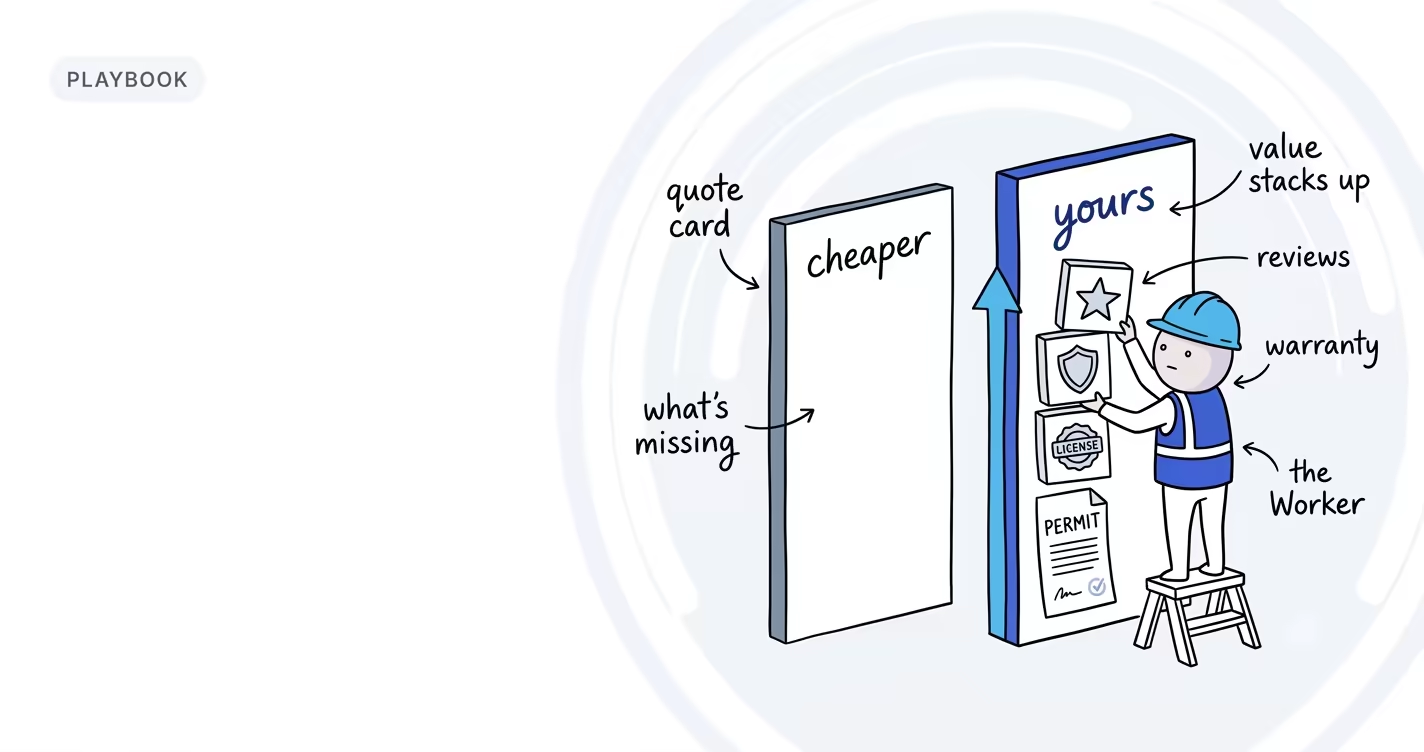
“They were $3,000 cheaper.”
That sentence tells you almost nothing. Maybe the scopes differed. Maybe the other shop runs a tighter route, buys better, or genuinely does the same work for less. Maybe your estimate was wrong. Until you know which one happened, “sell more value” is just advice-shaped fog.
Start with the bids you actually lost. Then fix the part of the sales process the evidence points to.
What your lost bids can tell you
The loudest customer shouldn’t set the strategy. Neither should the competitor who gets under your skin. Review at least 10 recent quotes from the same service category and record:
| Field | What to capture |
|---|---|
| Job type and price band | Compare similar work rather than mixing service calls with projects |
| Lead source and customer type | Referral, repeat, organic search, paid lead, property manager, homeowner |
| Your quoted scope and price | Include option presented and quote turnaround time |
| Competing price | Mark it unverified unless you saw the written proposal |
| Stated decision reason | Use the customer’s words; do not rewrite every loss as price |
| Follow-up completed | Date, channel, and response |
| Outcome | Won, lost, delayed, no decision, or scope changed |
| Completed-job result | For wins, record actual margin, callback, and collection time |
Patterns matter more than anecdotes. You may learn that you lose only paid marketplace leads, that estimates taking five days lose to same-day quotes, that one job type is genuinely overpriced, or that customers cannot tell what your larger scope includes.
Call or message selected lost prospects with one neutral question:
“Thanks again for considering us. Quick question as I review our estimates: what mattered most in your decision, and was anything in our proposal unclear?”
Take the answer, thank them, and leave the old sale closed. You’re looking for a pattern, not another chance to win the argument.
Five reasons another contractor can charge less
“Cheaper” can describe different situations:
- The scopes differ. One proposal includes more work, a different specification, or more responsibility.
- The competitor has a real cost advantage. They may have a denser route, different purchasing, lower acquisition cost, specialized production, or available capacity.
- Your business carries avoidable cost. Rework, slow estimating, poor scheduling, excess drive time, or purchasing leakage can make your required price higher without improving the customer outcome.
- Your quote is wrong. A quantity, production allowance, overhead allocation, or margin target may be incorrect for that service.
- The competitor may be underpricing. That is possible, but you cannot diagnose another business from one number.
Each situation needs a different response. A comparison sheet helps with the first. Operational improvement addresses the second and third. Job costing addresses the fourth. Stronger warnings about “lowballers” do not fix any of them.
Pick the work where your strengths matter
“Better service” is too broad to defend a higher price. Choose a customer and job where a specific capability changes the result.
Examples:
- Occupied-home remodeling where dust control, daily cleanup, access, and schedule communication matter
- Commercial service where documented arrival, site reporting, purchase-order compliance, and consolidated billing reduce admin time
- Older-home electrical work where diagnostic experience and clearly priced correction options reduce uncertainty
- Multi-property maintenance where route density and standardized reporting benefit both sides
- Emergency work where response coverage and stocked parts reduce downtime
Narrow positioning may reduce the number of leads that fit. It also gives the right customer a reason to compare more than hourly rate.
Turn credentials into customer consequences
A list of credentials isn’t enough. Explain why each one matters on this job and show evidence.
| Operational feature | Customer consequence | Proof to show |
|---|---|---|
| Written two-day completion plan | Less disruption and a clear handoff | Schedule attached to the proposal |
| Dust barriers and daily cleanup | Occupied rooms remain usable | Photos and protection checklist from a comparable job |
| Stocked common repair parts | Fewer return visits for covered repairs | Service process and first-visit completion data, if tracked |
| Named warranty process | Customer knows who responds and what is covered | Written parts-and-labor terms |
| Digital job documentation | Manager can verify work without being on site | Sample completion report with customer details removed |
| Relevant license and insurance | Required credentials can be verified | Current license and certificate appropriate to the work |
Claims without proof sound like every other sales pitch. Proof without relevance creates a thick proposal the customer will not read.
Put proof at every stage of the sale
Customers often decide whether you are comparable before the estimate arrives.
Build trust before the customer contacts you
Your website and business profile should show the services and geography you actually want, recent comparable work, relevant reviews, current contact information, and required credentials. A generic gallery of unrelated jobs does not help a customer evaluate this project.
Qualify price shoppers on the first call
Confirm fit before promising a site visit:
- What result are they trying to achieve?
- What is known about the scope and site?
- When is the work needed?
- Who approves scope and price?
- Is there a budget range or procurement requirement?
- What other options are they considering?
This shouldn’t feel like an interrogation. A few good questions save both sides from spending hours on a project that was never a fit.
Find what the customer values during the visit
Ask about priorities before presenting solutions. “Reliable” may mean fewer callbacks to one customer, a fixed completion date to another, and easy maintenance to a third. Record the priority and use it when building options.
Show value in the proposal
Include a complete scope, specifications, assumptions, exclusions, schedule, payment terms, warranty, and relevant proof. When appropriate, offer two or three safe, profitable options so the customer can compare solutions inside your proposal.
Follow up on the customer’s priority
Follow up with a specific question, not “just checking in”:
“When we met, you said completing before the tenant move-in was the priority. Does the proposed schedule solve that, and is there any scope or term preventing a decision?”
A $3,200 gap on an office repaint
A painting business quotes $18,400 for an occupied professional office. Another proposal is $15,200. Blaming the gap on corner-cutting would be easy. It would also be a guess. Start with what the office manager actually needs and what each contractor put in writing.
The office manager’s priority is reopening every room Monday morning. The higher proposal includes after-hours sequencing, daily reset and cleanup, low-odor material specifications, a room-by-room completion schedule, and a named site lead. The lower proposal may or may not include those items.
The contractor says:
“The
$3,200gap matters. You said reopening every room Monday is the priority. Our quote commits to the after-hours sequence, daily reset, specified material, and a named site lead. Let’s see whether the other quote promises the same things. If it does, they’re simply cheaper. If it doesn’t, you can decide what those commitments are worth.”
The contractor has not declared the other work inferior. They have connected a verifiable operating plan to the customer’s stated risk.
When your own price is the problem
If comparable, well-qualified work keeps going elsewhere on price, another sales script probably won’t fix it. Audit the business:
- Is the estimating quantity or production rate wrong?
- Is overhead allocated appropriately across service lines?
- Are drive time, purchasing, rework, or callbacks unnecessarily high?
- Does the scope include work the target customer does not value?
- Is the business targeting a segment that does not need its higher-cost capability?
- Does the current price still produce the required result in the five-job audit?
Possible fixes include reducing waste, narrowing the service area, standardizing scope, changing the target segment, offering a smaller compliant option, or accepting that some comparable bids will be lost. Copying a competitor’s price is justified only when your own economics support it.
Track the bids worth winning
Review monthly by job type and lead source:
- Qualified quote rate
- Quote turnaround time
- Close rate and stated loss reason
- Option selected and average job value
- Discount or price-match requests
- Completed-job margin and profit dollars
- Callback, review, repeat-work, and collection results
A high close rate with weak completed-job margin is not a win. A lower close rate on poor-fit leads is not necessarily a failure. The system works when the business wins enough suitable work at economics it can deliver consistently.
Give customers something to compare before price
If customers reach the estimate with no relevant proof to evaluate, improve that before adding more sales language. Show comparable completed work, explain the process, keep credentials current, and collect honest reviews at a consistent point after service. We set up review systems that help businesses make that last step repeatable.
Frequently asked questions
How do I compete when I’m new and don’t have many reviews yet?
Use proof you can create now: prompt communication, a complete proposal, current required credentials, a written process and warranty, and well-documented completed work. Ask eligible customers for honest reviews through a consistent neutral process, with no incentive and no pressure for a positive rating.
Should I ever drop my price to match a competitor?
Only after normalizing the written scopes and recalculating the job. Match when the lower number still meets the approved economics and you can document the business reason. Otherwise, hold, re-scope, or decline using the competitor-price decision matrix.
What if I really am more expensive for no clear reason?
Audit lost bids and completed jobs. If comparable, qualified customers repeatedly choose a lower price and your scope offers no relevant difference, examine estimating, operating cost, target segment, and positioning. A stronger sales pitch cannot make an unnecessary cost valuable.
Sources
- pricing
- competing-on-value
- value-selling
- lowball-competitors
- margins