How do I get commercial plumbing contracts?
Learn how to get commercial plumbing contracts by finding property buyers, checking service capacity, and qualifying access, work orders, and invoice paths.
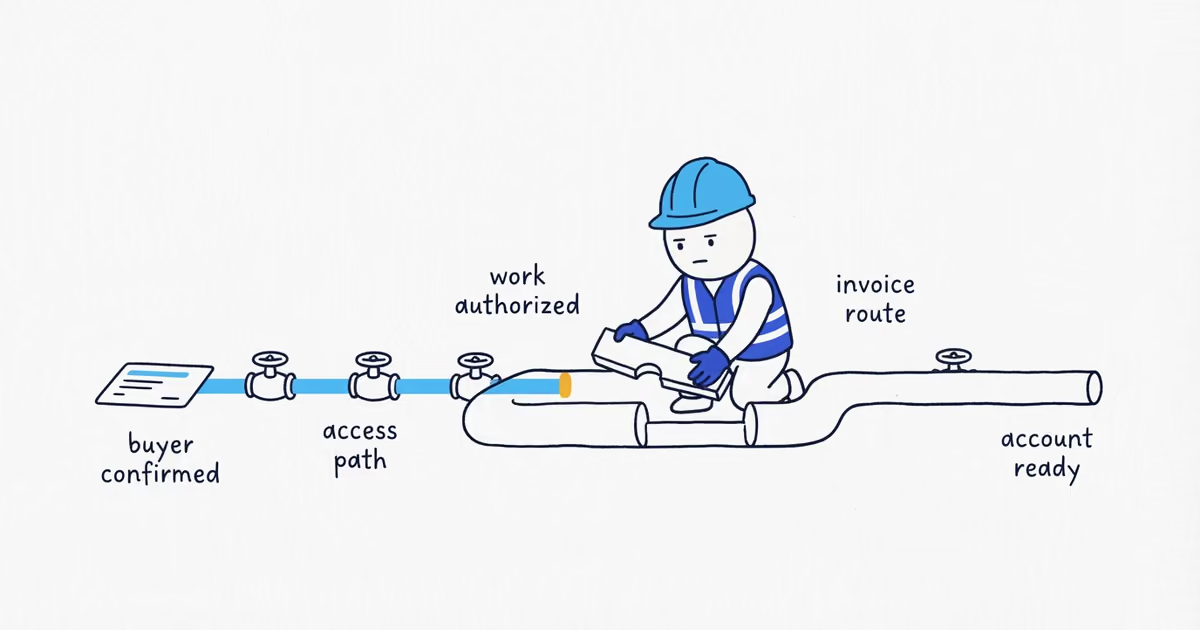
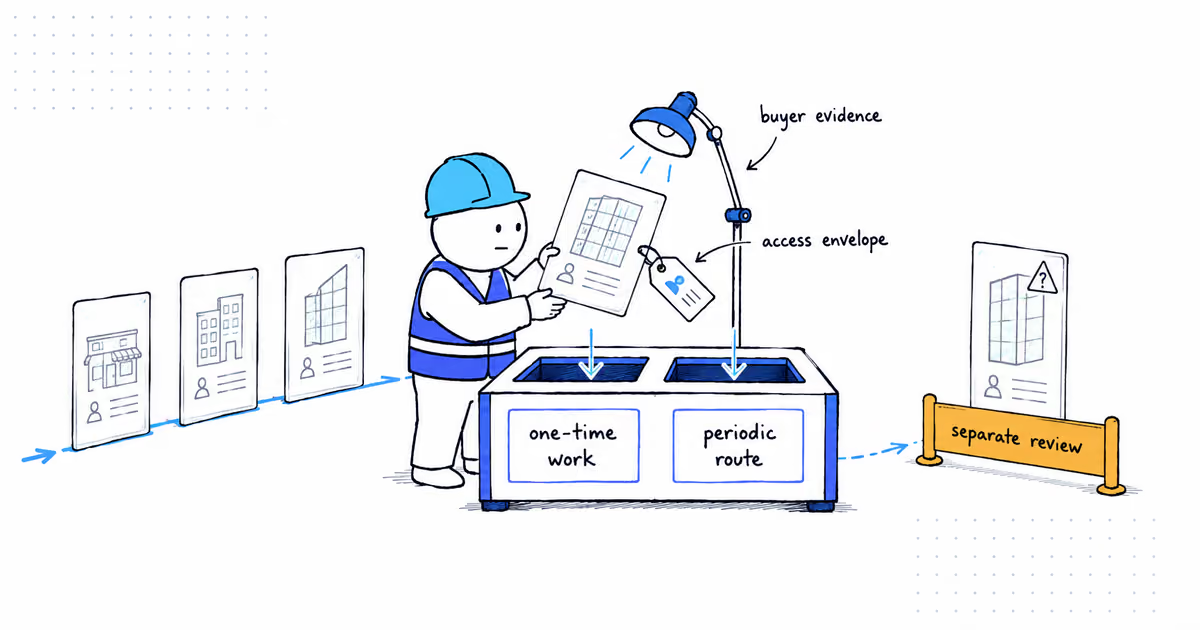
Get commercial plumbing contracts by choosing a supported property-service pattern; finding named accounts, selectors, and authorizers; showing truthful, relevant proof and availability; qualifying locations, access, operating limits, work authorization, work orders, and invoices; inspecting sites; and advancing capacity-fit accounts to pricing and proposal. This cannot guarantee an award.
This covers private plumbing service and suitable maintenance relationships for businesses, managed properties, facilities, and multi-site operators, including planned service and supported urgent response. Construction, remodel, replacement, or major projects need separate qualification. Public procurement and legal drafting are excluded.
A named account is not an opportunity; a contact is not a decision-maker; a vendor application is not approval; approval is not work authorization; a visit is not a bid; a proposal is not an agreement; proposed value is not revenue. Broad growth and generic commercial acquisition belong elsewhere.
How to choose commercial plumbing accounts you can support
Use records to define property operation, geography, supported service and locations, staffed normal/after-hours availability, technician/equipped-vehicle capacity, proof, buyer, administration load, and no-fit conditions. No segment is universally best or most profitable.
The SBA’s market-research guidance says to check demand, location, target customer, saturation, alternatives, and entry conditions. Apply this locally, not as national claims.
Commercial Plumbing Account Pursuit Checklist
Map commercial plumbing buyers and channels
A title is not authority. Complete each row with a named source, confirmed contact route, and answered ownership question.
| Role to verify | What this person may control | Named account or relationship source | Verified contact | Question to confirm ownership |
|---|---|---|---|---|
| Property or facility manager | Selection; property requirements | Website, introduction, or referral | [name; route] | Who selects the provider? |
| Maintenance or operations manager | Site facts; need; updates | Company connection or relevant event | [name; route] | Who states the request and receives updates? |
| Owner or procurement contact | Spend, dispatch, extra-work approval | Buyer review or private opportunity | [name; route] | Who authorizes dispatch and changes? |
| Office or site manager | Access, occupants, keys, parking, loading | Site connection or company website | [name; route] | Who controls access? |
| Completion contact | Completion evidence | Buyer-named contact | [name; route] | Who confirms receipt? |
| Accounts payable | Invoice processing or rejection | Verified buyer route | [name; route] | Who corrects a rejection? |
| Property-management vendor contact | Vendor review; administration | Property-management relationship | [name; route] | Selection or processing only? |
| General contractor or builder | Separate project opportunity | Supplier or contractor introduction | [name; route] | Service account or project handoff? |
Qualify each commercial plumbing account
Copy all three blocks per account. Complete fields from company, buyer, or site evidence; otherwise record unresolved, its owner, and Hold.
| Account and site | Property and operating pattern | Buyer and stakeholders | Verified trigger plus source/date | Buyer-stated need | Locations and known system or asset pattern |
|---|---|---|---|---|---|
[buyer; covered site] | [use; occupants/public; operations] | [selection; site facts; access; authorization; updates; completion; invoice] | [verified reason; source; date] | [buyer wording; planned/supported urgent] | [covered locations; known facts only] |
| Account and site | Access and occupied-site constraints | Requested service and response model | Current staffing and coverage | Relevant permission-cleared proof | Authorization and change approval | Work order and completion evidence |
|---|---|---|---|---|---|---|
[same account] | [security; escort; keys; parking/loading; work/shutdown windows; communications] | [request matched to truthful availability] | [qualified technicians; staffed hours; equipped vehicles; real supervision/backup] | [permission; property/service/access/documentation/completion match] | [visit/work/change approvers; recorded authorization; buyer-used PO/WO/NTE; no-approval action] | [buyer work-order route; required completion records] |
| Account and site | Invoice and rejection path | Buyer process and dates | Opportunity stage | Owner plus next action/date | Pass, hold, or decline reason |
|---|---|---|---|---|---|
[same account] | [bill-to; references; destination; submitter; review/payment; rejection/correction] | [review/bid steps; due, decision, start dates; vendor conditions] | [research / qualified / site review / pricing / stopped] | [named owner; action; date] | [decision; verified reason] |
Check commercial plumbing operating fit
Record current evidence and Pass, Hold, or Decline: supported now, missing fact plus owner, or verified no-fit evidence.
| Check | Evidence required | Pass, hold, or decline |
|---|---|---|
| Geography and travel | Sites and workable travel | [decision; reason] |
| Property, system, service | Request within supported scope | [decision; reason] |
| Technician qualifications/hours | Qualified people and reliable hours | [decision; reason] |
| Vehicles and tools | Equipped capacity available now | [decision; reason] |
| Site review and access | Security, escort, parking, loading feasible | [decision; reason] |
| Service/response windows | Expectation matches staffed availability | [decision; reason] |
| After-hours/backup | Offered and staffed | [decision; reason] |
| Supplier, parts, equipment, subcontractors | Dependency and owner identified | [decision; reason] |
| Authorization/change control | Dispatch, work, change approvers | [decision; reason] |
| Work-order/invoice administration | Evidence, rejection, correction workable | [decision; reason] |
| Direct cost/remaining capacity | Delivery inputs and capacity reviewed; no formula | [decision; reason] |
| Specialist/regulatory scope | Excluded or under qualified review | [decision; reason] |
How to contact commercial plumbing buyers
Use a named account from a customer or supplier introduction, permission-safe referral, local business or property connection, company website, relevant event, private vendor opportunity, or buyer notice. Record a dated buyer review, referral, invitation, opening or management change, backup-provider request, or published private opportunity.
An address, guessed contract date, public violation, visible feature, or assumed provider failure is not an opportunity. Reject scraped lists, bought leads, mass messages, and public-record pressure.
Before contact, verify business details, service/geography, response ownership, technician, tool, vehicle, supplier, and backup capacity, plus permitted proof matching the property, access, documentation, and completion pattern. Share only current, verified, relevant documents suitable for disclosure and requested by the buyer, work, or authority.
The FTC’s advertising guidance requires truthful, nondeceptive, evidence-based claims. Remove unsupported license, insurance, experience, specialist, availability, response, savings, prevention, result, or guarantee claims. The SBA notes that requirements vary by activity, location, and rules. Verify the work, property, buyer, authority, and jurisdiction; never invent credentials.
Use one low-pressure message about one verified reason:
Your property contact said Cedar Court is reviewing plumbing service coverage. We provide
[supported commercial plumbing service]in[service area], with relevant work samples. Who owns that decision, and would a short qualification call or appropriate site visit help?
Cedar Court is fictional. The message offers no diagnosis, free inspection, or provider claim.
For commercial email, the FTC says CAN-SPAM has no business-to-business exception. Use accurate sender/subject information, a postal address, a clear opt-out, and honor opt-outs. This is not legal advice or a campaign.
Last verified: September 2, 2026 (United States).
How to qualify a commercial plumbing account
Before a visit or bid, confirm locations, operations, occupied/public conditions, roles, need, planned/supported urgent work, known system facts, current provider or trigger when shared, response expectations, buyer process/dates, vendor conditions, access, communications, and fit.
Ask who may request a visit, approve work, record authorization, approve changes, and what to do when approval is missing. Record purchase-order, work-order, or not-to-exceed controls only when that buyer uses them. These are questions, not legal rules.
A site visit records covered properties/spaces, known systems, occupants, tenants or public access, security, escorts, keys, parking/loading, work and shutdown windows, noise, communications, customer responsibilities, completion evidence, visible gaps, exclusions, and assumptions. It excludes inspection, diagnosis, repair, code, safety, and emergency instructions.
Before proposal work, record bill-to details, buyer-required references, invoice destination, submitter, review/payment process, and rejection/correction route. Tax or supplier forms require a verified request. Onboarding and collections are separate.
When to pursue a commercial plumbing contract
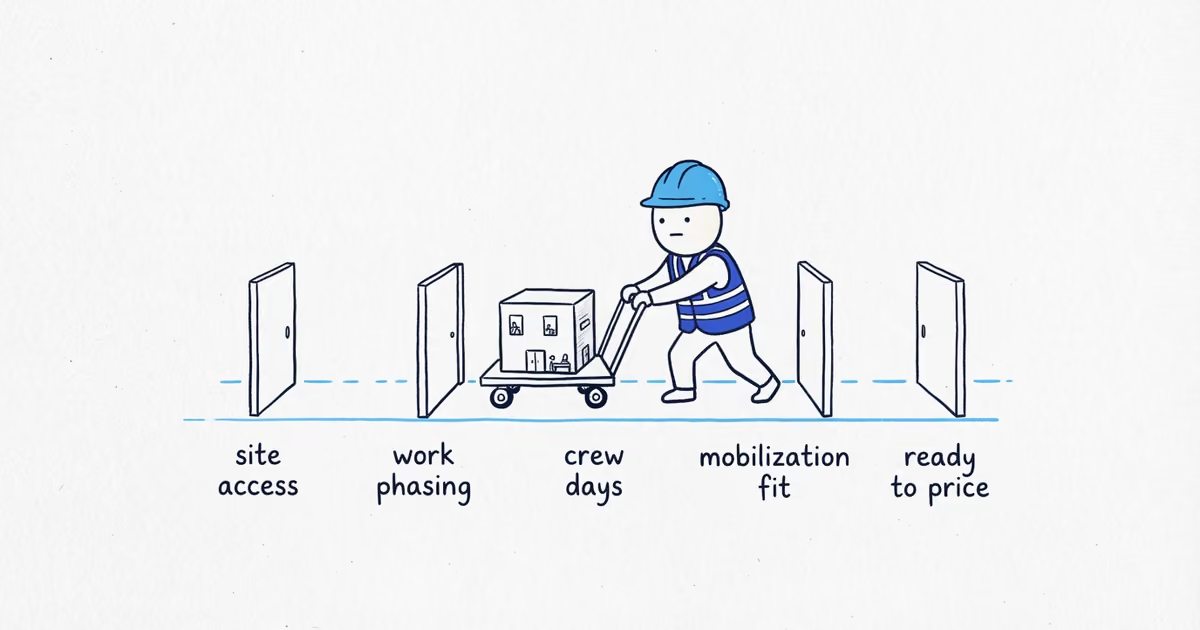
The handoff carries buyer, sites, request, system pattern, service model, response window, access, customer responsibilities, authorization/change approval, work order, completion evidence, invoice path, proof, assumptions, optional projects, dates, and next owner. When that handoff is complete and the account needs a job price, use the plumbing pricing guide to build the service-call, labor, parts, overhead, and profit inputs from company records. When a managed-property buyer requires onboarding, use the property-management vendor guide to verify the requested documents, approval steps, work authorization, and invoice route. Estimates, capability statements, and proposals belong elsewhere.
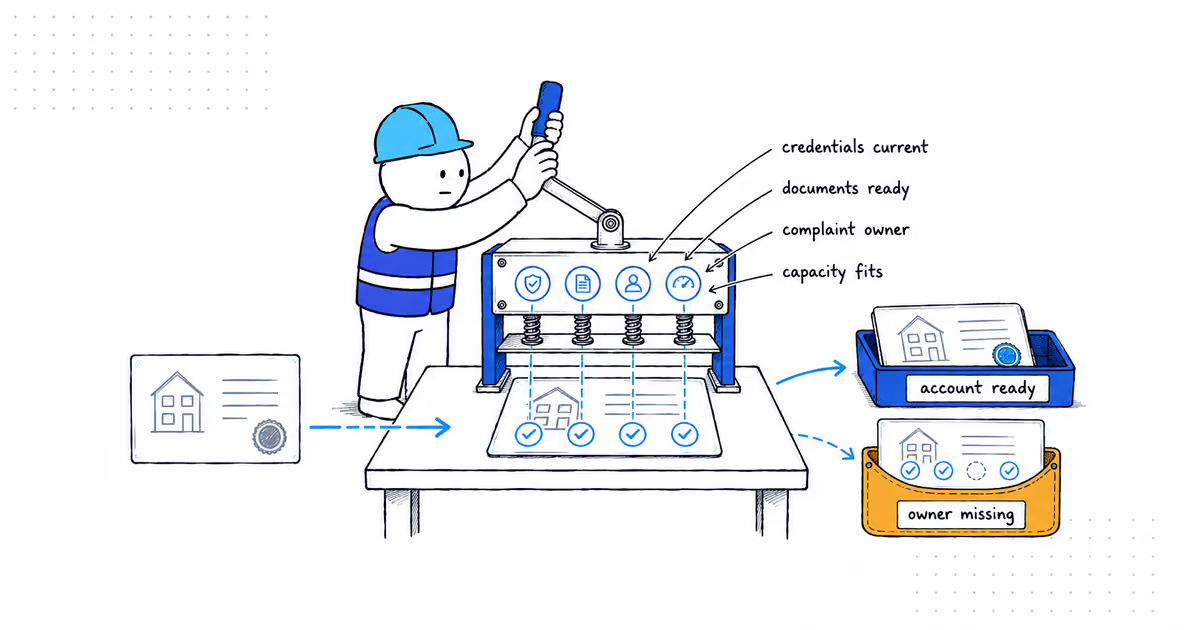
In fictional Cedar Court’s planned-service and maintenance review, a small plumbing company verifies buyer, trigger, site pattern, access, authorization, work-order route, proof, and technician coverage. The invoice destination is known; its rejection route is not. Decision: Hold. Owner: Dana Lee, account manager. Next action: ask the buyer to name the rejection contact and correction route. Date: September 8, 2026. Dana confirms receipt and follows the buyer’s process. No site-review or pricing handoff occurs until the missing route is complete. Vendor approval, a work order, visit, or undecided proposal is not earned revenue.
Frequently asked questions about commercial plumbing contracts
How do I get property-manager plumbing clients?
Start with a named property and verify whether the property manager selects the plumber, controls only vendor administration, or shares authority with an owner or procurement contact. Confirm access, authorization, work-order, completion-evidence, invoice, and rejection paths before treating the account as qualified.
How do I price a commercial plumbing job?
Price only after the buyer has confirmed the sites, supported service model, known system facts, response window, access limits, authorization controls, work-order route, invoice path, and open assumptions. Send that record to a separate plumbing pricing or estimate process; this article supplies no universal rate.
How fast should I respond to a commercial plumbing lead?
Use the response coverage your business actually staffs and the buyer requests. Give the account a named owner and dated next action, but do not promise a universal response time or after-hours coverage that your technicians and equipped vehicles cannot support.
- commercial-contracts
- how-to-get-commercial-plumbing-contracts
- commercial-plumbing-contracts
- commercial-plumbing-service-contracts
- property-manager-plumbing-clients
- plumbing