How do I get commercial pressure washing contracts?
Learn how to get commercial pressure washing contracts by finding real buyers, qualifying each site, and deciding which commercial pressure washing jobs to bid.
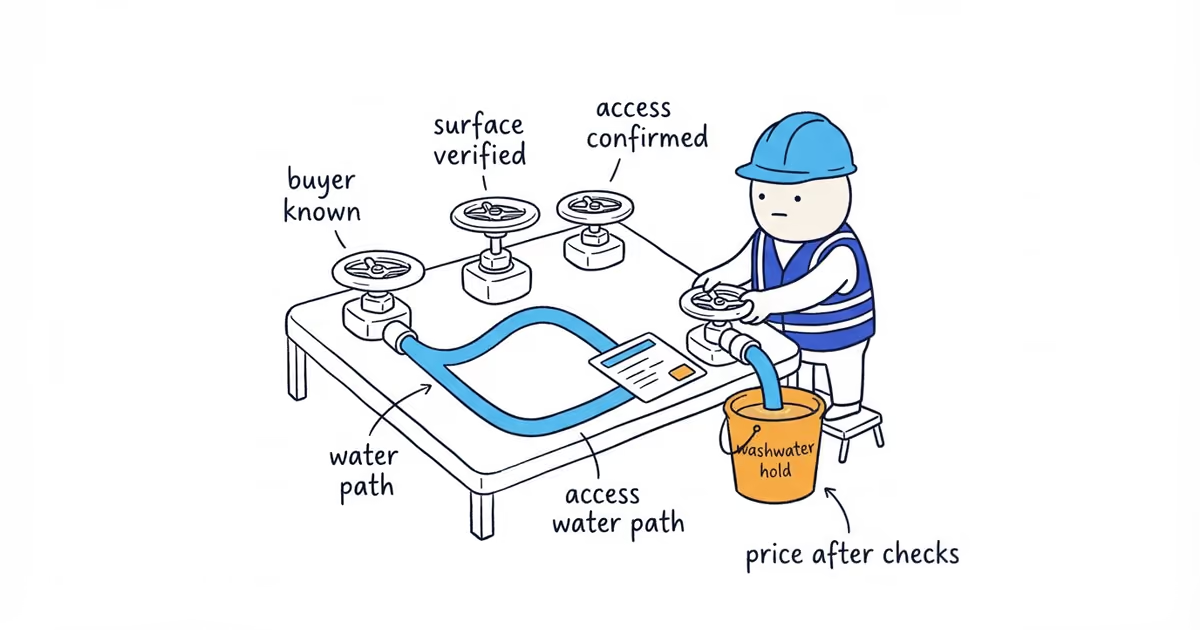
Get commercial pressure washing contracts by choosing a property, buyer, surface, and work pattern you can support; finding named sites and decision-makers; showing truthful proof; confirming a real need; checking site and administrative constraints; and sending a workable scope to pricing and proposal. It cannot guarantee an award.
This covers private pressure washing or supported exterior cleaning for a business, managed property, facility, HOA or association, multi-site operator, or subcontract relationship. Work is one-time or periodic only when the facts support it. Government procurement and contract law are outside scope.
The pressure washing growth article owns the 90-day local growth system. The equipment article owns setup and upgrades. The general commercial-contract article owns the cross-trade pipeline. Here, one named private account moves from sourced trigger to qualified handoff.
Choose a commercial pressure washing account pattern
Start with your records, not a supposed best niche. The SBA’s market-research guidance says to check local demand, customer location, saturation, alternatives, and the target customer.
For one starting pattern, record:
- actual service area, property use, and customer-described surface or asset;
- supported one-time or periodic work and the likely buyer role;
- normal access window, crew hours, supervision, and equipment capability;
- permission-cleared proof matching the scope; and
- explicit decline conditions.
An office may fit one operator while a warehouse fits another. Neither is universally easier, more profitable, or more likely to recur.
Find the right commercial property buyer
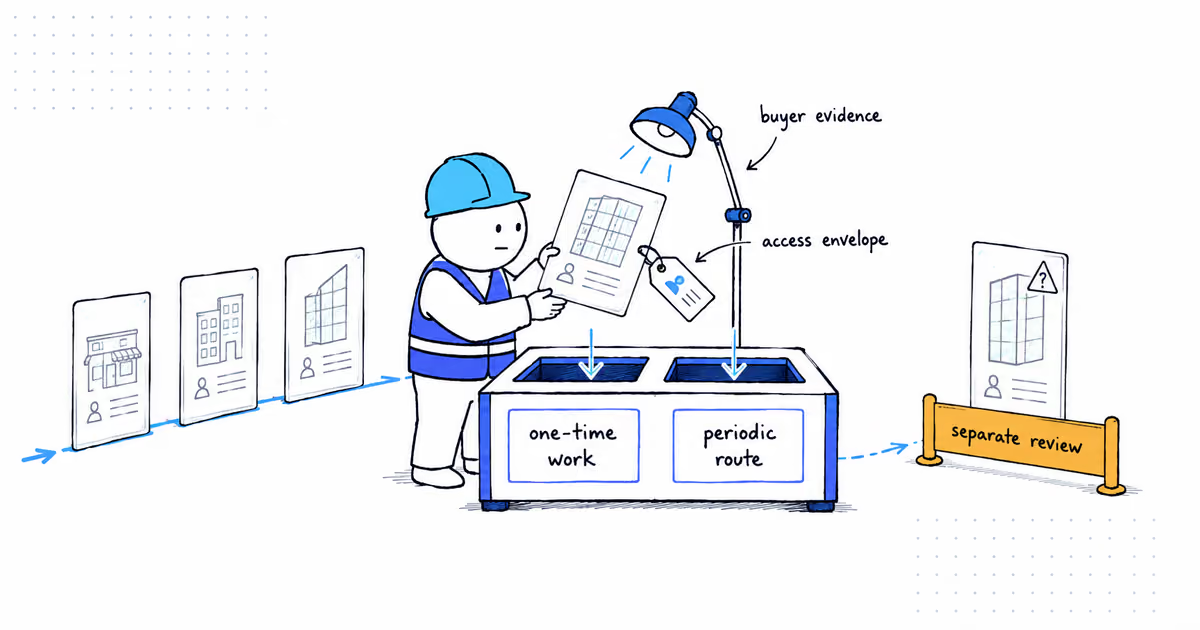
Use this first table to decide where a named opportunity could come from. A property address, visible staining, or a guessed contract end date is not a trigger.
| Property and customer-described surface pattern | Contact role to verify | Starting channel | Acceptable pursuit trigger | Matching permission-cleared proof | Caution or stop signal |
|---|---|---|---|---|---|
| Retail or office property | Owner, property manager, or facility manager | Customer introduction; property website | Confirmed review, referral, private notice, or stated need | Permitted comparable-scope proof | No buyer, trigger, or workable window |
| Multifamily common areas | Property or facility manager | Property connection or association event | Invitation, stated need, or buyer review | Permitted relevant common-area proof | Access or responsibility has no owner |
| HOA or association | Association contact or manager | Referral or association directory | Confirmed review or need | Permitted matching asset proof | Assuming a contact can approve spend |
| Warehouse or operations site | Facility or operations manager | Business relationship or company website | Site change, invitation, or private opportunity | Relevant supported-site proof | Access, vehicles, or window does not fit |
| Local multi-site operator | Operations or procurement contact | Company connection or buyer notice | Covered sites and decision process confirmed | Relevant property-and-surface proof | Assuming one inquiry covers every site |
| Subcontract or facilities-vendor relationship | Contractor or facilities vendor | Supplier, contractor, or vendor relationship | Named project, introduction, or coverage need | Relevant proof and current capacity | Unclear scope, authority, completion, or invoice path |
Complete a row with company records, property facts, or a buyer source. Assumptions mean no contact yet.
Verify the pressure washing opportunity and proof
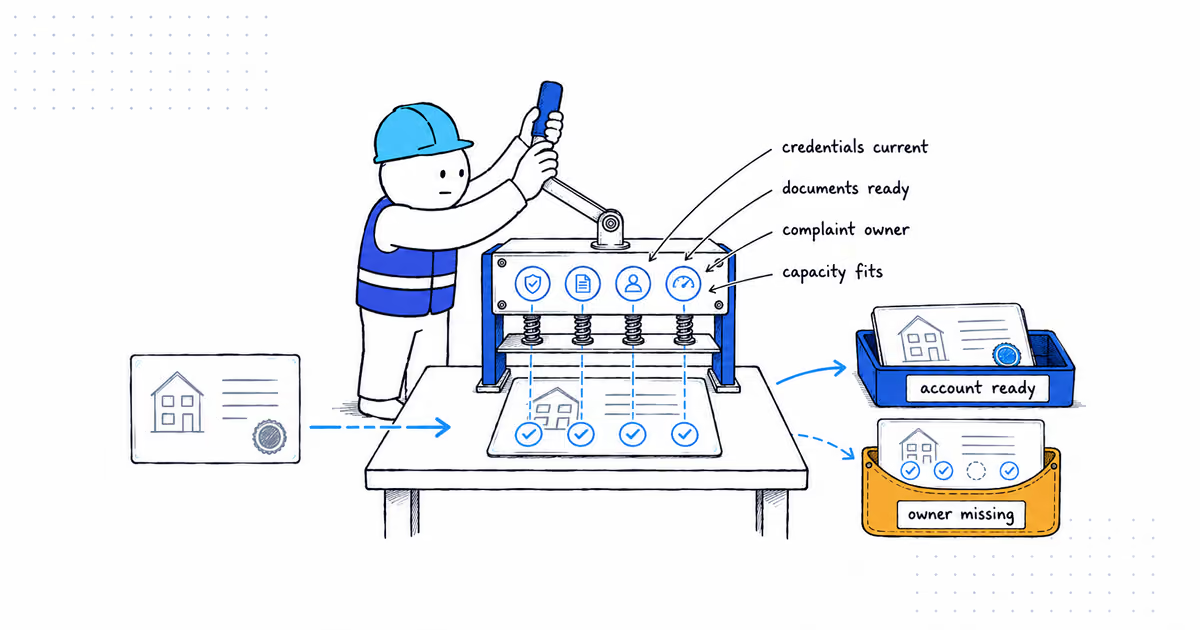
Do not treat a title as authority. Identify who selects service, controls access, approves spend, states requirements, owns pedestrian or vehicle controls, resolves washwater questions, confirms completion, and handles invoices or accounts payable. One person may hold several roles; verify it.
Readiness means accurate business details, a plain service-area statement, a working inquiry path, permitted relevant proof, and current crew, schedule, equipment, and supervision capacity. When a buyer requests a one-page overview, use the contractor capability statement guide to assemble those facts without turning the document into an award claim. When a property manager requires formal onboarding, use the property-management vendor guide to verify its application, document, approval, and work-order route.
The FTC’s advertising guidance says advertising must be truthful, nondeceptive, and supported. Remove unverified statements about experience, results, surface safety, environmental benefit, credentials, response, capacity, or guarantees. Never invent a client, result, license, certification, or insurance status. The SBA notes that license and permit requirements vary by activity, location, and government rules; verify the service, property, authority, and jurisdiction.
Contact one person about one sourced opportunity. For example:
Your facilities contact told me Harbor Square is reviewing exterior cleaning for the property. We provide the supported exterior-cleaning service described in our work samples within this area. Who owns that decision, and would a short qualification call or site visit be useful before you request a scope?
Harbor Square is fictional; the wording claims neither a problem nor a prior relationship.
For commercial email, the FTC says CAN-SPAM has no business-to-business exception. Use accurate sender and subject information, a valid postal address, a clear opt-out route, and honor opt-outs. This is a boundary, not legal advice or a campaign plan.
Last verified: September 2, 2026 (United States).
Qualify the commercial pressure washing account
Before a walkthrough or bid, confirm covered locations, property use and occupied hours, stakeholder roles, customer-described surfaces and result, and whether work is one-time, periodic, or review needed. Periodic status requires buyer history, observed need, requested cadence, or a stated decision process. Commercial proves nothing about frequency.
Record the trigger and current provider when shared, service or review window, bid process, due, decision, and expected-start dates, requested vendor conditions, access, invoice path, and operating fit. Mark missing facts unresolved and name their owners.
Copy the following three table blocks for every named account. Keep the account name identical across them.
| Account and site | Trigger source/date | Work-type status | Stakeholder roles | Requested result and included/excluded scope |
|---|---|---|---|---|
[named account and covered location(s)] | [source plus date; complete when buyer-confirmed or published] | [one-time / periodic / review needed, with evidence] | [selection; access; approval; requirements; traffic; washwater review; completion; invoice] | [customer wording, included areas, excluded areas, optional work; complete when boundaries are explicit] |
| Account and site | Readiness proof and current capacity | Property use and occupied hours | Access, staging, and water status | Surface condition and qualified-review needs | Pedestrian, vehicle, and adjacent-property exposure plus control owner |
|---|---|---|---|---|---|
[same account] | [permission, relevance, crew, schedule, equipment, supervision; complete when verified now] | [actual use and occupied periods] | [gates, keys, loading, parking, staging, usable-water status, supplier/approver] | [customer-described surfaces, visible condition, pre-existing damage, exclusions, review owner] | [each exposure, boundary, and buyer-side control owner] |
| Account and site | Apparent drainage or washwater route plus review owner/status | Buyer requirements and invoice path | Unresolved assumptions | Current stage | Owner and next action/date | Advance, hold, or stop reason |
|---|---|---|---|---|---|---|
[same account] | [observed route; responsible reviewer; open/resolved status] | [only verified requests; completion contact; invoice processor and submission path] | [each unknown plus resolution owner] | [research / qualified / walkthrough / pricing handoff / stopped] | [one named person, one action, one calendar date] | [decision tied to operating fit or a missing fact] |
For fictional Harbor Square, a buyer confirms a retail-property review. The operator verifies the decision and access roles, matches permitted proof to the stated surface pattern, and records scope boundaries, property use, occupied hours, visible condition, pre-existing damage, gates, loading, parking, staging, water status, pedestrian and vehicle exposure, adjacent-property exposure, and their control owners. Unknown surface or specialist needs go to qualified review, not a cleaning guess.
The EPA explains that polluted runoff can move through municipal separate storm sewer systems and discharge untreated. Therefore, record the apparent drainage route and site-specific washwater-review owner. This is not a universal disposal rule or a decision about a particular discharge. The property, local authority, and qualified reviewer must resolve it before work advances.
Decide whether to advance, hold, or stop
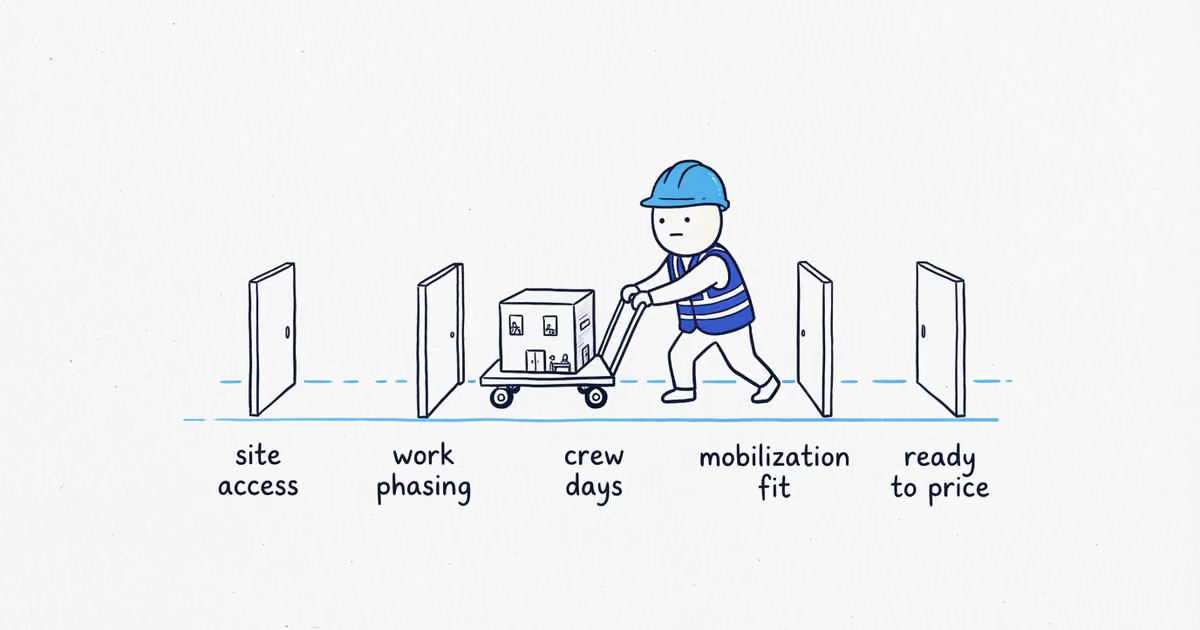
Before proposal effort or acceptance, compare scope with mobilization, service window, reliable crew hours and skill, supervision, equipment capacity, water and access, traffic-control ownership, specialist or surface uncertainty, washwater-review status, backup coverage, administration, invoice and payment process, startup commitments, direct delivery costs, and remaining capacity. Pricing is separate future content. Proposal construction and follow-up have their own guides.
Advance sends verified scope, contacts, constraints, customer responsibilities, optional work, assumptions, process, and dates to a named pricing or proposal owner. Hold names a missing fact and its owner. Stop records the fit reason.
For fictional Harbor Square, the decision is Hold. Owner: account estimator. Next action/date: ask the property contact to identify the washwater-review owner and confirm access and water facts by September 5, 2026. Advance to pricing only after each issue has an owner. Confirm receipt, follow the buyer’s process, answer requested questions, and stop after a decline or do-not-contact request. A contact, vendor-list entry, walkthrough, or proposal is not a contract or earned revenue.
Frequently asked questions
Do I need vendor approval before bidding a commercial pressure washing job?
Only when the buyer’s process requires it. Confirm whether approval is a prerequisite, what verified documents the buyer requests, and who owns the decision. Vendor approval is still not work authorization or a contract.
What equipment do I need for commercial pressure washing contracts?
There is no universal commercial setup. Compare the named site’s surface pattern, access, water status, work window, and requested result with equipment and crew capability you have verified. Hold or decline work that requires unsupported equipment or specialist review.
How do I price a commercial pressure washing job?
Price only after the buyer and site facts produce a verified scope. Pass the included and excluded areas, constraints, customer responsibilities, optional work, and unresolved assumptions into a separate pricing process; do not guess from the property type alone.
- commercial-contracts
- how-to-get-commercial-pressure-washing-contracts
- commercial-pressure-washing-jobs
- commercial-pressure-washing-accounts
- commercial-property-pressure-washing
- pressure-washing