

How Do I Get Customers Without Buying Leads?
Learn how to get customers without buying leads using a 30-day contractor marketing plan that builds referrals, visible proof, and trackable local demand.
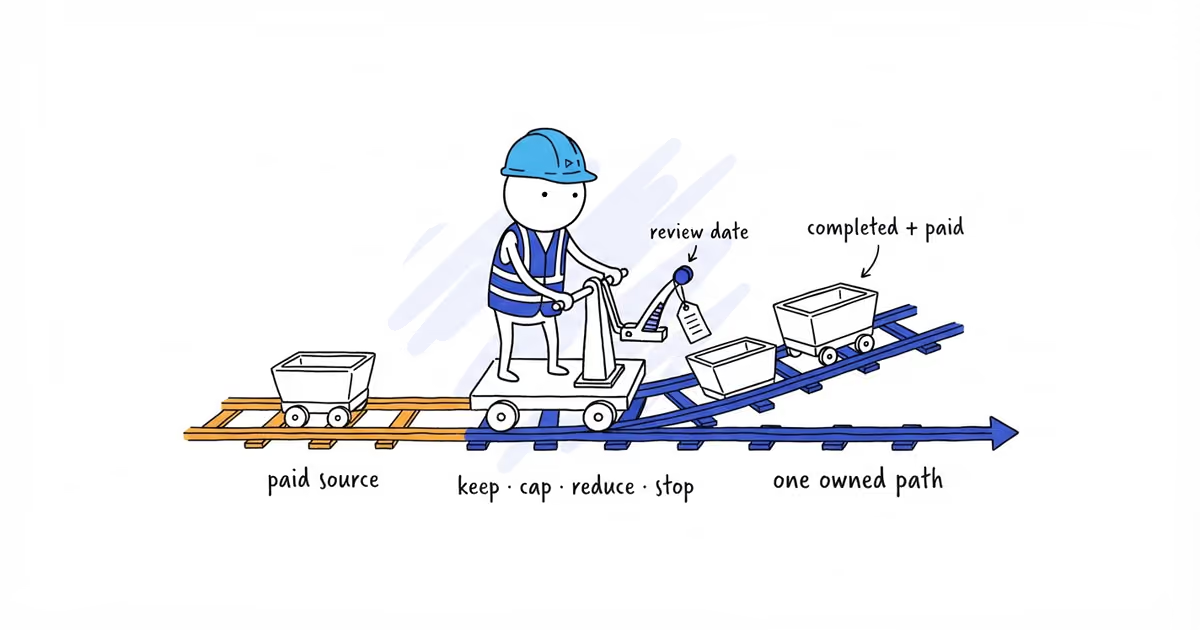
Start with demand the business has already earned: open estimates, past customers, referrals, and recent work that can be shown to the next customer. Build one of those paths until it produces qualified, completed, paid jobs before reducing a lead source that still keeps the schedule moving.
The goal is not to replace 20 purchased leads with 20 “free” leads. Replace the useful result: jobs that fit the crew, get completed, get paid, and leave enough gross profit.
Decide what the paid source must replace
Look at one complete lead-to-payment cycle. Record what the source cost and how many leads became qualified opportunities, estimates, completed-and-paid jobs, collected revenue, and gross profit after direct job costs and source spend.
Then write the replacement target in business terms:
We need [number] additional completed-and-paid [service] jobs per [review period], producing at least $[gross profit after acquisition], without exceeding [crew capacity].
Use a review period long enough for a typical customer to book, receive the work, and pay. A 30-day plan can create early evidence. It cannot guarantee that referrals or organic search will replace paid demand in a month.
Start with the path you can use now
Choose one starting point, not five new channels.
| What the business already has | Start here |
|---|---|
| Open estimates, past customers, or recurring work | Make a named follow-up list and give each customer a next action. |
| Recent jobs but weak public proof | Publish one relevant job result and make sure the main phone, form, hours, and service information work. |
| Working follow-up and credible proof, but too little new discovery | Build one repeatable service-and-area path where local customers already look. |
Past demand usually comes first because those customers already know the business or have described a real job. If there is no customer history yet, fix the basic service, service-area, proof, and contact information before spreading time across social platforms.
Use 30 days to test one replacement path
| Week | Work | Finished when |
|---|---|---|
| 1 | Record the paid source’s real output, available crew capacity, a spending limit, and the replacement target. | The target and next review date are written down. |
| 2 | Follow up open estimates, relevant past customers, and a small number of genuine referral relationships. | Every selected name has been contacted or has a dated next action. |
| 3 | Publish one recent job with the problem, completed work, general area, and next step. Check the main contact route from a phone. | A customer can see relevant proof and successfully contact the business. |
| 4 | Repeat the action that produced qualified conversations and update each opportunity through payment. | The owner can compare the new path with the paid source using the same definitions. |
A spreadsheet, notebook, or current job system is enough. Track source, service, qualified status, estimate, booked job, completed-and-paid status, collected revenue, direct job cost, and next action. Likes and views can explain activity, but they do not replace paid work.
Reduce spending only when the work supports it
At the review date, make one of four decisions:
- Keep: the new path has not produced enough evidence and the paid source still supplies acceptable work.
- Cap: the new path has produced real opportunities or jobs, but not enough repeat results to take over.
- Reduce: comparable completed-and-paid work is repeating and the crew needs less paid volume.
- Stop: the replacement path reliably fills the intended capacity, or the paid source has separately failed its quality and economic review.
“Not enough evidence yet” is a valid result. Pair it with a spending limit and another review date. It is not a reason to keep paying indefinitely, and it is not evidence that the replacement path has failed.
How a painting company can reduce its lead budget
A two-person painting company spends $1,500 a month on a paid source. In a recent complete cycle, 18 leads became seven qualified opportunities, four estimates, and three completed-and-paid jobs. Those jobs produced $3,300 in gross profit after the source cost. These are fictional inputs, not benchmarks.
The replacement target is three comparable painting jobs or at least $3,300 in gross profit after acquisition, not 18 inquiries.
The owner follows up open estimates and past customers, publishes one interior repaint example, and checks the contact details on Google and the website. By the review date, that work has produced two completed-and-paid jobs and two live estimates.
That is evidence, but not yet a stable replacement. The sensible decision is to cap the next paid-lead budget, keep tracking both paths, and review again after the open estimates have had time to close.
When the business has no customer list or proof
Build the customer list from estimates, invoices, and the current schedule. Start collecting an approved job photo and an honest review as current work closes. Keep the paid source inside an affordable limit while that foundation is being built.
If the business gets attention but no qualified work, stop adding channels. Check whether the service, area, proof, contact route, and follow-up match the jobs the business actually wants. ShiftFlow’s online presence audit can identify the first online basics that are getting in the way.
Frequently asked questions
Can contractors get leads for free?
Not in the strict business sense. Referrals, repeat customers, and organic discovery may avoid a per-lead fee, but they still require owner time, proof, follow-up, and tools. Compare acquisition cost and completed-and-paid work, not whether a platform invoice appears.
Do I need a website to get customers without buying leads?
No. An accurate Google Business Profile and a reliable phone or contact route can support early demand. A website matters more when customers need to verify services, locations, job proof, and next steps before calling.
Should I ask every past customer for a referral?
No. Start with customers whose jobs ended well and match the services you want more of. Make a direct, job-specific request and stop if the customer declines or contact permission is unclear.
Sources
- Tips to Improve Your Local Ranking on Google, Google Business Profile Help.
- Marketing and Sales, U.S. Small Business Administration.
- pricing
- how-to-get-customers-without-buying-leads
- contractor-marketing-without-paid-leads
- how-to-get-contractor-leads-without-paying
- 30-day-paid-lead-transition-plan



