How Do I Get Local Backlinks for My Contractor Business?
Find local backlink opportunities through suppliers, projects, partners, and community relationships, then choose the right page and avoid link schemes.
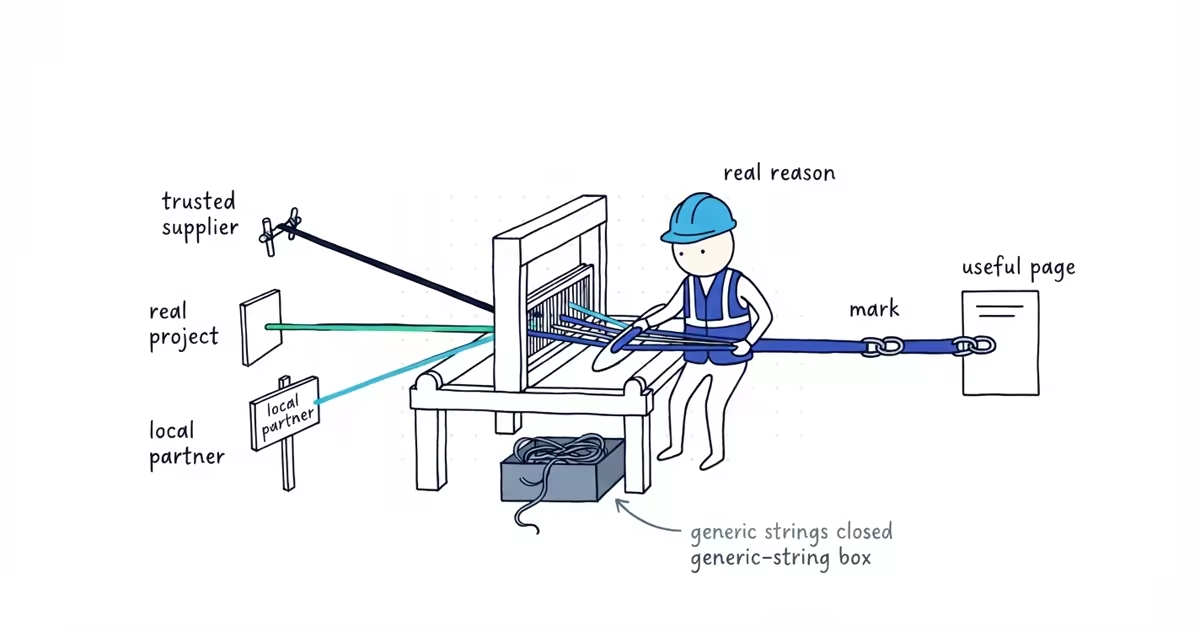
Start with businesses and organizations that already have a reason to know you: suppliers, manufacturers, trade partners, associations, schools, property managers, and community groups.
The useful backlink is not the one with the highest score in an SEO tool. It is a truthful mention on a relevant site whose audience may care about the business, project, credential, or relationship. Make three well-founded requests before sending one cold campaign.
Google local ranking and link-spam guidance checked: July 30, 2026.
Local backlinks vs. mentions and citations
A backlink is a clickable link to the business website. An unlinked mention names the company without a link. A citation is a structured business listing, usually with the name, address or service area, and phone.
Citations and backlinks are not interchangeable. If the task is choosing structured listings, the contractor directory guide separates customer profiles, citations, backlinks, and paid products.
Google says prominence uses information such as websites linking to a business, but it publishes no ranking-guaranteeing count. Links also cannot erase distance limits; the service-area ranking guide explains what service areas do and do not change.
Where contractors can find local backlink opportunities
Open the vendor list, project records, memberships, and referral notes. Write down ten names across these groups:
- Suppliers or distributors the company buys from regularly
- Manufacturers whose products the company is certified or approved to install
- Complementary trades that share legitimate projects
- Property managers, real estate professionals, or general contractors
- Trade associations and local business groups with real membership
- Trade schools, apprenticeship programs, or workforce partners
- Community organizations supported through actual work or sponsorship
- Local publications connected to a specific project or useful local issue
Do not ask all ten for “a backlink.” First find the reason their audience would need the mention.
How to evaluate a local backlink opportunity
Give each relationship 0, 1, or 2 points for:
- Trade relevance: Does the site relate directly to the work?
- Local relevance: Does it serve the same market or customers?
- Existing relationship: Would the recipient recognize the business?
- Editorial reason: Is there a directory, project, credential, event, or resource where the mention belongs?
- Audience value: Would the mention help someone find a provider or understand useful work?
- Effort: Can the business supply accurate information and proof without inventing a campaign?
Reject an opportunity with no truthful editorial reason even if its total looks high. Choose the best three remaining scores.
Your tracker needs only these fields:
Relationship | Audience | Reason to mention | Page to link to | Owner | Next action | Result | Referral or relationship outcomeThe final column prevents the team from treating the live URL as the only result.
How to request a supplier or manufacturer directory link
A roofer holds a current manufacturer certification, but the manufacturer’s installer directory shows an old website. This is not a favor disguised as SEO. The directory exists to help homeowners find eligible installers, and the business has a current credential.
Send:
Subject: Update to our [installer/vendor/member] entry
Hi [name], we’re a current [program status] serving [area]. Our entry at [URL] shows [missing or outdated detail]. Could you update the business name to [name] and the website to [specific URL]? That page explains [relevant certified service] for customers using the directory. I can send our current account or credential details if needed.
Link to the page that proves and explains the relevant work, not automatically to the homepage.
How to earn a backlink from a project case study
A plumbing distributor helped source equipment for a difficult retrofit. The useful story is not “our companies are great partners.” It is the constraint, the selected equipment, the installation decision, and the result.
Send:
Subject: Project example for [publication or customer audience]
Hi [name], we recently completed [project type] in [area] using [relevant product or method]. The useful part for your audience is [specific problem or lesson]. We can provide approved photos, scope, product details, and the result for a short case study. The project page is [URL]. If it does not fit your editorial plans, no problem.
The recipient should retain editorial control. A paragraph created only to hold keyword-rich anchor text is not a useful case study.
How to request a partner or sponsor backlink
A landscaper restores the planting beds at a community center, and the organization maintains a page for project partners. An accurate acknowledgment helps residents understand who did the work and gives the organization a complete record.
Send:
Subject: Details for the [partner/sponsor/member] page
Hi [name], thanks again for working with us on [project or event]. I noticed [page name] lists participating organizations. If our business belongs there, the correct name is [business name], the description is [one factual sentence], and the relevant project or service page is [URL]. Please use whatever format fits the page.
Do not turn one donation into several thin sponsor pages. The relationship and audience value come first.
Which page should a local backlink point to?
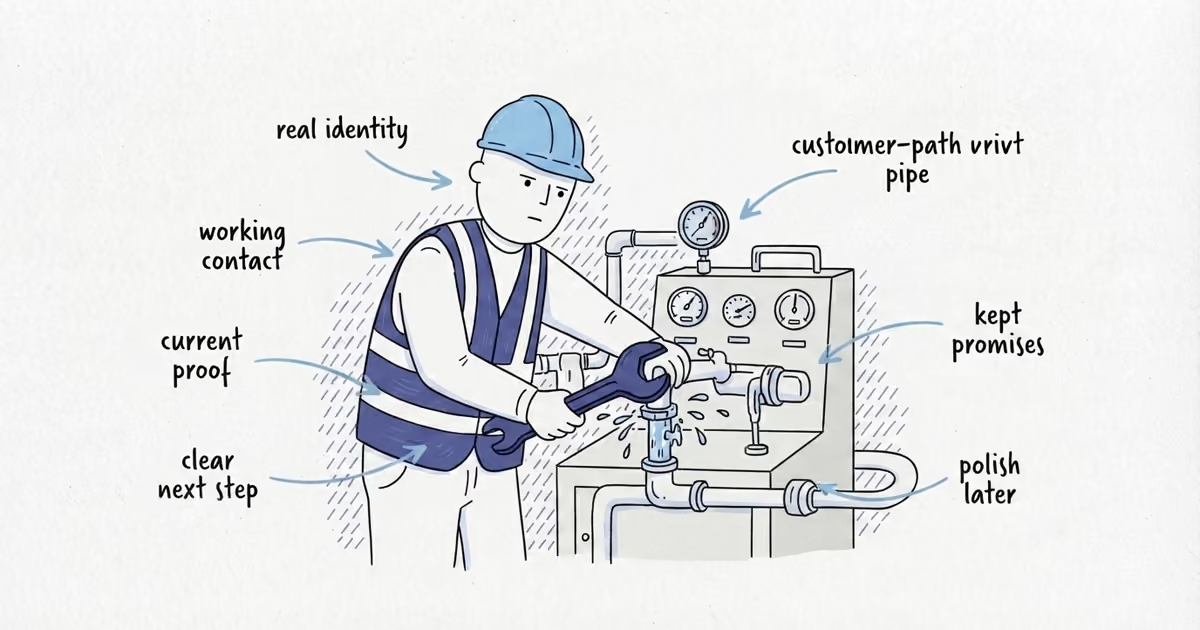
Before making any request, open the proposed destination on a phone. It should show the service, credential, project, or relationship named by the referring page; relevant proof; the real service area; and a working contact path.
A manufacturer directory should not send a homeowner to a homepage that never mentions the certified system. A project story should not link to a generic services list. The page should finish the thought that caused the click.
Which local link-building tactics should contractors avoid?
Google’s spam policies list paid links for ranking purposes, excessive exchanges, automated link creation, low-quality directory links, and paid advertorial links that pass ranking credit as link-spam examples.
Reject:
- Bulk paid-link or guest-post packages
- “Awards” sold mainly for the badge and link
- Partner pages created only for reciprocal links
- Private blog networks
- Automated outreach that invents familiarity
- Scholarships created solely to manufacture coverage
- Sponsorship demands that remove the publisher’s editorial choice
Advertising and sponsorship are normal business activities. The problem is buying or structuring them to pass undisclosed ranking credit rather than reach a real audience.
Track referral visits and qualified leads, but also record introductions, supplier support, and what happened to the relationship. A property manager may send valuable work without adding a link. A live link nobody relevant visits may add nothing.
The first round is complete when ten real relationships have been considered, three defensible requests have been sent, and every request points to a page useful to the recipient’s audience.
Frequently asked questions
How many local backlinks does a contractor need?
Google does not publish a backlink count that guarantees a local ranking. Start with three credible opportunities tied to real suppliers, projects, memberships, or community relationships and judge their referral value as well as the link.
Should contractors pay for local backlinks?
Do not pay for links intended to pass ranking credit. Advertising and sponsorship can be legitimate when they reach a real audience and the publisher handles the link according to Google’s spam policies.
Are local directory citations the same as backlinks?
No. A citation is a structured business listing; a backlink is a clickable link to the website. A useful directory profile may contain both, but one does not automatically provide the value of the other.
Sources
- local-backlinks
- link-building
- local-seo
- contractor-marketing
- home-services