How to Get Your Business Recommended by ChatGPT
Improve your chances of appearing in ChatGPT with a repeatable search baseline, crawler checks, clear service pages, public proof, and measured retesting.
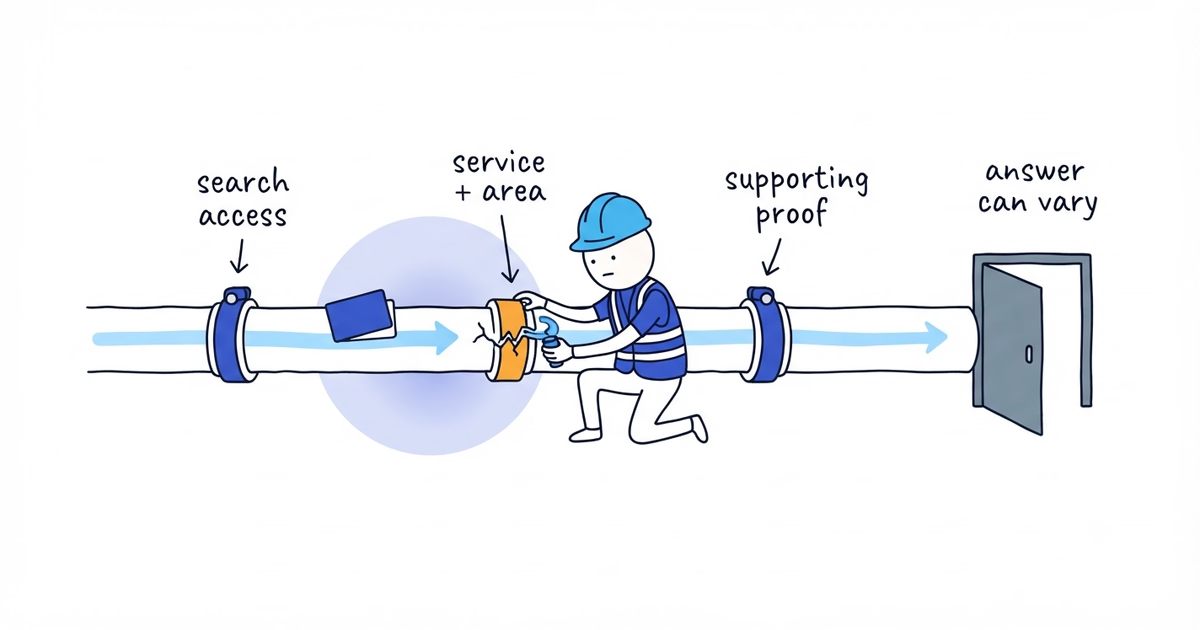
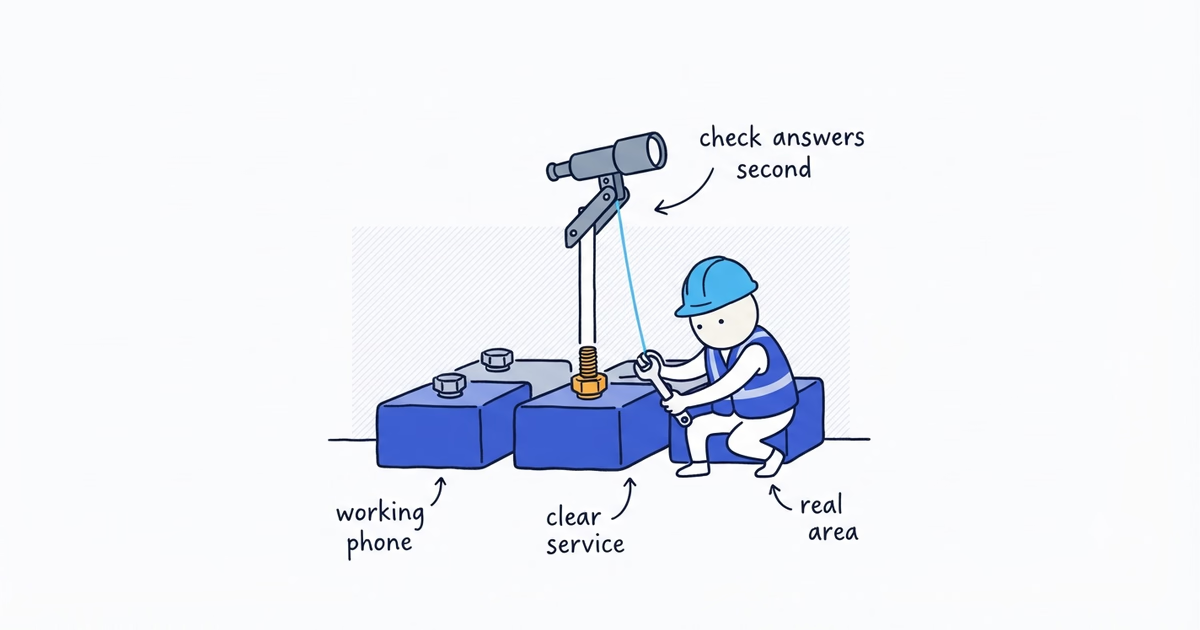
There is no documented setting that guarantees ChatGPT will recommend your business. The practical way to improve your chances is to make the business easy to find, understand, and verify when ChatGPT uses web search:
- Record how the business appears for a small set of real customer questions.
- Make sure OAI-SearchBot can reach the pages that answer those questions.
- Publish specific service, location, availability, and contact information.
- Correct conflicting facts on important public profiles and listings.
- Add proof that supports why the business is a good fit for the job.
- Repeat the same questions and inspect the citations and customer outcomes.
That is the short answer. The rest of this guide shows exactly how to do each step without treating an unconfirmed tactic as a ChatGPT ranking factor.
Last verified: August 8, 2026 (United States).
What Does “Recommended by ChatGPT” Actually Mean?
Before changing the website, separate four outcomes that are often treated as the same thing:
| Outcome | What happened | What it establishes |
|---|---|---|
| Mention | The business name appears in an answer | ChatGPT included the business in that answer |
| Citation | The answer links to a public page beside a claim | The page was presented as a source; open it to see which claim it supports |
| Recommendation | The answer presents the business as a possible fit for the customer’s request | The business was recommended for that particular wording, location, and moment |
| Get Quote | An eligible local-services result displays a quote action through an approved partner integration | The business is connected to OpenAI’s separate local-services beta; this is not a normal profile-claim flow |
A business can be mentioned without its website being cited. A website can be cited without the business being recommended. One recommendation is also not a permanent local rank. Keep those distinctions in the audit so a useful improvement does not get reduced to a single yes-or-no score.
Step 1: Record a ChatGPT Search Baseline
Start with questions customers could genuinely ask, not twenty slight variations designed to make the business appear.
Use ChatGPT Search for the test. OpenAI’s documentation says search results and citations appear when ChatGPT uses web search. If the answer does not show that search was used, it does not test whether a newly corrected public page can surface through ChatGPT Search.
Run a small set that covers different decisions:
Branded check
What can you tell me about [business name] in [city and state]?
Service and location
Which [type of business] provides [specific service] in [city and state]?
Customer constraint
Who handles [specific job] in [city] for [property type, timing, or other real constraint]?
Comparison
Compare [business name] and [competitor] for [specific service] in [city].
State the location inside the question instead of relying on an unstated device location. Keep the wording fixed when you retest.
For every question, record:
| Record | Why it matters |
|---|---|
| Exact question and date | Lets you repeat the same test instead of comparing different requests |
| Stated location | Keeps the geographic intent visible |
| Businesses mentioned | Establishes the current answer set |
| Description of your team | Reveals wrong or incomplete services, areas, hours, or qualifications |
| Inline citations | Shows which visible pages were attached to specific claims |
| Customer next step | Confirms whether a person can call, request a quote, or book after the recommendation |
Five useful questions recorded properly are a better baseline than fifty prompts with no consistent wording.
The guide to how ChatGPT finds and recommends local businesses explains why the whole question matters and how to inspect citations without treating them as a published ranking formula.
Step 2: Check ChatGPT Citations Before Choosing a Fix
Open every citation attached to a claim about the business. Do not assume the presence of a link explains the whole recommendation or reveals a universal source hierarchy.
Break the answer into facts a customer would need to verify:
- Does the business perform the requested service?
- Does it serve the stated location?
- Does it work on that property, system, or job type?
- Is the claimed availability accurate?
- Are the phone number, hours, and website current?
- What public evidence supports the reason it was recommended?
Then compare the answer with the cited page:
| What you observe | First place to inspect | Useful next action |
|---|---|---|
| Correct business, wrong hours | Citation beside the hours claim | Correct the page that publishes the old hours |
| Competitor cited for a service you also offer | Competitor citation and your corresponding service page | Confirm whether your page clearly states the real service and area |
| Your site never appears as a source | robots.txt, access logs, firewall rules, and priority page | Check search-crawler access before rewriting unrelated content |
| Business is named but the reason is vague | Pages cited for the recommendation | Publish relevant proof that a customer can inspect |
| Directory contradicts the website | Both live records | Correct the record that is wrong; the wording does not need to be identical |
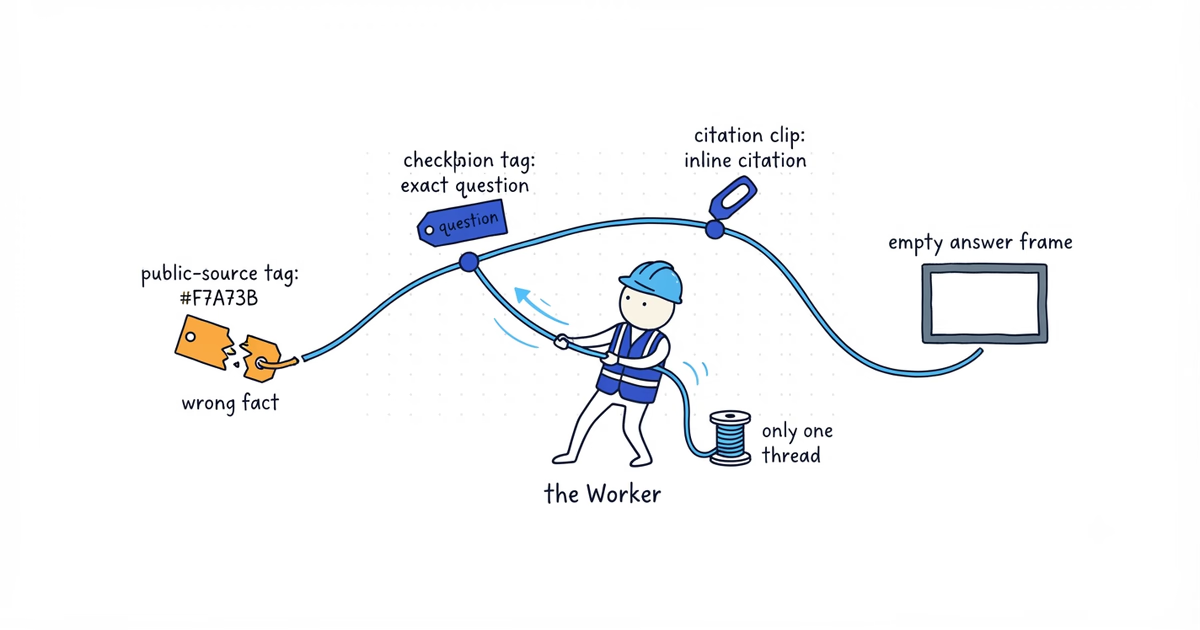
This process will not prove why ChatGPT selected one company. It will identify a public fact that is missing, contradicted, or unsupported, which is something the business can actually correct.
If the business is already absent or described incorrectly, use the step-by-step ChatGPT troubleshooting guide to diagnose the first confirmed gap instead of changing several things at once.
Step 3: Make the Important Pages Eligible for ChatGPT Search
OpenAI documents OAI-SearchBot as the crawler used to surface websites in ChatGPT Search. A site that opts out will not be shown in ChatGPT search answers, although it may still appear as a navigational link.
Check https://yourdomain.com/robots.txt. The simplest explicit allow rule is:
User-agent: OAI-SearchBot Allow: /
The complete site configuration may contain broader rules, so ask the person responsible for the website to review the whole file before changing it. Also confirm that the firewall or content delivery network allows requests from OpenAI’s published SearchBot IP ranges.
For each priority service page, check that:
- It loads without a login or customer account.
- It returns a normal successful response.
- It is not accidentally blocked by a sitewide crawler rule.
- The useful service and location information is present on the public page.
- The call, booking, or quote path works on mobile and desktop.
Do not confuse OAI-SearchBot with GPTBot. OpenAI treats them as independent controls: OAI-SearchBot is for search, while GPTBot relates to content that may be used to improve OpenAI’s models. Allowing GPTBot is not required to allow the website to surface through ChatGPT Search.
OpenAI says it can take about 24 hours for its systems to adjust after a robots.txt change. That is only the crawler-control update. It is not a promise that the page will be recrawled, cited, or used in a recommendation within 24 hours.
Step 4: Give Each Priority Service a Page That Can Answer the Question
A generic homepage cannot support every buying decision. Start with the service that matters most, then make the relevant page answer the facts a customer would otherwise have to guess.
| Customer needs to know | What the page should state |
|---|---|
| What do you do? | The exact service, repair, installation, or job type |
| Where do you do it? | The real city, service area, or travel boundary |
| Is my job a fit? | Relevant property, equipment, customer, or project type |
| When can I contact you? | Real hours, response expectations, and important availability limits |
| Why should I believe it? | Licenses, relevant work examples, customer evidence, or another inspectable source |
| What happens next? | A working phone, booking, estimate, or quote path |
Replace copy that could describe any contractor in any city:
Dependable plumbing solutions for homes and businesses.
With an accurate sentence that resolves a real decision:
We repair burst and leaking residential water lines in Tacoma. Call during posted hours to confirm the next available appointment.
The improved version is useful because it names the job, customer, place, and next step, not because it repeats a keyword. Continue beneath it with the service limits, process, relevant work, and contact information a customer needs.
Do not publish a page for every nearby city by swapping place names. Create a location page only when there is enough real information to explain how the business serves that place. One complete service-area explanation is more useful than a collection of near-duplicate pages.
The website visibility guide provides the complete crawler-access and priority-service-page audit for a local service business.
Step 5: Correct Google Business Profile and Other Public Listings
Your website is the source you control, but it is rarely the only public record of the business. Compare the priority page with customer-facing profiles and listings that are important in the market or appear in the citations you recorded.
Check:
- Real business name and business type
- Primary phone number and website destination
- Address or service-area description
- Opening and contact hours
- Services that are actually offered
- Material limits such as residential-only work or restricted emergency coverage
The sentences do not need to match word for word. A broad profile and a detailed service page can serve different purposes while describing the same operation. Correct contradictions, not harmless differences in phrasing.
Maintain Google Business Profile, Bing Places, Apple Business Connect, trade associations, licensing records, and relevant industry directories because customers use those records and because incorrect information can survive on them. OpenAI does not publish a rule saying any one of those profiles guarantees a ChatGPT recommendation. The Google Business Profile and AI search guide explains which profile fields matter and how the profile works alongside the website.
Beyond those core records, start with profiles people in the market recognize or sources that actually appeared in the baseline. Do not submit the business everywhere merely to increase a listing count.
Step 6: Publish Reviews, Project Proof, and Business Credentials
Clear copy establishes what the business claims. Proof helps a customer evaluate whether the claim holds up.
Useful proof can include:
- Short project summaries naming the problem, general area, and completed work
- Original project photos with enough context to understand what they show
- Genuine reviews that naturally describe the service received
- Current licenses, certifications, insurance details, or manufacturer credentials where relevant
- Membership pages from legitimate trade or local organizations
- Local reporting, interviews, or partnerships that genuinely involve the business
- Clear process, warranty, price range, or response information the team can stand behind
Match the evidence to the question. A gallery of kitchen remodels does not establish experience repairing a burst water line. A review saying “great service” is positive but less useful for verifying a specialized job than a review that independently describes the work completed.
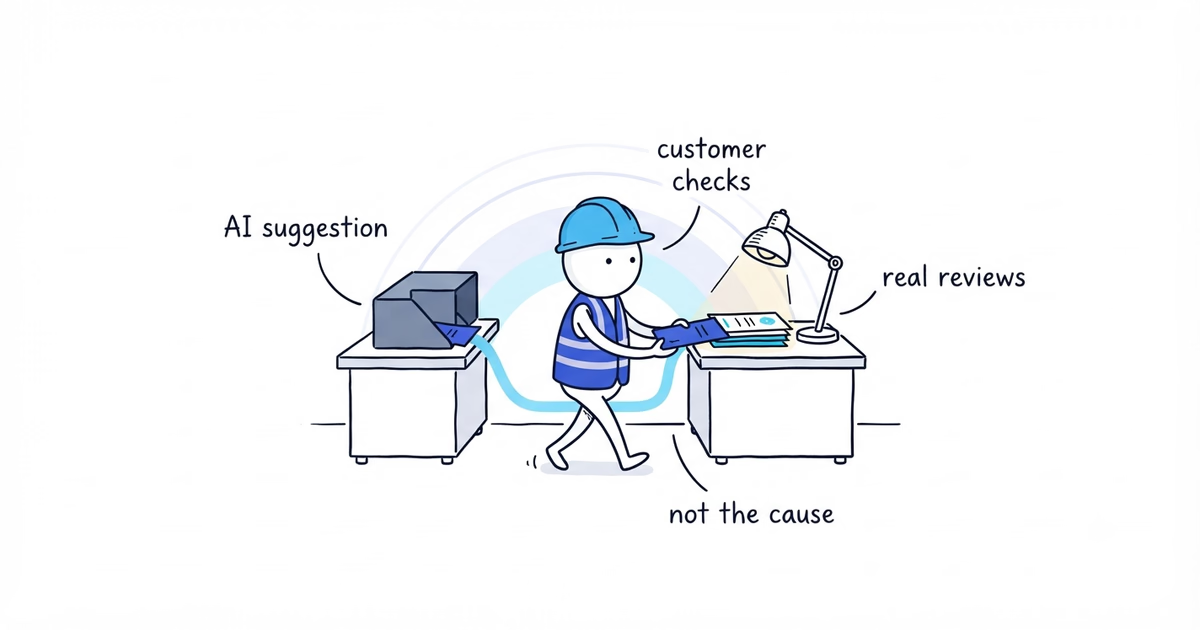
This does not mean feeding customers phrases to include in reviews or manufacturing press coverage. Ask for honest feedback, publish real work, and correct inaccurate public information. OpenAI does not publish a review count, directory count, backlink threshold, or press-mention quota that earns a recommendation.
For the reputation side of this work, read how Google reviews and other public feedback can affect AI recommendations.
Step 7: Retest the Same Questions and Measure the Right Changes
After the corrected information is public, repeat the original questions without changing the wording to improve the result.
Compare:
| Measure | What to look for |
|---|---|
| Mention rate | How often the business appears across the fixed question set |
| Description accuracy | Whether services, areas, hours, and important limits are stated correctly |
| Citation support | Whether the visible source actually supports the claim beside it |
| Customer path | Whether a qualified customer can reach the correct page and take the next step |
| Business outcome | ChatGPT referrals, qualified calls, quote requests, booked work, and customer-reported source |
An improvement is not limited to moving from absent to recommended. Replacing a wrong 24-hour claim, gaining a citation to the correct service page, or making the next step work can all improve the customer journey.
ChatGPT answers may change as the question, available sources, location, or time-sensitive business facts change. Do not describe one appearance as a permanent rank. Keep the stable baseline and review meaningful changes over time.
How Does ChatGPT’s Local Services Get Quote Beta Work?
OpenAI also documents a local-services Get Quote beta. This is different from improving the public pages available to ChatGPT Search.
The specification is for approved partners that provide a feed of local businesses and a configured plugin for quote requests. Eligible results can display a business card or sidebar with a Get Quote button. OpenAI currently directs prospective partners to a ChatGPT merchants application form.
That is not a normal claim-and-manage profile where an owner verifies one business and secures recommendations. A marketplace, directory, or platform that can provide a compliant business feed and quote workflow may evaluate the partner program. An individual business should not mistake the application for a guaranteed listing or recommendation.
The ChatGPT business listing guide compares this partner beta with normal Search visibility and custom GPTs.
What Not to Do for ChatGPT Recommendations
Several popular tactics start with a conclusion that OpenAI has not documented.
- Do not claim that Google Business Profile, Bing ranking, schema, reviews, or one directory is a confirmed ChatGPT ranking factor.
- Do not allow GPTBot solely because someone says it controls ChatGPT Search; OAI-SearchBot is the documented search crawler.
- Do not treat llms.txt, FAQ schema, or another machine-readable file as a recommendation switch.
- Do not publish dozens of near-duplicate service-area pages.
- Do not buy generic directory submissions or syndicated press releases to manufacture authority.
- Do not buy reviews, ask only selected customers, or give customers search phrases to repeat.
- Do not change a page date without making a useful change to the information.
- Do not keep rewriting the test question until the business appears.
Use structured data when it accurately represents visible page content and supports the site’s normal search implementation. Use directories when customers or industry participants rely on them. Use press releases when the business has actual news. None should be sold internally as a guaranteed route into a ChatGPT answer.
A 30-Day Plan to Improve ChatGPT Business Visibility
| Timing | Work |
|---|---|
| Day 1 | Record five stable ChatGPT Search questions, answers, competitors, citations, and factual errors |
| Week 1 | Check OAI-SearchBot, firewall access, priority-page availability, and working contact paths |
| Week 2 | Rewrite one priority service page with the real service, area, limits, evidence, and next step |
| Week 3 | Correct important public contradictions and add relevant project, credential, or customer proof |
| Week 4 | Repeat the fixed questions, compare citations and accuracy, and record qualified customer activity |
Do not wait for a perfect AI visibility strategy before fixing a wrong phone number, inaccessible page, or missing service description. Those corrections help customers on every discovery channel.
If you are deciding how this work fits with Google Search and Maps, read AI SEO vs Local SEO for contractors. If you want the baseline and source review handled for you, ShiftFlow’s free AI visibility report records the agreed customer questions, businesses mentioned, visible sources, incorrect claims, and first three information gaps to address.
Frequently Asked Questions
Can I list my business directly on ChatGPT?
OpenAI documentation does not describe a claim-and-manage local-business profile that guarantees recommendations. Its documented local-services Get Quote route is a separate beta for approved partners, with applications handled through the ChatGPT merchants form.
Does Google Business Profile guarantee a ChatGPT recommendation?
No. OpenAI does not document Google Business Profile as a required source or ranking factor for local answers. Maintain an accurate profile for customers and Google’s ecosystem, then inspect the sources shown with the actual ChatGPT answer instead of assuming one profile controls it.
Do I need to allow GPTBot to appear in ChatGPT Search?
No. OpenAI documents OAI-SearchBot as the crawler used to surface websites in ChatGPT Search. GPTBot is a separate control for content that may be used to improve OpenAI models.
How long does it take to appear in ChatGPT after making changes?
OpenAI says its systems may take about 24 hours to adjust after a robots.txt change. That is not a promise that a page will be recrawled, cited, or used in a recommendation within 24 hours, and OpenAI does not publish a fixed recommendation timeline.
Sources
- ai-search
- chatgpt
- local-business
- business-recommendations