How Do I Include Drive Time in My Pricing?
Recover normal local drive time in your minimum fee, service-call fee, loaded rate, or flat job price. Use zones, miles, or travel hours when distance or congestion makes one local allowance unfair.

Recover normal local drive time in your minimum fee, service-call fee, loaded rate, or flat job price. Use zones, miles, or travel hours when distance or congestion varies enough that one local allowance stops being fair.
Do not start by asking what to charge per mile. Start by separating four different numbers that are often mixed together.
Truck cost vs. technician drive time
| Number | What it represents | Where it belongs |
|---|---|---|
| Truck operating cost | Fuel, depreciation/lease, insurance, maintenance, tires, and repairs | Truck cost per mile or productive hour |
| Technician drive time | Wages, payroll burden, and time unavailable for on-site work | Labor cost or travel-time cost |
| Customer travel price | The amount quoted through a fee, zone, mileage, hourly, or all-in model | Estimate and invoice policy |
| Employee travel compensation | Which travel counts as paid work under applicable rules | Payroll and compliance policy |
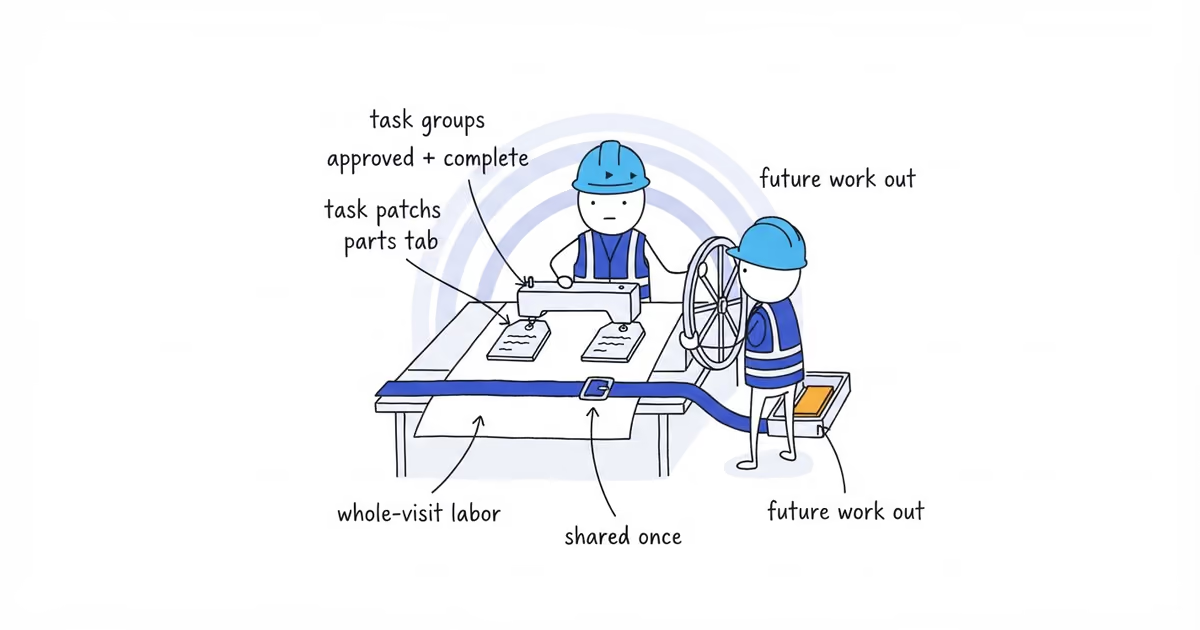
The customer price must recover the first two plus the required margin. It does not have to display them as separate invoice lines. Employee compensation is a different question from customer billing and must be checked against current federal and state rules.
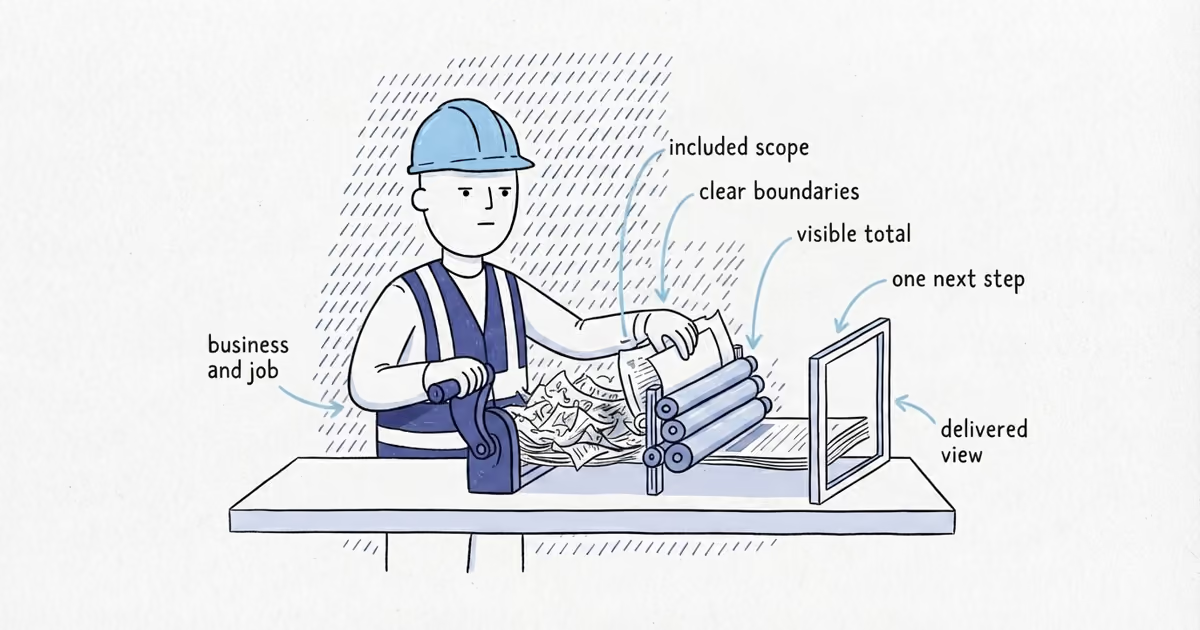
Set a core service area and included travel
Draw a core service area based on the jobs you can reach efficiently. That might be a radius, a group of ZIP codes, a county boundary, or a typical drive-time window.
Then state what the normal price already covers:
Our standard service price includes travel within [area or drive-time limit].
Travel beyond that area is priced by [zone / mile / travel hour].
If most customers are close together, building ordinary travel into the minimum or service-call fee keeps booking simple. A separate $12 travel line on every local invoice looks arbitrary even when the business needs the money.
The separate charge becomes useful when one customer’s location consumes materially more truck and technician time than the local average.
Ways to charge for drive time
| Model | Best fit | Main risk |
|---|---|---|
| Built into the all-in price | Short, consistent local travel | Distant jobs quietly lose money |
| Service-call or trip fee | A predictable truck roll or extended-area visit | The deliverable is unclear if the fee is poorly named |
| Zone fee | Stable service areas with clear distance bands | A hard boundary can make neighboring addresses pay very different prices |
| Per-mile charge | Rural or predictable-distance travel | Miles do not capture congestion or technician time well |
| Hourly travel rate | Urban traffic or highly variable drive times | Customers need a clear start/stop rule |
Use miles where distance explains the cost. Use hours where traffic explains it. Use zones when addresses fall into repeatable bands. Keep travel inside the normal price when local variation is too small to justify another customer decision.
Drive-time pricing example for city traffic
Suppose a technician’s burdened labor cost is $42 per hour and the truck costs $0.95 per business mile. A customer is only nine miles away, but the round trip takes 90 minutes in traffic.
Truck cost:
18 miles x $0.95 = $17.10

Technician drive-time cost:
1.5 hours x $42 = $63.00

Total travel cost before profit:
$17.10 + $63.00 = $80.10
A mileage-only charge would miss most of the cost because time, not distance, is the problem. The business could use an hourly travel rate, a traffic-based zone fee, or restrict that area to off-peak appointments.
Do not simply invoice $80.10. That is the cost input. Apply the business’s established margin method, then quote a clean customer price before booking.
Drive-time pricing example for rural jobs
Now suppose a job requires a 60-mile round trip that takes 72 minutes. The truck costs $0.85 per mile and technician burden is still $42 per hour.
Truck cost:
60 miles x $0.85 = $51.00

Technician drive-time cost:
1.2 hours x $42 = $50.40

Total travel cost before profit:
$51.00 + $50.40 = $101.40
Here, distance is stable and easy to verify. A zone price or per-mile model can work, but a truck-only rate of $0.85 per mile would recover $51 and ignore $50.40 of technician time.
The IRS optional business mileage rate is 72.5 cents per mile for 2026. It measures deductible vehicle operating cost, not technician labor, business overhead, or customer profit. It is a useful comparison for the truck input, not a complete travel price.
How to split drive time across routed jobs
Do not charge every customer as if the truck returned to the shop after each appointment when the crew actually moves from one nearby job to the next.
Suppose a four-job route uses 60 miles and two hours of total driving:
- Shop to the first job
- Job one to job two
- Job two to job three
- Job three to job four
- Last job back to the shop
You can allocate travel by the actual leg serving each job, split common start/end travel across the route, or use a standard local allowance based on past routes. Pick one method and apply it consistently.
For similar recurring visits, an equal route allowance may be reasonable. For one job far outside the cluster, assign the extra leg to that job instead of making the other three customers subsidize it.
Track route density as well as distance. Four customers in one neighborhood can cost less per job than two customers with the same total revenue at opposite ends of the service area.
How to explain a travel fee before booking
Give the customer the included area and exact added amount:
Our standard price includes travel within [core area]. Your address is in [extended zone], which adds $[amount] to cover the extra drive. I’ll include that in the written estimate before you book.
For an hourly model, define the clock:
Travel outside our core area is billed at $[rate] per hour from [starting point] to arrival, based on the scheduled route. We confirm the estimated travel amount before dispatch.
Do not reveal the charge after the job. Also avoid calling the fee “round trip” unless the route and allocation method actually treat it that way.
Customer travel fees vs. employee travel pay
Federal and state rules determine which employee travel time must be paid and at what rate. Customer pricing does not change those obligations. A business may build travel into a flat customer price and still have to record compensable employee time accurately.
Use current Department of Labor guidance as a starting point, then verify the rule for your state, crew arrangement, home-to-work travel, shop reporting, job-to-job travel, and overtime situation. This article sets the customer-pricing method, not the payroll answer.
How to test your drive-time pricing
For each job, record:
- Drive miles
- Drive time
- Truck cost using the business’s current rate
- Technician travel cost
- Travel amount recovered from the customer
- Whether the job was routed with nearby work
- Actual job margin
After 30 days, compare local, extended-zone, urban, and rural work. If local customers consistently overpay while distant jobs still lose money, the service area or allocation model needs adjustment. A good travel policy makes the exception visible without turning every ordinary drive into a separate fee.
Frequently asked questions
Should drive time start at my home or shop?
Use the business base and route stated in your customer policy, not an undisclosed personal commute. Keep the customer calculation separate from the employee travel-time rules that apply to your crew.
Should customers pay more when traffic is bad?
Use a disclosed hourly or traffic-zone model when congestion regularly changes the cost. Do not add an improvised traffic charge after the customer has already booked.
What if a customer is just outside my service area?
Quote the small additional travel amount before booking or use gradual zone bands. Avoid a large price jump at one boundary when neighboring addresses create nearly the same trip.
Sources
- pricing
- drive-time-pricing
- travel-fee
- charge-for-travel-time
- trip-fee
- service-area-pricing