
How Much Does an HVAC Technician Make?
HVAC technicians earn a median $29.33 per hour and $61,010 per year. Compare the pay range and median wages across every U.S. state.
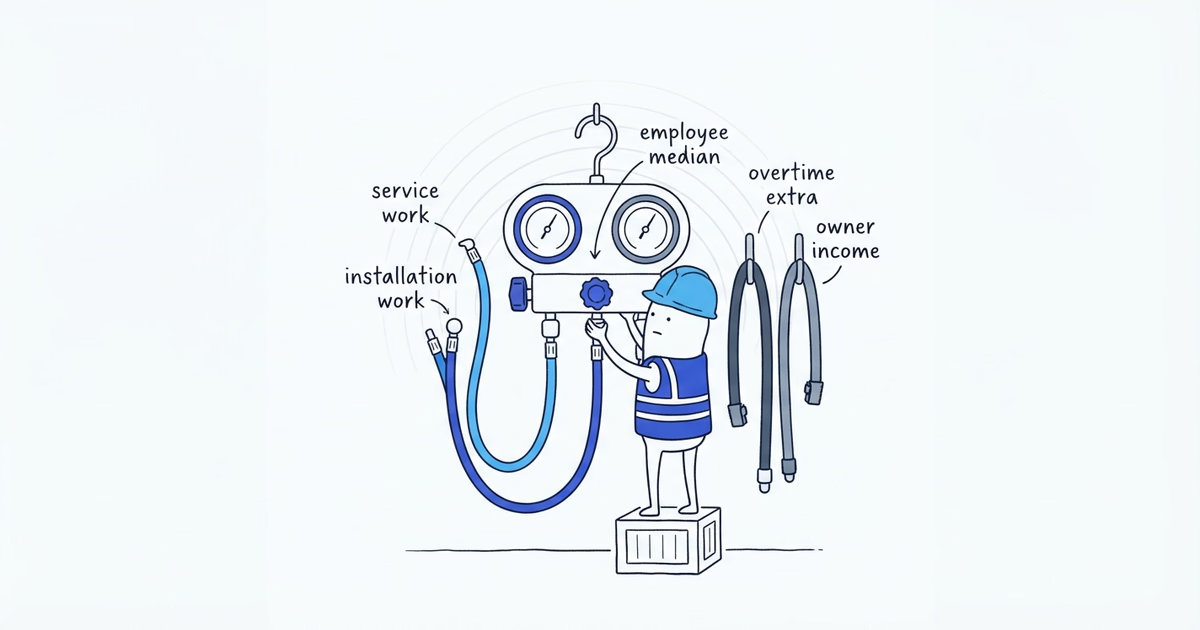
The national median HVAC technician salary is $29.33 per hour, or $61,010 per year, according to the latest U.S. Bureau of Labor Statistics wage data. That is approximately $1,173 per week or $5,084 per month when the official annual median is divided by 52 or 12.
BLS calls the occupation Heating, Air Conditioning, and Refrigeration Mechanics and Installers, SOC 49-9021. It includes service technicians and installers. It does not include stationary engineers or general maintenance workers. The figures cover wage-and-salary jobs, not self-employed technicians or HVAC business owners, and exclude overtime premium pay and employer benefits.
| Pay period | National median |
|---|---|
| Hourly | $29.33 |
| Weekly | $1,173 |
| Monthly | $5,084 |
| Annual | $61,010 |
The weekly and monthly numbers are conversions, not separate BLS observations. Seasonal hours, overtime, on-call work, and unpaid time can make actual checks differ.
What Is the Typical HVAC Technician Pay Range?
The 10th-percentile annual wage was $40,050, while the 90th-percentile wage was $95,210. The median sits at $61,010.
These points describe the wage distribution. They are not official apprentice, certified, lead, or senior-technician pay bands. OEWS does not report years of experience, certification type, or service-versus-install work in this table.
HVAC Technician Wage Distribution
Source: U.S. Bureau of Labor Statistics, May 2025 OEWS, SOC 49-9021
The median means half of covered jobs paid less and half paid more. The mean was higher at $64,780 per year and $31.14 per hour. Higher-paid jobs can pull an arithmetic average upward, so the median is the cleaner starting point for a typical wage comparison.
Which States Pay HVAC Technicians the Most?
The District of Columbia had the highest state-equivalent median at $84,390, followed by Alaska at $77,430 and Illinois at $77,410. Massachusetts, Connecticut, Minnesota, and Washington also had medians above $75,000.
Highest Median HVAC Technician Pay by State
Source: U.S. Bureau of Labor Statistics, May 2025 OEWS, SOC 49-9021. Nominal wages, not adjusted for cost of living.
Housing, taxes, commuting costs, licensing rules, union coverage, and the mix of residential, commercial, and refrigeration work differ by state. A higher nominal median does not automatically provide greater buying power.
HVAC technician salary by state
| State | Median hourly | Median annual |
|---|---|---|
| Alabama | $23.26 | $48,370 |
| Alaska | $37.23 | $77,430 |
| Arizona | $28.56 | $59,400 |
| Arkansas | $23.13 | $48,110 |
| California | $34.88 | $72,560 |
| Colorado | $31.35 | $65,200 |
| Connecticut | $36.83 | $76,610 |
| Delaware | $29.96 | $62,320 |
| District of Columbia | $40.57 | $84,390 |
| Florida | $27.24 | $56,670 |
| Georgia | $27.11 | $56,390 |
| Hawaii | $31.47 | $65,450 |
| Idaho | $27.04 | $56,240 |
| Illinois | $37.21 | $77,410 |
| Indiana | $29.05 | $60,430 |
| Iowa | $29.17 | $60,680 |
| Kansas | $29.07 | $60,460 |
| Kentucky | $28.18 | $58,620 |
| Louisiana | $28.20 | $58,650 |
| Maine | $30.37 | $63,170 |
| Maryland | $33.67 | $70,020 |
| Massachusetts | $37.16 | $77,300 |
| Michigan | $29.26 | $60,850 |
| Minnesota | $36.71 | $76,350 |
| Mississippi | $23.41 | $48,680 |
| Missouri | $28.82 | $59,950 |
| Montana | $29.26 | $60,850 |
| Nebraska | $28.77 | $59,850 |
| Nevada | $29.09 | $60,510 |
| New Hampshire | $35.51 | $73,850 |
| New Jersey | $35.79 | $74,450 |
| New Mexico | $24.17 | $50,270 |
| New York | $35.78 | $74,430 |
| North Carolina | $27.53 | $57,260 |
| North Dakota | $35.81 | $74,490 |
| Ohio | $30.06 | $62,510 |
| Oklahoma | $27.67 | $57,560 |
| Oregon | $30.26 | $62,940 |
| Pennsylvania | $30.00 | $62,400 |
| Rhode Island | $32.39 | $67,370 |
| South Carolina | $27.22 | $56,610 |
| South Dakota | $29.51 | $61,390 |
| Tennessee | $26.68 | $55,490 |
| Texas | $27.77 | $57,760 |
| Utah | $28.24 | $58,730 |
| Vermont | $29.88 | $62,150 |
| Virginia | $28.72 | $59,730 |
| Washington | $36.38 | $75,660 |
| West Virginia | $23.49 | $48,850 |
| Wisconsin | $29.67 | $61,710 |
| Wyoming | $26.30 | $54,700 |
What Changes an HVAC Technician’s Pay?
Local market and work mix. Residential service, installation, commercial refrigeration, controls, and facilities maintenance do not all price labor the same way. Compare roles in the same market and segment.
Training and responsibility. Diagnostic ability, electrical troubleshooting, airflow measurement, controls, and crew leadership can expand the work a technician can perform. The national percentiles do not isolate a fixed premium for any skill or title.
Section 608 certification. EPA requires certification for technicians who maintain, service, repair, or dispose of covered equipment that could release ozone-depleting refrigerants. That is a qualification rule, not evidence of a universal pay increase. Certification type and work scope still matter.
Season, overtime, and on-call work. Heat waves, cold snaps, emergency calls, and installation deadlines can increase gross pay. OEWS excludes overtime premiums and shift differentials, so ask about normal hours, on-call rotation, travel pay, and seasonal scheduling.
Service and Installation Roles Are Different
The national occupation combines mechanics and installers, but the day-to-day jobs can differ. A service technician may spend more time diagnosing intermittent faults, explaining options to customers, driving between calls, and joining an on-call rotation. An installer may work with a crew on longer jobs, equipment changeouts, ductwork, startup, and project deadlines.
BLS does not publish a separate national median for each of those job shapes in this occupation. Compare the actual duties, normal schedule, paid travel, tool expectations, sales or commission plan, and on-call requirements rather than assuming that either title automatically pays more. A hybrid service-and-install role should be compared with offers that require a similar mix of diagnosis, customer work, and installation labor.
How to Compare an HVAC Job Offer
Compare the regular hourly rate with the $29.33 median before adding possible overtime, bonuses, commissions, or on-call income. Confirm the usual paid schedule and whether travel between calls, parts runs, training, and standby time are paid.
Then compare health insurance, retirement contributions, paid leave, certification support, tools, uniforms, and vehicle use. OEWS excludes employer benefits, so two similar hourly rates can produce different total packages. A $32 rate over 2,080 regular hours equals $66,560 before overtime, taxes, unpaid time, or benefits, but the offer should confirm whether those hours are realistic.
Employee Pay Is Not HVAC Business Owner Income
The $61,010 median is an employee wage benchmark. HVAC customer revenue must also cover payroll costs, equipment, parts, vehicles, warranty work, dispatch, marketing, financing fees, and retained cash.
If you are deciding what the company can pay its owner rather than what a technician earns, the HVAC owner earnings guide models maintenance agreements, repair calls, installations, and retained cash separately.
Frequently Asked Questions
How much do HVAC technicians make per hour?
The May 2025 national median was $29.33 per hour. The mean was $31.14 per hour.
How much do HVAC technicians make per year?
The national median annual wage was $61,010, equal to about $5,084 per month or $1,173 per week when divided evenly.
What is the HVAC technician salary range?
The 10th-percentile annual wage was $40,050, the median was $61,010, and the 90th-percentile wage was $95,210. These percentiles are not official experience or certification bands.
Which state pays HVAC technicians the most?
The District of Columbia had the highest state-equivalent median at $40.57 per hour and $84,390 per year. Alaska was next at $37.23 per hour and $77,430 per year. The figures are not adjusted for living costs.
Sources
- hvac-technician-salary
- hvac-hourly-pay
- hvac
- salary-by-state
- field-service
- section-608