
How Much Do HVAC Business Owners Make?
No reliable national average exists. Compare three HVAC scenarios modeling $123,898, $170,366, and $375,120 in owner compensation.
There is no reliable national average salary for an HVAC business owner. Census reports business receipts, BLS reports employee wages, and salary websites do not observe a representative set of company books. None directly measures how much HVAC owners pay themselves while retaining enough cash for payroll, equipment, and seasonality.
In three disclosed residential service-and-installation scenarios, the business supports $123,898, $170,366, or $375,120 in planned annual owner compensation before personal tax.
| Planning scenario | Collected revenue | Owner compensation | Retained cash | Owner field hours |
|---|---|---|---|---|
| Owner-operator | $430,200 | $123,898 | $30,974 | 140/month |
| Small HVAC team | $1,285,250 | $170,366 | $73,014 | 40/month |
| Established HVAC team | $3,870,000 | $375,120 | $250,080 | 0 |
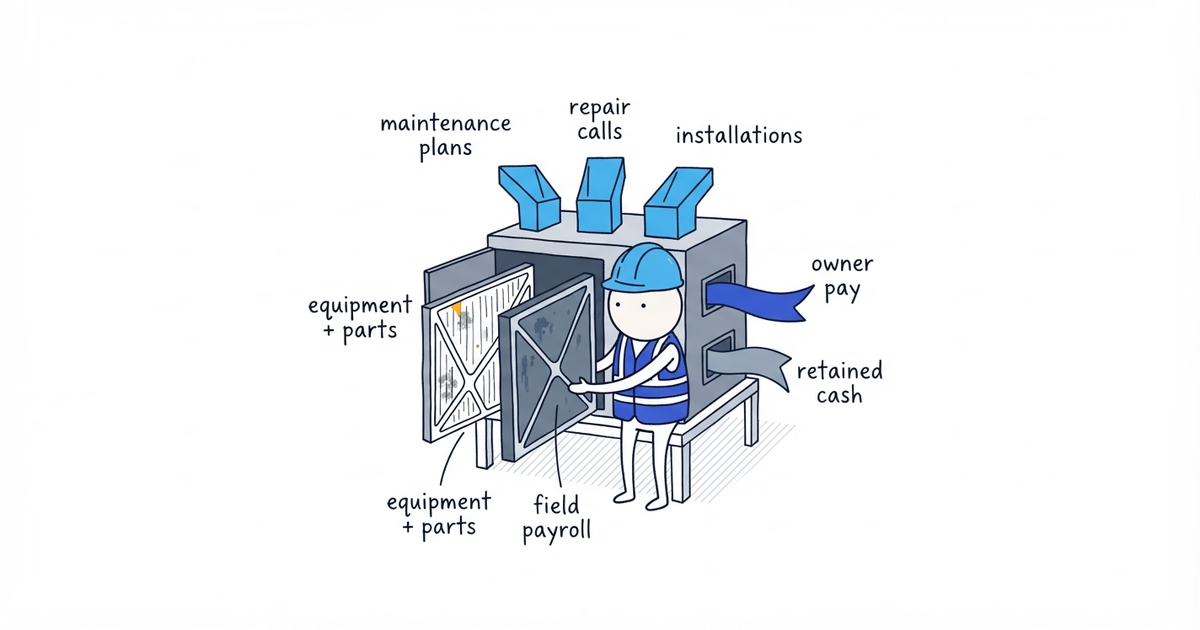
These are different operating shapes, not low, average, and high salaries. Each combines maintenance agreements, repair calls, and equipment installations. The model excludes large commercial construction and new-development work. In the first two scenarios, owner compensation also pays for the owner’s remaining field labor.
Is HVAC Business Revenue the Same as Owner Income?
Collected revenue is money received from agreements, repairs, and installations. Booked replacement work and unpaid invoices are not yet collected revenue.
Field payroll is the loaded cost of non-owner service technicians and installers.
Equipment and operating costs include units, parts, refrigerant, permits, vehicles, financing and merchant fees, insurance, training, marketing, dispatch, warranty work, and overhead.
Owner compensation is the planned wage, draw, or distribution paid to the owner. The model does not prescribe an entity type or tax treatment.
Retained cash remains for seasonal working capital, payroll, inventory, trucks, warranty exposure, and growth. It is not current owner take-home.
How Much Can a Small HVAC Business Owner Make?
The small-team scenario collects $104,000 from 400 active maintenance agreements, $446,250 from 850 repair calls, and $735,000 from 70 installations. Total annual collected revenue is $1,285,250.
Where $1,285,250 of Small-Team Revenue Goes
Source: ShiftFlow planning model. Percentages use collected revenue.
The payroll line uses 5,760 paid non-owner field hours at a loaded cost of $47 per hour. Equipment and parts take 34% of revenue, other direct costs take 8%, and overhead takes 18%. The resulting $243,380 of pre-owner cash is divided 70% to owner compensation and 30% to retained cash.
That subtotal is not labeled profit because the owner still contributes about 40 field hours per month to estimates, difficult diagnostics, installations, and callbacks.
HVAC Business Owner Earnings Model Assumptions
These August 2026 planning inputs are replaceable. Agreement prices represent annual collected revenue per active agreement. Included visits still consume capacity even though the visit is not counted again as separate revenue.
| Input | Owner-operator | Small HVAC team | Established HVAC team |
|---|---|---|---|
| Active maintenance agreements | 180 | 400 | 1,200 |
| Collected revenue per agreement | $240 | $260 | $275 |
| Repair calls per year | 360 | 850 | 2,400 |
| Collected repair ticket | $475 | $525 | $575 |
| Installations per year | 24 | 70 | 180 |
| Collected installation value | $9,000 | $10,500 | $12,000 |
| Paid non-owner field hours | 0 | 5,760 | 15,360 |
| Loaded field labor cost | N/A | $47/hour | $50/hour |
| Equipment and parts | 36% | 34% | 36% |
| Other direct costs | 10% | 8% | 8% |
| Overhead | 18% | 18% | 20% |
| Owner field hours | 140/month | 40/month | 0 |
| Pre-owner cash paid to owner | 80% | 70% | 60% |
The owner-operator may use helpers or subcontractors for installations; those costs must fit inside the stated direct cost allocations. Actual capacity changes with climate, equipment type, install complexity, drive time, technician skill, maintenance-visit timing, and warranty work.
How HVAC Revenue Mix Affects Owner Earnings
| Work stream | Revenue driver | Main cost and capacity question |
|---|---|---|
| Maintenance agreements | Active agreements x collected annual value | Renewal, included visits, and visit capacity |
| Repair calls | Completed calls x collected repair ticket | Diagnostic time, parts, travel, and first-time completion |
| Installations | Completed installs x collected installation value | Equipment, crew-days, permits, financing, and warranty |
In the small-team example, installations produce 57% of revenue but carry substantial equipment pass-through cost. Maintenance agreements contribute only 8% of revenue while creating planned visits and a future service relationship. Those dollars should not be compared as though they have identical labor, material, or cash requirements.
Cash timing also differs. Agreement cash may arrive before all included visits are delivered, while an installation may require equipment, permits, and payroll before the final customer payment clears. Financing providers and card processors can introduce fees or settlement delays. The annual model smooths those movements, so an owner should also review a rolling cash forecast before treating modeled pre-owner cash as available compensation.
What Census Data Shows About HVAC Contractors
The 2023 Census Nonemployer Statistics data contains 178,663 U.S. nonemployer establishments and $14.01 billion in aggregate receipts for NAICS 238220. Dividing those totals gives an arithmetic mean of $78,389 in receipts per establishment.
That number is not owner salary, profit, or a full-time revenue benchmark. Receipts come before expenses, and nonemployer records may include part-time operations. More importantly, NAICS 238220 combines plumbing, heating, and air-conditioning contractors. It cannot isolate HVAC businesses from plumbing businesses.
If the number you need is employee pay rather than ownership income, the HVAC technician salary guide compares the $29.33 national median with hourly and annual wages across every state.
What Changes HVAC Business Owner Earnings?
Agreement retention and visit capacity. Forty active agreements in the small-team model represent $10,400 of annual collected revenue. A renewal is useful only if pricing covers included visits and the schedule can deliver them. Track included maintenance visits separately from repair calls so prepaid work does not disappear from capacity planning.
Collected repair ticket. A 10% increase in the small-team repair ticket adds $44,625 in revenue. After the model’s percentage-based costs, about $17,850 reaches cash before owner compensation.
Paid hours and warranty work. Ten percent more paid field hours with no additional revenue removes $27,072 from pre-owner cash. Reducing the modeled other-direct allocation from 8% to 7% adds $12,853. When repeat visits disappear into ordinary job time, the callback and warranty hours guide explains how to separate them from revenue-producing capacity.
Retained cash. Equipment purchases, payroll, and financing fees can occur before final collection. The scenarios retain 20%, 30%, and 40% of pre-owner cash as the business grows. Those are model choices, not universal targets.
When paid hours are difficult to allocate across agreements, repair calls, and installations, time tracking for HVAC teams makes the revenue mix easier to evaluate.
How to Calculate Your HVAC Business Owner Income
Use 12 months of collected agreement, repair, and installation revenue. Count active agreements and included visits, completed repair calls, and completed installations. Then total paid field hours at a loaded cost and classify equipment, parts, other direct costs, and overhead consistently.
Record owner field hours even when unpaid. Run each work stream separately before combining it, choose a retained-cash amount, and test owner compensation last. This shows whether the planned payment depends on renewals, tickets, installs, or labor capacity that the schedule may not support.
Frequently Asked Questions
How much does an HVAC business owner make?
No reliable national average exists. These three planning scenarios produce $123,898, $170,366, and $375,120 in owner compensation before personal tax. They are models, not market averages.
How much can a solo HVAC business owner make?
The owner-operator model produces $430,200 in collected revenue, $123,898 in owner compensation, and $30,974 in retained cash from agreements, 360 repair calls, and 24 installations.
Is HVAC business revenue the same as owner income?
No. Revenue comes before field payroll, equipment, parts, vehicles, warranty work, financing fees, dispatch, marketing, overhead, and retained cash.
What affects HVAC business owner earnings most?
Agreement retention, completed calls, collected tickets, installation estimating, equipment and labor recovery, callbacks, seasonality, overhead, and retained cash policy are major levers.
Sources
- hvac-business-owner
- hvac-business-income
- owner-earnings
- hvac
- job-costing
- maintenance-agreements