

How Much Do Landscaping Business Owners Make?
How much do landscaping business owners make? Compare three cash-flow examples covering revenue, crew costs, owner compensation, and retained cash each year.
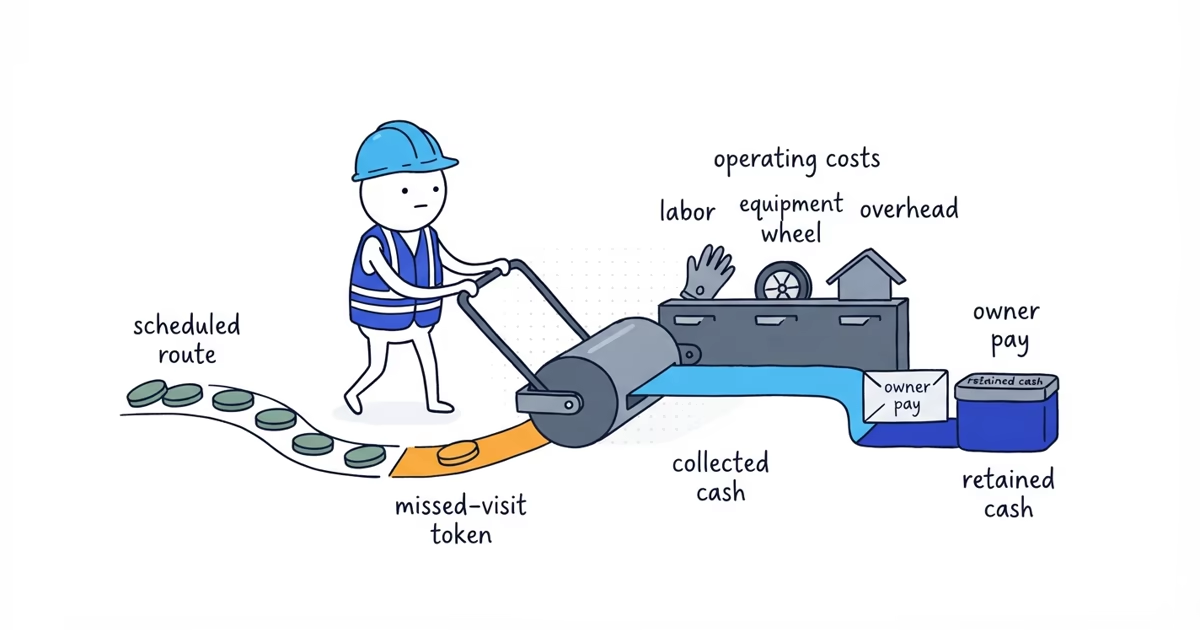
There is no defensible national average salary for landscaping business owners in the public BLS or Census data reviewed for this guide. Those sources measure employee wages, business counts, payroll, and receipts. They do not measure what a representative owner pays themselves or takes home.
A useful answer has to start with the business’s own numbers. In the three examples below, planned annual owner compensation is $71,608 for a solo recurring route, $102,602 for a small maintenance crew, and $175,939 for an established mixed-service team. Each case also leaves cash in the business.
These are separate planning examples, not a national range, average, benchmark, or forecast. Every operating input is an editorial assumption that still needs to be replaced with the owner’s records.
Landscaping revenue, profit, and owner pay
Owners get into trouble when they call sales, profit, and personal pay the same thing. Use this sequence instead:
| Term | What it means in this model |
|---|---|
| Collected revenue | Money collected from recurring visits and enhancement or installation work |
| Non-owner direct costs | Crew payroll, materials, fuel and equipment, and rework or damage tied to delivering work |
| Overhead | Insurance, marketing, admin and software, and other operating expenses |
| Cash before owner compensation | Collected revenue minus modeled direct costs and overhead |
| Planned owner compensation | The share of pre-owner cash allocated to the owner before personal tax |
| Retained cash | The amount left in the business after planned owner compensation |
Retained cash is not money the owner has already earned personally. It may be needed for seasonal gaps, equipment, repairs, debt, taxes, or other obligations. This model also does not prescribe whether owner compensation should be a salary, draw, or distribution.
Landscaping business owner income examples
The examples represent different operating shapes. The first is a recurring route with no paid non-owner crew hours. The second uses a small maintenance crew. The third combines a larger recurring base with more enhancement or installation work.
Illustrative planning model, not an industry average.
| Annual input | Solo recurring route | Small maintenance crew | Established mixed-service team |
|---|---|---|---|
| Recurring clients | 60 | 140 | 280 |
| Visits per client | 28 | 30 | 30 |
| Collected price per visit | $60 | $70 | $80 |
| Enhancement/install collections | $15,000 | $70,000 | $220,000 |
| Revenue adjustment | 3% | 3% | 3% |
| Paid non-owner crew hours | 0 | 5,400 | 14,000 |
| Loaded crew wage | N/A | $23 | $25 |
| Materials | 4% | 6% | 8% |
| Fuel and equipment | 9% | 8% | 7% |
| Rework and damage | 1% | 1.5% | 1.5% |
| Insurance | 2% | 2% | 2% |
| Marketing | 4% | 5% | 5% |
| Admin and software | 2% | 3% | 4% |
| Other overhead | 3% | 3% | 3% |
| Share allocated to owner compensation | 85% | 80% | 70% |
The 3% revenue adjustment is an allowance for scheduled work that is not ultimately completed or collected. It is not
a national cancellation or bad-debt rate. The loaded crew wages and every percentage in the table are also assumptions,
not BLS or Census benchmarks.
The formula is:
Cash before owner compensation = collected revenue - non-owner direct costs - overhead
Then:
Planned owner compensation = cash before owner compensation x selected owner-compensation share
Three separate examples: not a national range, average, or percentile distribution.
| Annual model output | Solo recurring route | Small maintenance crew | Established mixed-service team |
|---|---|---|---|
| Scheduled revenue | $115,800 | $364,000 | $892,000 |
| Collected revenue | $112,326 | $353,080 | $865,240 |
| Crew payroll | $0 | $124,200 | $350,000 |
| Other direct costs | $15,726 | $54,727 | $142,765 |
| Overhead | $12,356 | $45,900 | $121,134 |
| Cash before owner compensation | $84,245 | $128,252 | $251,342 |
| Planned owner compensation | $71,608 | $102,602 | $175,939 |
| Retained cash | $12,637 | $25,650 | $75,403 |
The owner compensation line mixes compensation for the owner’s field or management work with the return on ownership. It is before personal tax. Crew payroll covers non-owner labor only.
Small landscaping crew revenue and owner pay
The small maintenance crew shows why company revenue is not owner income:
| Step | Annual amount |
|---|---|
| Collected revenue | $353,080 |
| Less crew payroll | -$124,200 |
| Less other direct costs | -$54,727 |
| Less overhead | -$45,900 |
| Cash before owner compensation | $128,252 |
| Planned owner compensation | $102,602 |
| Retained cash | $25,650 |
The business collects $353,080, but $224,827 is consumed by modeled non-owner direct costs and overhead. The remaining $128,252 is not automatically the owner’s paycheck. This example deliberately keeps 20% of that amount in the business.
Personal tax, debt principal, owner benefits, depreciation, capital purchases, and any reserve beyond the retained-cash line are outside this simplified model. Add those items before using the result for a real pay decision.
What affects landscaping business owner income?
How route density affects landscaping profit
A route that looks full on the schedule can still lose paid time to driving, loading, fuel stops, and gaps between jobs. Use payroll and route records to calculate paid crew hours per completed visit. In the small-crew example, cutting paid crew hours by 10% while completing the same work would add $12,420 to cash before owner compensation. That is arithmetic, not a recommendation to rush work or cut quality.
How pricing and visit frequency affect owner income
The model uses collected price, not quoted price. Raising the recurring price by 10% in the small-crew example adds $20,390 to cash before owner compensation after the modeled revenue adjustment and percentage-based costs. Losing two visits per client per year reduces it by $13,594.
If the collected-price input is still a guess, use the landscaping job pricing guide to build a price from crew labor, materials, disposal, equipment, overhead, and target margin before carrying it into the owner-income model.
The practical check is simple: compare scheduled visits, completed visits, and collected invoices. Do not count a route as productive just because recurring work appears on the calendar.
How equipment and service mix affect landscaping profit
Maintenance routes need fuel, repairs, replacement equipment, and productive travel. Enhancement and installation work can raise the collected ticket, but it also changes materials, equipment use, production time, and risk. Keep recurring and enhancement revenue separate long enough to see which work is actually producing cash.
Seasonality belongs in the same review. A business that loses visits during part of the year needs a smaller annual visit count or an explicit revenue adjustment. Do not use a peak-month route to estimate a full year.
What Census data says about landscaping business revenue
The 2023 Census Nonemployer Statistics file records 516,572 Landscaping Services nonemployer establishments and $18.62 billion in aggregate receipts. Dividing receipts by establishments produces about $36,041, but that is an arithmetic mean of business receipts, not median revenue, profit, or owner pay.
The count-based median establishment falls somewhere in the $10,000–$24,999 annual-receipts bracket. That still does not describe a full-time owner: nonemployer records can include part-time businesses, receipts are measured before expenses, and the exact median is not published.
County Business Patterns separately reports 117,969 employer establishments, 802,899 employees, and $41.18 billion in annual payroll for Landscaping Services in 2023. Those figures describe employer businesses and employee payroll. They do not reveal owner compensation.
How to calculate landscaping owner compensation
Use one consistent trailing-12-month period:
- Count completed and collected recurring visits, not estimates or scheduled stops.
- Add collected enhancement and installation invoices separately.
- Pull paid non-owner hours and loaded labor cost from payroll records.
- Separate materials, fuel and equipment, repairs, rework, and damage from overhead where the books allow it.
- Pull insurance, marketing, admin, software, and other overhead for the same period.
- Subtract direct costs and overhead from collected revenue.
- Choose a retained-cash amount before deciding what is available for owner compensation.
If the business has debt, major equipment purchases, owner benefits, or tax obligations not represented above, add them before making a pay decision. Entity-specific salary, draw, and distribution questions belong with the business’s accountant.
Owners comparing their crew’s base pay with the employee market can use the separate landscaper salary guide, which uses May 2025 employee wage data rather than owner scenarios.
Frequently asked questions
How much do lawn care business owners make?
No public BLS or Census source provides a representative national take-home figure. A lawn care owner can use the recurring-route model in this guide, then replace the clients, visits, collected price, crew hours, costs, owner compensation, and retained cash with their own records.
How do I price lawn mowing jobs for this owner-income model?
Use the amount actually collected per visit as the model input. The job price still has to cover paid crew time, materials, fuel and equipment, rework, and overhead; this owner-income model does not replace a lawn-mowing estimate.
Sources
- landscaping
- business-owner-earnings
- owner-compensation
- business-revenue
- landscaping-profit



