

How to Price a Landscaping Job
Most landscapers bid off the yard and lose the day to a dump run and a second load of mulch. Here is how to build a landscaping price from your own costs — labor, materials, disposal, equipment, and profit — and walk away with a real number.
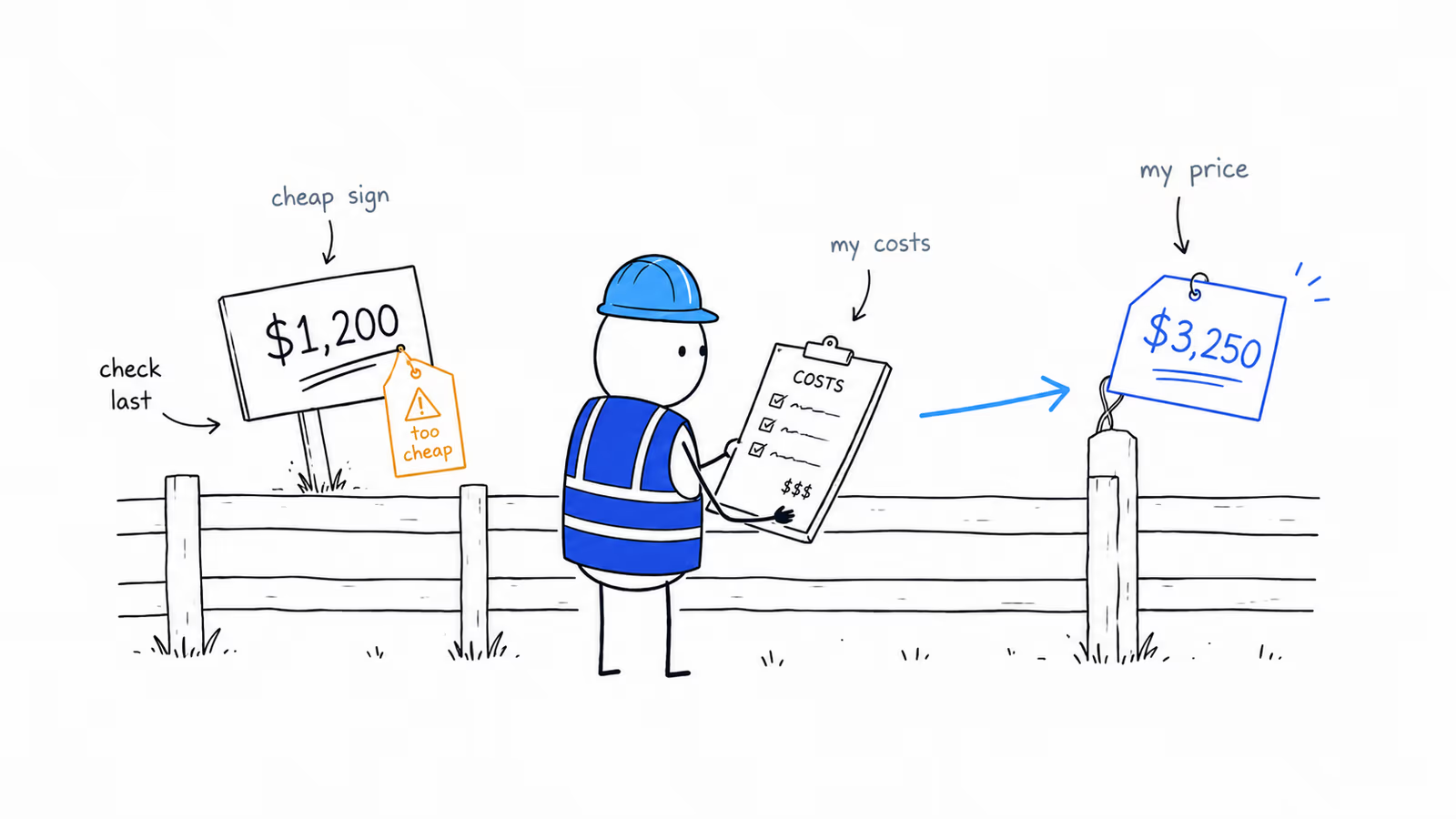
Landscapers lose money on the driveway, not in the spreadsheet. You walk the property, picture the finished beds, and name a number that feels right — then the day disappears into a dump run, a second load of mulch because the first came up short, and fuel nobody counted. It looked like a good job at the handshake and wasn’t one by dark.
The fix is to stop pricing the yard and start pricing what the yard costs you. Total the job’s real inputs, add your profit, and only then look at what other crews charge.
How to calculate your landscaping labor cost
Your crew’s wage isn’t what the crew costs you. Add employer payroll taxes, workers’ comp, benefits, and other payroll costs from your own records. Then account for paid time that is not spent on the job, such as loading, driving, unloading, and fuel stops, without counting the same cost twice. Put yourself on that clock too if you’re swinging a shovel; your hours are a cost, not free labor.
Fix one loaded hourly figure per crew member and price every job off it. Set it too low and the loss rides along on every quote you write.
What goes into a landscaping price
Five costs belong in the calculation, including disposal and equipment costs that are easy to miss:
- Crew labor — hours on site times your loaded hourly rate.
- Materials — mulch, plants, soil, stone, at what you pay this week. These prices move; a spring quote built on last fall’s mulch cost is already wrong.
- Disposal — the dump or transfer-station fee to get the debris off the truck. On a cleanup that’s a real number, not a rounding error.
- Equipment and fuel — mower, trailer, blower, and truck wear, carried as a per-job share. You spend it whether or not you write it down.
- Overhead — insurance, phone, software, marketing, spread across the season’s jobs.
Add those five and you have cost. Choose a target margin that covers the return the business needs beyond paying the crew, then calculate the selling price from that margin.
Flat rate vs hourly landscaping pricing
Once you’ve done enough cleanups and installs to trust your own time estimates, quote a flat per-job price. The customer gets one number and books sooner, and a quick crew pockets the time it saves instead of handing it back on an hourly clock. Use the broader hourly-versus-flat-rate decision guide when a job does not fit cleanly into either model.
Hold hourly for the jobs you honestly can’t read from the curb — an overgrown lot where the debris volume is anyone’s guess until you start cutting. Price recurring maintenance per visit, and set that per-visit number below a one-off: a property you keep up is faster each time, and the revenue comes back without you selling it again.
A simple landscaping price formula
Price = (Labor + Materials + Disposal + Equipment + Overhead) ÷ (1 − target margin)
A 30% margin is not the same as adding 30% to cost. Adding 30% is a markup and produces about a 23% margin. To price for a true 30% margin, divide cost by 0.70.
How to price a spring cleanup and mulch job
A cleanup-and-mulch on an average suburban lot: two-person crew, roughly half a day. Eight crew-hours at $40 is $320 of labor. Six yards of mulch is $210, the debris haul is a $60 dump fee, equipment and fuel come to $40, and overhead adds $50 — $680 in cost. For a 30% target margin, divide $680 by 0.70: the calculated price is about $971, which you might round to $975. Those are stand-in numbers; the breakdown is the point, so fill in yours.
Notice the two lines a curbside guess would miss: the $60 dump fee and the $40 of fuel and wear. Leave them off and they don’t disappear — they come straight out of your profit.
Set a minimum landscaping price
A small front-yard cleanup still carries the drive, load, and unload, so set a floor from the full visit cost and your target margin. A copied national minimum cannot tell you whether the job pays after your route time, equipment, disposal, and overhead. Calculate that floor with the minimum service fee method.
How to compare your prices to local landscapers
Now check genuinely comparable local scopes. A large difference is a reason to review quantities, productivity, disposal, materials, equipment, overhead, and scope; it does not prove which price is correct.
The move that actually hurts is dropping under your own cost to match a lower quote. Another crew may have different productivity, scope, route density, overhead, or profit goals. Compare the promised work and check your inputs instead of assuming their number should become yours. If several completed jobs still miss the intended margin, run the checks in am I charging enough?.
Pricing sets what each job earns; it won’t fill a slow week on its own. Before you start paying for leads to do that, it’s worth finding what’s quietly turning searchers away — a missing website, a bare Google profile, thin reviews. We audit what’s missing for service businesses.
Frequently asked questions
How much should I charge for a spring cleanup and mulch job?
There’s no fixed rate — it depends on your costs. Built from crew labor, mulch, disposal, equipment, overhead, and a 30% target margin, the cleanup-and-mulch example works out to about $971 before rounding. Run your own numbers to get your figure.
Should I charge hourly or a flat rate?
Charge a flat rate once you’ve done enough jobs to trust your time estimates — a fast crew keeps the upside. Use hourly only for jobs you can’t read, like an overgrown lot where you won’t know the debris volume until you start.
How much should I charge for recurring lawn maintenance?
Price it per visit from the labor, travel, equipment, and materials each service uses. Lower the price only when your route density and tracked service time actually reduce the cost per visit.
- pricing
- landscaping
- landscaping-business
- quoting
- small-business



