

How Much Do Painting Business Owners Make?
How much do painting business owners make? Compare three cash models using completed jobs, crew labor, materials, overhead, owner pay, and retained cash.
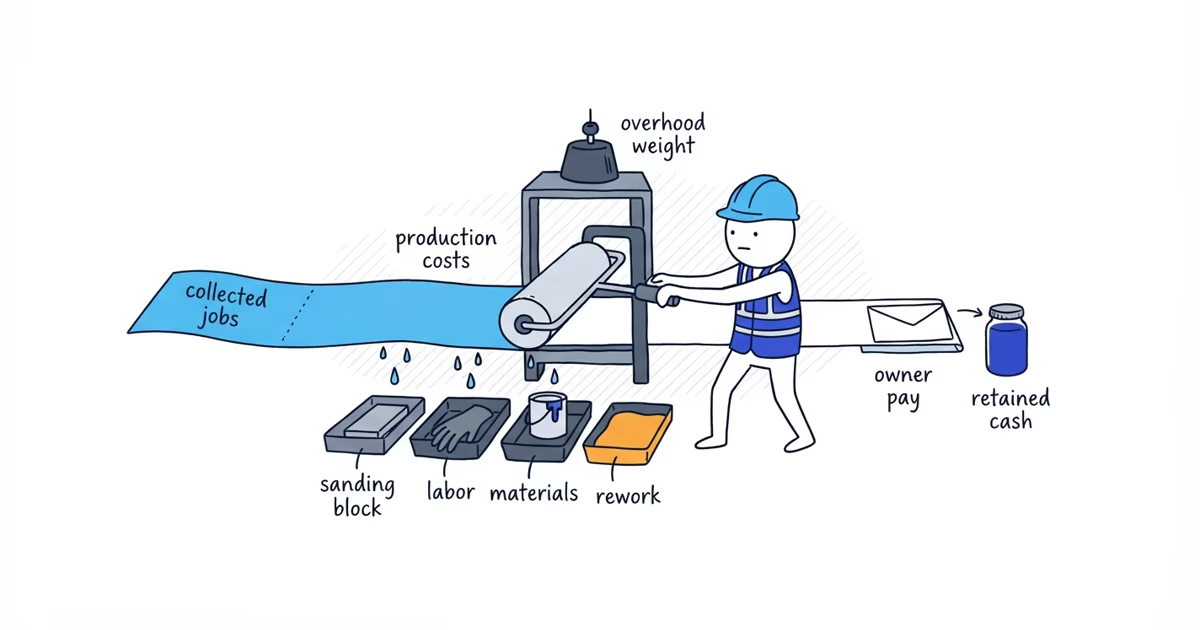
No reviewed public source provides a representative national salary or take-home figure for painting business owners. BLS data measure employee painter wages. Census data measure businesses, employees, payroll, and receipts. Neither shows what owners across the country pay themselves.
The practical answer is to work from completed jobs and actual costs. In the three examples below, planned annual owner compensation is $89,161 for an owner-operator repaint business, $145,152 for a small residential crew, and $223,275 for an established mixed residential and commercial team. Each case retains additional cash in the business.
These are separate planning examples, not a national range, average, benchmark, or forecast. The assumptions have not been validated as representative painting-business results.
Painting business revenue, profit, and owner pay
A painting company can collect a large amount of revenue and still have little cash available to the owner. Read the model in this order:
| Term | What it means in this model |
|---|---|
| Collected revenue | Completed jobs multiplied by the average amount actually collected |
| Non-owner direct job costs | Crew payroll, materials, rework, warranty work, and other direct project costs |
| Overhead | Insurance, marketing, admin and software, and other operating expenses |
| Cash before owner compensation | Collected revenue minus modeled direct job costs and overhead |
| Planned owner compensation | The selected share of pre-owner cash allocated to the owner before personal tax |
| Retained cash | Business cash left after planned owner compensation |
The owner-compensation line may combine pay for field and management work with a return on ownership. It does not tell the owner whether to use a W-2 salary, draw, or distribution. Retained cash remains in the business; it is not personal take-home.
Painting business owner income examples
The first case is an owner who remains the main producer but uses some paid non-owner help. The second has a small residential crew. The third has a larger mixed residential and commercial workload.
Illustrative planning model, not an industry average.
| Annual input | Owner-operator repaint business | Small residential crew | Established mixed residential/commercial team |
|---|---|---|---|
| Completed jobs | 54 | 96 | 150 |
| Collected average ticket | $3,500 | $6,000 | $9,000 |
| Paid non-owner production hours/job | 15 | 65 | 100 |
| Loaded crew wage | $28 | $30 | $32 |
| Materials | 15% | 16% | 17% |
| Rework and warranty | 1.5% | 2% | 2% |
| Other direct job costs | 2% | 2% | 2% |
| Insurance | 2% | 2% | 2% |
| Marketing | 6% | 6% | 7% |
| Admin and software | 2% | 4% | 5% |
| Other overhead | 4% | 4% | 4% |
| Share allocated to owner compensation | 85% | 80% | 65% |
The owner-operator case includes 810 paid non-owner production hours during the year: 54 jobs multiplied by 15 hours. It is not a one-person company with zero paid help.
The loaded crew wages, project counts, tickets, production hours, and cost percentages are editorial assumptions. The BLS does not publish $28–$32 as a loaded painting labor cost, and private consumer price guides do not validate the collected-ticket assumptions.
The calculation is:
Crew payroll = completed jobs x paid non-owner hours per job x loaded crew wage
Cash before owner compensation = collected revenue - non-owner direct job costs - overhead
Planned owner compensation = cash before owner compensation x selected owner-compensation share
Three separate examples: not a national range, average, or percentile distribution.
| Annual model output | Owner-operator repaint business | Small residential crew | Established mixed residential/commercial team |
|---|---|---|---|
| Collected revenue | $189,000 | $576,000 | $1,350,000 |
| Crew payroll | $22,680 | $187,200 | $480,000 |
| Other direct costs | $34,965 | $115,200 | $283,500 |
| Overhead | $26,460 | $92,160 | $243,000 |
| Cash before owner compensation | $104,895 | $181,440 | $343,500 |
| Planned owner compensation | $89,161 | $145,152 | $223,275 |
| Retained cash | $15,734 | $36,288 | $120,225 |
The model does not include personal tax, debt principal, owner benefits, depreciation, capital purchases, or any reserve beyond the retained-cash line. Add those items before using the output for a real pay decision.
Small painting crew revenue and owner pay
The small residential crew makes the gap between company sales and owner compensation visible:
| Step | Annual amount |
|---|---|
| Collected revenue | $576,000 |
| Less crew payroll | -$187,200 |
| Less other direct costs | -$115,200 |
| Less overhead | -$92,160 |
| Cash before owner compensation | $181,440 |
| Planned owner compensation | $145,152 |
| Retained cash | $36,288 |
This business collects $576,000. After modeled non-owner labor, materials and other direct costs, and overhead, $181,440 remains before owner compensation. The example allocates 80% to the owner and retains 20% in the business.
That $145,152 is not after-tax household income. It is also not a recommended salary or distribution. It is one planning allocation based on disclosed assumptions.
What affects painting business owner income?
How production hours affect painting profit
The estimate can look profitable while actual prep and production time erase the margin. Compare estimated hours with time records after every completed job. In the small-crew example, a 10% increase in paid non-owner production hours per job reduces cash before owner compensation by $18,720.
Do not solve that by rushing prep. The useful question is why hours moved: hidden surface damage, weak scope notes, change orders, access, crew mix, drying time, or a production-rate assumption that was wrong from the start.
How job price and scope affect owner income
The model uses collected average ticket, not quoted contract value. A 10% increase in the small-crew ticket adds $36,864 to cash before owner compensation after percentage-based direct costs and overhead. That only helps when the added scope or price is sold, delivered, and collected.
Track interior, exterior, residential, and commercial work separately before blending them. A single company-wide average can hide which job types need more prep, travel, equipment, materials, or payment time.
If scope, prep time, and production hours are not yet producing a defensible ticket, use the painting job pricing guide to rebuild the price from measured work, loaded labor, materials, overhead, and target margin before using it in this model.
How materials, rework, and weather affect profit
Material usage should be matched to completed jobs where the books allow it. A one-percentage-point increase in rework or warranty cost reduces the small-crew example’s cash before owner compensation by $5,760.
Outdoor weather delays can also reduce completed jobs or add paid time without creating another invoice. Change the annual job count or production-hours assumption when a local working season makes the original plan unrealistic. Do not project a peak month across the whole year.
What Census data says about painting business revenue
The most precise 2023 Census employer data are for NAICS 238320, Painting and Wall Covering Contractors. County Business Patterns reports 38,280 employer establishments, 208,201 employees, and $11.49 billion in annual payroll. Those numbers describe employer businesses and employee payroll, not owner compensation.
The nonemployer data require more care. The inspected 2023 historical file does not publish an exact national 238320 row. It publishes the broader 2383 Building Finishing Contractors group, with 669,136 nonemployer establishments and $43.98 billion in aggregate receipts. That group includes painting and other building-finishing activities.
Do not call the 669,136 records painting businesses. Do not divide the broad group’s receipts by establishments and call the answer painting revenue, profit, or owner income. The painting-only nonemployer figure needed for that calculation is not published in this file.
How to calculate painting owner compensation
Use one trailing-12-month period for every input:
- Export completed jobs and collected invoices. Exclude open estimates, deposits for unfinished work, and unpaid balances.
- Separate at least interior from exterior and residential from commercial work.
- Pull actual non-owner production hours and loaded labor cost from time and payroll records.
- Match materials, equipment, disposal, callbacks, and warranty work to jobs where possible.
- Pull insurance, marketing, admin, software, and other overhead for the same period.
- Subtract direct job costs and overhead before deciding what is available to the owner.
- Choose retained cash deliberately, then add debt, equipment, tax, benefit, and reserve needs that the simple model leaves out.
Use estimated-versus-actual job reports to find the cause when the result misses the plan. Job count and sales alone will not show whether production hours, prep, materials, rework, or overhead caused the difference.
Entity-specific questions about salary, draws, distributions, and taxes belong with the business’s accountant. For an employee-pay benchmark, use the separate painter salary guide, which covers May 2025 wage data for construction and maintenance painters.
Frequently asked questions
What is a good painting business profit margin?
The reviewed sources do not support one universal margin benchmark. Calculate collected revenue minus crew labor, other direct job costs, and overhead, then keep cash before owner compensation separate from owner pay and retained cash.
How do I price a painting job for this owner-income model?
Use the amount actually collected as the model input, but build the job price from scope, production hours, loaded labor, materials, equipment, rework risk, and overhead. This owner-income model does not replace a job estimate.
Sources
- Census 2023 US County Business Patterns
- Census 2023 US Nonemployer Statistics
- BLS May 2025 Occupational Employment and Wage Statistics
- Housecall Pro painting price guide
- Sherwin-Williams overhead estimating guide
- American Painting Contractor job-costing guide
- American Painting Contractor estimating guide
- painting
- business-owner-earnings
- owner-compensation
- business-revenue
- painting-profit



