
How Much Do Pressure Washing Business Owners Make?
How much do pressure washing business owners make? Model jobs per week, billable weeks, collected revenue, costs, crew payroll, owner pay, and retained cash.
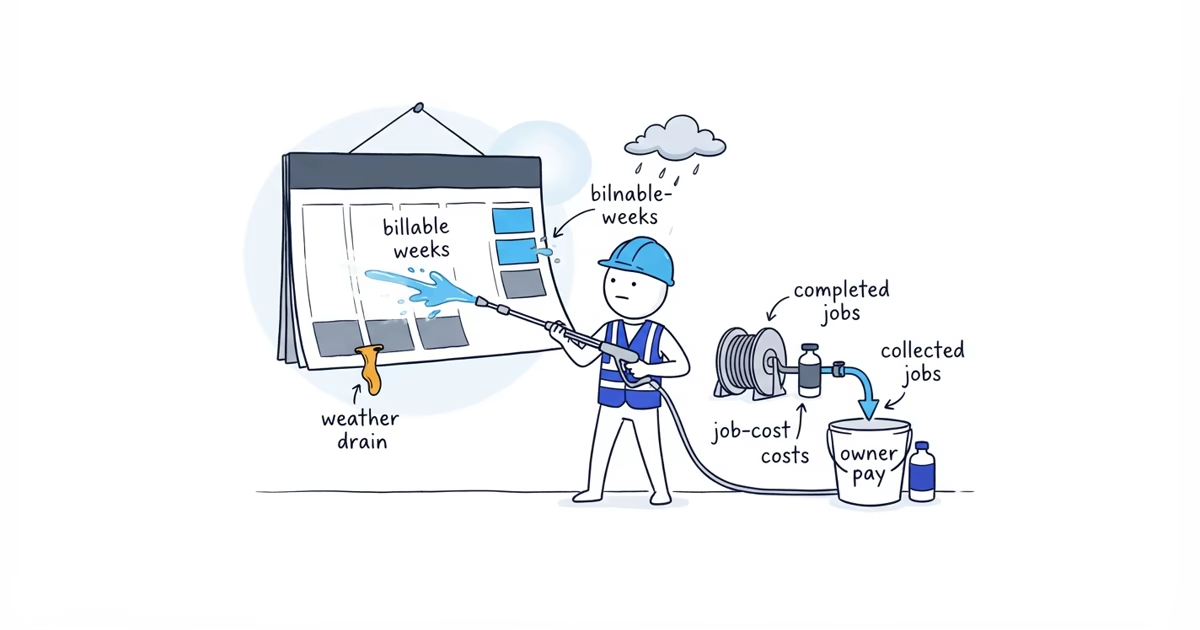
There is no reliable national average for pressure washing owner pay. In the established-solo model below, 342 completed jobs at a $375 collected average ticket produce $128,250 in annual collections, $60,352 in planned owner compensation, and $15,088 retained in the business.
The owner completes the field work and handles quoting, travel, maintenance, scheduling, collection, and admin in that example. The model uses 38 billable weeks, not 52. It is a planning illustration, not an industry benchmark.
A $350 job is not $350 of owner income.
Pressure washing revenue and owner pay
The fast calculation multiplies a quoted price by two or three jobs per day and a full calendar. It quietly assumes every job is completed, every invoice is collected, every week has enough workable days, and the business has no cost.
A quoted ticket is the customer price before cancellation, scope change, discount, or collection. The usable formula starts with work that actually happened and cash the business received:
Collected average ticket x completed jobs per week x billable weeks = collected revenue
| Capacity term | Meaning |
|---|---|
| Collected average ticket | Customer money received divided by the completed jobs represented by those collections |
| Completed jobs | Finished customer jobs, not estimates, bookings, or canceled appointments |
| Billable weeks | Weeks in which the modeled job pace is actually completed across the year |
Travel, setup, pack-down, quoting, maintenance, and an empty rain day can consume owner time without creating a second collected ticket. That time does not disappear because the business prices by the job rather than by the hour.
How jobs per week affect pressure washing owner income
The sensitivity table below uses the established-solo assumptions:
- $375 collected average ticket
- $55 direct cost per completed job
- $34,000 annual overhead and equipment-replacement allowance
- no paid helper or crew
- owner performs all field work
- cash before owner compensation and personal tax
The formula is:
Completed jobs x ($375 - $55) - $34,000 = cash before owner compensation
| Completed jobs per week | 30 billable weeks | 38 billable weeks | 44 billable weeks |
|---|---|---|---|
| 6 | $23,600 | $38,960 | $50,480 |
| 9 | $52,400 | $75,440 | $92,720 |
| 12 | $81,200 | $111,920 | $134,960 |
These outputs are cash before owner compensation, not owner salaries. The model still has to fund the owner’s allocation and any debt, cost, or reserve missing from the disclosed assumptions.
The table exposes the real question behind an annual projection: can the calendar support the selected number of completed and collected jobs for the selected number of weeks? Twelve jobs per week across 44 weeks is not the same business as six jobs per week across a 30-week season. A spreadsheet can multiply either row; only the job record can show which one fits.
Do not fill a winter or rain week with a peak-season average. Count the weeks that actually carried the modeled pace. If work continues year-round but slows materially, use separate seasonal rows rather than hiding the slowdown inside one annual average.
Pressure washing business owner income examples
The sensitivity table stops before owner pay. The next five terms carry the calculation through the business:
| Cash term | Meaning |
|---|---|
| Direct job cost | Cost that moves with completed work, such as fuel, chemicals, fees, water, and job wear |
| Overhead and reserve | Vehicle, trailer, insurance, equipment, marketing, software, admin, and planned reserve |
| Cash before owner compensation | Collections after paid labor, direct job cost, and overhead |
| Owner compensation | The selected share allocated to the owner’s field and ownership work before personal tax |
| Retained cash | Pre-owner cash left in the business after that allocation |
The examples are three operating shapes, not low, typical, and high earnings. Their figures are editorial assumptions to replace with business records.
The seasonal solo owner completes every job and handles all non-field work across a 30-week service year. The established solo owner also performs every job but carries nine completed jobs per week across 38 billable weeks. In owner plus a two-person crew, the owner is mostly responsible for sales, estimates, scheduling, collection, quality control, and field coverage while the paid crew performs most production. That model includes a mixed residential and small-commercial ticket, not an automatic soft-washing service mix.
| Annual input | Seasonal solo | Established solo | Owner + two-person crew |
|---|---|---|---|
| Collected average ticket | $325 | $375 | $425 |
| Completed jobs per week | 6 | 9 | 18 |
| Billable weeks | 30 | 38 | 40 |
| Completed jobs | 180 | 342 | 720 |
| Direct cost per completed job | $45 | $55 | $70 |
| Loaded non-owner payroll | $0 | $0 | $100,000 |
| Annual overhead and reserve | $22,000 | $34,000 | $55,000 |
| Share of pre-owner cash allocated | 80% | 80% | 70% |
The direct job-cost input combines modeled fuel, chemicals, water when supplied by the business, merchant fees, and a per-job maintenance or wear allowance. Annual overhead combines vehicle or trailer cost, insurance, equipment and replacement reserve, marketing, software, admin, and other fixed or period cost. Those combinations are for arithmetic clarity, not trade cost benchmarks.
| Annual model output | Seasonal solo | Established solo | Owner + two-person crew |
|---|---|---|---|
| Collected revenue | $58,500 | $128,250 | $306,000 |
| Direct job cost | -$8,100 | -$18,810 | -$50,400 |
| Loaded non-owner payroll | $0 | $0 | -$100,000 |
| Overhead and reserve | -$22,000 | -$34,000 | -$55,000 |
| Cash before owner pay | $28,400 | $75,440 | $100,600 |
| Planned owner compensation | -$22,720 | -$60,352 | -$70,420 |
| Retained cash | $5,680 | $15,088 | $30,180 |
The crew model collects more than twice the established-solo model, but planned owner compensation rises by only $10,068. Loaded payroll and the larger direct and overhead cost base use most of the additional cash. The model also retains 30% of pre-owner cash instead of 20% because the operation has paid labor and more operating exposure.
That does not prove a crew is worse or better. It shows the transition the owner has to fund. More production can increase collections while payroll, vehicles, equipment, management time, and schedule risk prevent the same increase from reaching the owner.
Personal tax, debt principal, owner benefits, depreciation treatment, and reserves beyond the stated line are outside the examples. Add any that apply before treating planned compensation as spendable cash.
How to calculate pressure washing job capacity
A pressure-washing calendar needs the whole block around a completed job: route gaps and travel, customer walk-through, access and protection, setup, cleaning, rinse and inspection, pack-down, loading, and the trip onward. Quoting, invoicing, payment follow-up, maintenance, and resupply also consume owner time outside the visit.
Two jobs with two hours of cleaning each do not automatically fit into four owner hours. If the surrounding work turns them into a full day, another advertised slot does not create capacity.
Weather and equipment downtime can remove a job, move it, or compress the rest of the week. Record cancellations, reschedules, lost service days, quoting time, and recovered work separately. Count a rescheduled job once, on the date it is completed, and track any unpaid balance separately.
Pressure washing job costs and overhead
The $55 direct-cost input in the established-solo model rises with completed jobs. At nine jobs per week across 38 weeks, 342 jobs create $18,810 of modeled direct cost. If the true cost is $70 per job, cash before owner compensation falls by $5,130 with every other assumption unchanged:
342 jobs x ($70 - $55) = $5,130
Annual overhead does not necessarily move in the same way. Insurance, a vehicle payment, software, storage, and core equipment cost can continue through a slow month. Marketing may be partly discretionary, while a replacement reserve is a deliberate decision rather than a current invoice.
Split the actual ledger into costs that change with jobs, costs that continue by month or year, paid labor, and planned reserves. Applying one margin percentage to every business hides which line is responsible when owner cash falls.
Equipment purchase deserves special care. A machine bought this year is a cash event, but its accounting treatment is not the same as an ordinary repair or chemical purchase. Keep major purchases and debt visible in the cash plan and use an accountant for depreciation and tax treatment. Do not erase replacement needs merely because the current equipment is already paid for.
If the collected ticket still has to be built from realistic billable hours, owner pay, overhead, and profit, use the solo-owner pricing guide to turn those inputs into a working rate before the ticket enters this model.
Residential vs. commercial pressure washing revenue
The established-solo model is a residential operating shape. The crew example permits a mixed residential and small-commercial collected ticket. It does not assume that every commercial job is larger, more profitable, or recurring.
For commercial work, keep contract frequency, crew hours, site requirements, access windows, equipment, invoicing, and collection timing on their own lines. A larger invoice may also carry more labor, travel, insurance, reporting, or equipment cost. Soft washing belongs in the model only when the business offers it and its collected tickets, service records, chemicals, equipment, and training are represented.
Why there is no average pressure washing owner salary
There is no clean national pressure-washing owner-income dataset in the reviewed public sources. The closest Census starting point is Other Services to Buildings and Dwellings, NAICS 561790, a category broader than pressure washing.
The 2023 Nonemployer Statistics extract reports 142,112 establishments without paid employees and $5.815 billion in aggregate receipts for that broad category. Dividing those figures produces about $40,915 in receipts per establishment.
That arithmetic is not a published median, a pressure-washing-only revenue figure, or owner income. The category includes other building and dwelling services, establishments can have different activity levels, and receipts are measured before expenses. It also excludes employer firms such as the paid-crew scenario.
The row is useful only as a warning against false precision. It cannot anchor a pressure-washing owner range. Completed jobs, collections, costs, owner role, and retained cash must supply the answer.
How to calculate pressure washing owner compensation
Use one trailing-12-month period and make the job calendar, deposits, payroll, and expenses reconcile.
- Mark booked jobs as canceled, rescheduled, completed, callback, or unpaid, then match deposits to the completed jobs that produced them.
- Count completed jobs by week and identify the weeks that actually carried each pace, including weather loss, equipment downtime, and recovered work.
- Separate fuel, chemicals, supplied water, merchant fees, wear, and repairs that move with jobs from vehicle or trailer, insurance, equipment reserve, marketing, software, admin, storage, and other annual overhead.
- Pull every paid crew hour and loaded labor cost, including travel, setup, pack-down, maintenance, and paid gaps.
- Subtract direct cost, payroll, and overhead from collections, set the retained-cash requirement, and only then allocate compensation for the owner’s field and ownership work.
Reconcile completed, collected jobs and the full cost stack for one trailing year. An average ticket cannot answer the owner-pay question by itself.
Frequently asked questions
How profitable is a pressure washing business?
The reviewed public sources do not provide a representative national profit benchmark. Calculate the result from completed and collected jobs, direct costs, payroll, overhead, owner compensation, and retained cash rather than an advertised ticket or industry margin claim.
How many pressure washing jobs can one person complete per day?
There is no universal jobs-per-day number in the reviewed sources. Count the full block from travel and setup through cleaning, pack-down, invoicing, maintenance, and the trip onward, then use completed-job records to set a defensible pace.
Should a pressure washing business project revenue across 52 weeks?
Only if the records show the selected completed-job pace for all 52 weeks. Otherwise, use the number of billable weeks that actually carried that pace or model slow and peak seasons separately.
Sources
- pressure-washing
- business-owner-earnings
- owner-compensation
- job-capacity
- business-revenue