
How Much Does a Roofer Make?
How much does a roofer make? See May 2025 hourly and annual wages, salary percentiles, state medians, realistic paid hours, overtime, and benefits nationwide.
The median wage for US roofers was $26.65 per hour, or $55,440 per year, in May 2025. That works out to about $1,066 per week or $4,620 per month when the annual figure is divided evenly across the year.
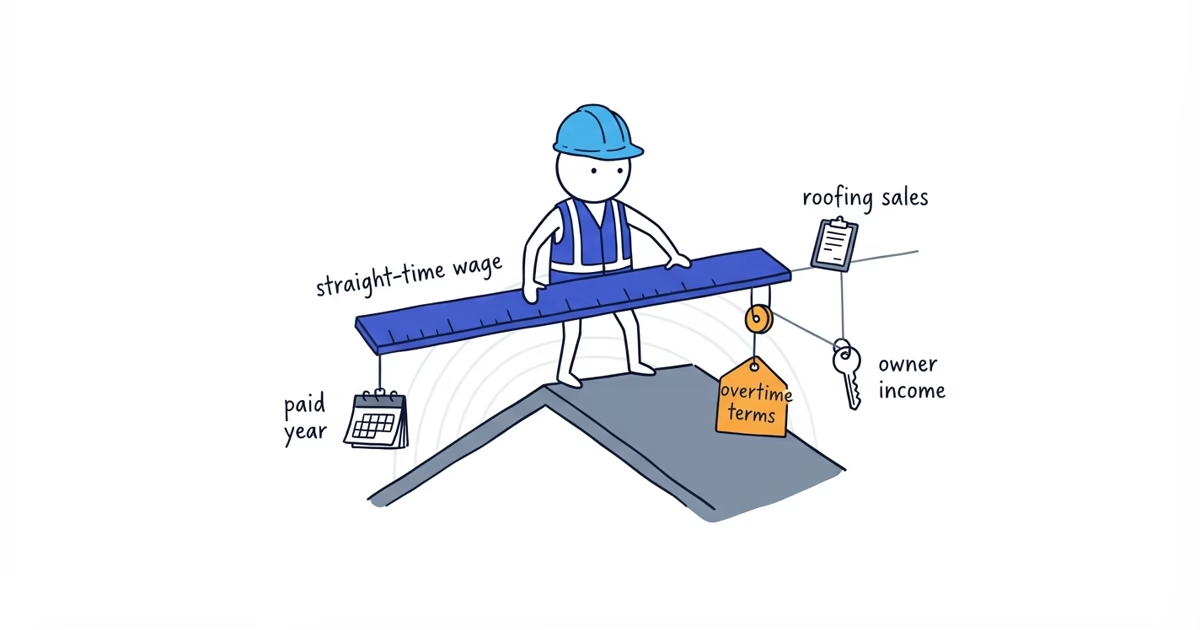
Those figures are for Roofers (SOC 47-2181) working in wage-and-salary jobs. They cover workers who install and repair roofs, not roofing sales representatives, self-employed contractors, or company owners. If you own the company, use the roofing business owner earnings guide to model contract collections, job costs, owner compensation, and retained cash instead of treating an employee wage as owner income.
Roofer hourly pay and wage percentiles
The May 2025 federal estimate covered 135,490 employed roofers. The median sits in the middle of this distribution:
| Percentile | Hourly wage | Annual wage | What the percentile means |
|---|---|---|---|
| 10th | $18.01 | $37,460 | 10% earned this amount or less |
| 25th | $22.24 | $46,260 | 25% earned this amount or less |
| 50th | $26.65 | $55,440 | The median: half earned less and half earned more |
| 75th | $31.44 | $65,390 | 25% earned this amount or more |
| 90th | $39.29 | $81,720 | 10% earned this amount or more |
The middle half of roofer wages ran from $22.24 to $31.44 per hour. These percentiles describe workers in the survey; they are not official apprentice, journey-level, lead, foreman, or master-roofer rates. The data do not reveal the experience, credential, union status, employer, or duties of every worker at each point.
The weekly and monthly amounts above are conversions of the annual median, not guaranteed pay periods. A roofer’s actual year depends on the paid schedule as well as the hourly rate, which is why the offer test below keeps those two questions separate.
How to compare a roofer job offer
A good roofer offer has two layers. The first is the base-wage comparison: put the offered rate beside the $26.65 national median and the median for the state. The second is the paid-year comparison: ask how many hours and weeks are realistic, then add compensation outside straight-time wages.
Consider two hypothetical schedules:
| Offer | Base wage | Expected paid schedule | Straight-time base for that schedule |
|---|---|---|---|
| Lower rate with a steadier schedule | $28.00 | 40 hours x 50 weeks | $56,000 |
| Higher rate with more interrupted work | $31.00 | 34 hours x 44 weeks | $46,376 |
These are illustrations, not a prediction of either schedule. They show the question the annual median cannot answer for a specific job: how much paid work will actually be available?
Roofers work outdoors, and weather can delay or interrupt production. In some locations, work can also be seasonal; busy periods may bring overtime while slower periods reduce hours. Do not apply a made-up national weather discount to the hourly wage. Ask the employer what happened to paid hours on comparable crews during the last full year.
Then ask how the company handles:
- Overtime eligibility and the hours that typically trigger it
- Travel between the yard and job sites, overnight work, and per-diem payments
- Weather delays, cancellations, seasonal gaps, and guaranteed hours
- Bonuses, paid time off, health coverage, retirement contributions, and other benefits
- Tool, clothing, transport, and training costs the worker is expected to carry
Keep each answer on its own line. A per diem is not a base-wage increase, an overtime opportunity is not guaranteed straight-time pay, and an employer benefit is not cash in the weekly check.
Roofer pay versus roofing sales and owner income
SOC 47-2181 covers workers who install or repair roofs using materials such as shingles, slate, asphalt, aluminum, wood, or related materials. O*NET tasks include inspecting roof surfaces, removing old material, measuring and cutting new material, installing flashing, sealing seams, and repairing leaks.
That is not the same as selling roofing contracts for commission. It is also not the same as owning the company that collects contract revenue and pays for materials, production, leads, insurance, vehicles, callbacks, and overhead. Putting sales commission or owner distributions into the roofer wage table would make the median less useful, not more complete.
The wage survey also excludes self-employed workers and owners or partners of unincorporated firms. Its wage definition is straight-time gross pay. Overtime premiums, shift differentials, nonproduction bonuses, severance, employer benefit costs, and tuition reimbursement are outside that measure.
Roofer training, apprenticeships, and pay
The BLS says roofers typically learn on the job, and some enter through apprenticeship programs. The occupation usually does not require a formal educational credential for entry. Those are broad occupation patterns, not a reason to assign an applicant to a specific wage percentile.
For an actual offer, compare the duties in the posting, the training arrangement, and who pays for required instruction or equipment. If the role is primarily sales, production supervision, or business ownership, stop and use the matching compensation comparison instead.
Roofer salary by state
Illinois had the highest published state median at $77,900 per year, followed by New Jersey at $76,600 and Minnesota at $74,490. All 51 rows use the same May 2025 occupation and 50th-percentile measure.
| Rank | State or district | Median annual | Median hourly |
|---|---|---|---|
| 1 | Illinois | $77,900 | $37.45 |
| 2 | New Jersey | $76,600 | $36.83 |
| 3 | Minnesota | $74,490 | $35.81 |
| 4 | Massachusetts | $72,750 | $34.98 |
| 5 | Alaska | $66,750 | $32.09 |
| 6 | New York | $66,020 | $31.74 |
| 7 | California | $63,600 | $30.58 |
| 8 | Connecticut | $62,070 | $29.84 |
| 9 | District of Columbia | $61,750 | $29.69 |
| 10 | Rhode Island | $61,630 | $29.63 |
| 11 | Washington | $60,640 | $29.16 |
| 12 | Maryland | $60,090 | $28.89 |
| 13 | New Hampshire | $59,830 | $28.76 |
| 14 | North Dakota | $59,740 | $28.72 |
| 15 | Hawaii | $59,580 | $28.64 |
| 16 | Michigan | $59,530 | $28.62 |
| 17 | Delaware | $59,440 | $28.58 |
| 18 | Wisconsin | $59,370 | $28.54 |
| 19 | Vermont | $59,040 | $28.39 |
| 20 | Montana | $59,030 | $28.38 |
| 21 | Oregon | $58,970 | $28.35 |
| 22 | Indiana | $57,980 | $27.88 |
| 23 | Idaho | $57,790 | $27.78 |
| 24 | Pennsylvania | $55,710 | $26.79 |
| 25 | Colorado | $51,750 | $24.88 |
| 26 | West Virginia | $51,170 | $24.60 |
| 27 | Nevada | $51,090 | $24.56 |
| 28 | Maine | $50,120 | $24.10 |
| 29 | Ohio | $49,390 | $23.74 |
| 30 | North Carolina | $49,010 | $23.56 |
| 31 | Louisiana | $48,760 | $23.44 |
| 32 | Utah | $48,680 | $23.40 |
| 33 | Iowa | $48,660 | $23.39 |
| 34 | Missouri | $48,570 | $23.35 |
| 35 | Virginia | $48,420 | $23.28 |
| 36 | South Dakota | $47,710 | $22.94 |
| 37 | Florida | $47,590 | $22.88 |
| 38 | Arkansas | $47,470 | $22.82 |
| 39 | Arizona | $47,340 | $22.76 |
| 40 | Kansas | $47,190 | $22.69 |
| 41 | Georgia | $46,940 | $22.57 |
| 42 | Kentucky | $46,940 | $22.57 |
| 43 | Nebraska | $46,460 | $22.34 |
| 44 | Texas | $46,030 | $22.13 |
| 45 | South Carolina | $45,760 | $22.00 |
| 46 | Tennessee | $45,690 | $21.97 |
| 47 | Alabama | $45,670 | $21.96 |
| 48 | Wyoming | $45,650 | $21.95 |
| 49 | New Mexico | $45,300 | $21.78 |
| 50 | Mississippi | $44,940 | $21.61 |
| 51 | Oklahoma | $43,680 | $21.00 |
The ranking does not adjust for cost of living, union coverage, weather, benefits, job mix, or travel. It also does not prove why one state pays more than another. Use it to locate the employee median, not to explain the market from one number.
The final rule is: match the occupation, compare the base rate with the national and state medians, build a realistic paid year, and value overtime, travel payments, and benefits separately. That produces a much better decision than choosing the largest hourly number on the page.
Frequently asked questions
Are self-employed roofers included in roofer salary data?
No. OEWS wage data cover wage-and-salary employees and exclude self-employed workers and owners or partners of unincorporated businesses. Owner earnings have to be calculated from collected contracts, job costs, overhead, owner compensation, and retained cash.
How much do roofing salespeople make?
SOC 47-2181 covers workers who install and repair roofs, not roofing sales representatives. Sales compensation may include commissions and needs its own role-specific data; it should not be compared with the roofer wage percentiles in this guide.
Sources
- roofing
- roofer-salary
- hourly-pay
- salary-by-state
- employee-wages