

Should I Include Options in a Quote?
Learn when to include options in a quote, how many choices to show, and how to compare scope and price with an honest Good, Better, Best recommendation.
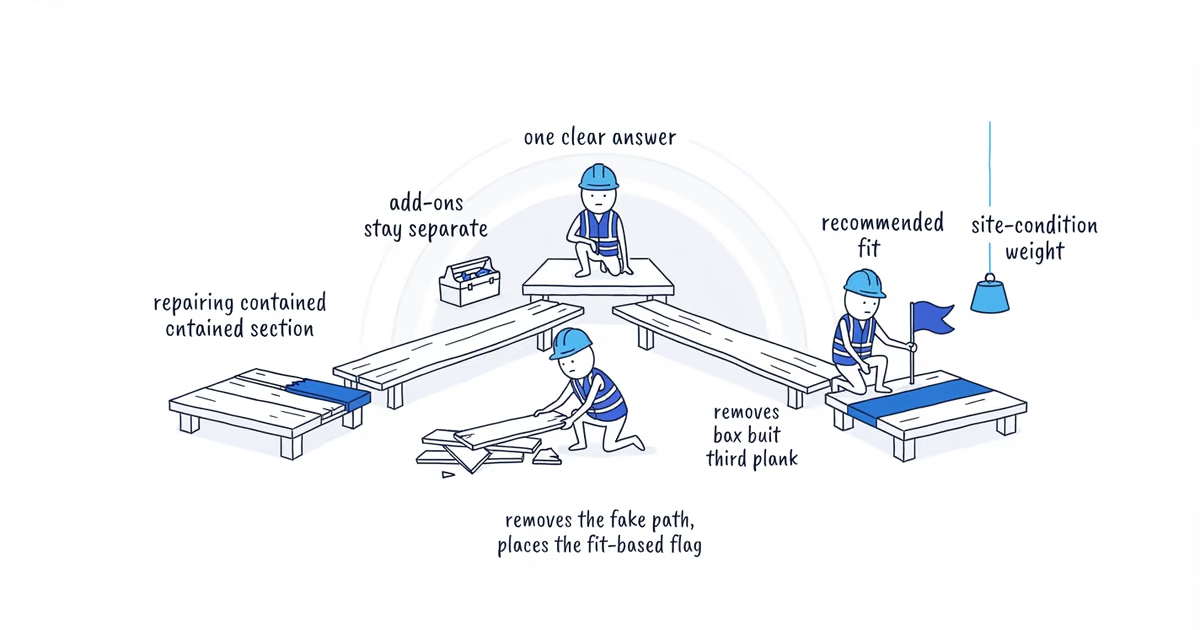
Yes, include options in a quote when the customer has a genuine choice between scopes, materials, service levels, or outcomes you can responsibly deliver. Use one recommendation when only one solution fits or the customer has already chosen the scope.
One real fork needs two options; three distinct outcomes may need three. If you must weaken the first option or invent an upgrade to fill a column, send one recommendation.
When to give one, two, or three quote options
| Situation | Quote structure |
|---|---|
| One responsible solution fits the site, safety need, required standard, or equipment | One recommendation |
| The customer has already defined the material, finish, and scope | One recommendation |
| An urgent repair needs one clear action, not a package discussion | One recommendation |
| One meaningful fork exists, such as repair versus replacement | Two options |
| The customer is unsure and three complete outcomes differ in scope, material, or service | Three options |
| Differences are trivial, fake, or difficult to explain | One recommendation |
| The core job is clear but several extras can attach to it | One core option plus separate add-ons |
Three is a readability cap, not a proven conversion optimum. Choice-overload research does not establish one option count for every decision; complexity, task difficulty, and customer certainty matter. For many selections and extras, quote the recommended core scope and use a separate short list instead of packaging every combination.
When Good, Better, and Best pricing works
Good, Better, and Best works only when three complete results form a clear progression. Good must remain safe, adequate, profitable, and work you will stand behind. Higher levels can add scope, a different material or finish, longer service life, or convenience.
Do not strip necessary prep, cleanup, or a required component from Good and add it back to Better. That is an intentionally weak quote.
Prefer names such as Repair / Replace or Wash / Wash and Seal. If you use Good, Better, and Best, add the work name beside each label.
How to present multiple options in a quote
The Federal Trade Commission says a written estimate should identify the work, materials, completion date, and price. Options should clarify those details, not weaken them.
Use the same rows in the same order for every choice:
| Comparison row | Option A | Option B | Option C |
|---|---|---|---|
| Name and intended result | [Result this option delivers] | [Result this option delivers] | [Result this option delivers] |
| Included scope | [Work included] | [Work included] | [Work included] |
| Excluded or unchanged | [What remains outside scope] | [What remains outside scope] | [What remains outside scope] |
| Material, equipment, or finish | [Meaningful specification] | [Meaningful specification] | [Meaningful specification] |
| Timing, only when it differs | [Expected timing] | [Expected timing] | [Expected timing] |
| Total price for that exact scope | $[price] | $[price] | $[price] |
| Customer selection | [ ] Select Option A | [ ] Select Option B | [ ] Select Option C |
Keep each price beside its scope. Do not put three prices above buried descriptions, and give every column the same level of detail.
Mark one choice Recommended when site findings or the customer’s priority support it:
Recommended because [job condition or customer priority] makes this the best fit for this job.
Recommend the option you would defend if the customer asked, “Why this one for my job?” It need not be the highest price.
Options are alternative paths to the main result. An add-on can attach to several paths, so keep it outside the comparison and show its price once.
Once the customer selects a path, use our contractor estimate generator to carry the chosen scope, allowances, optional work, exclusions, and total into a customer-ready PDF.
Example of three options in a contractor quote
This example uses invented scope and prices. It is not a market price guide.
A 60-foot side fence has a damaged 24-foot section and two failed posts. The customer wants the leaning section fixed and expects to stay in the property for several years.
| Comparison row | Repair damaged section | Replace damaged section Recommended | Replace full fence side |
|---|---|---|---|
| Intended result | Stabilize the existing damaged section | Renew the failed 24-foot section | Renew the complete 60-foot fence side |
| Included scope | Reset two posts and refasten panels | Remove and replace two posts and four panels | Remove and replace all posts and panels |
| Excluded or unchanged | Existing panels and rest of fence stay | Sound 36-foot section stays | Gate and adjoining fence stay |
| Material or finish | Reuse serviceable panels; new fasteners | New treated posts and matching wood panels | New treated posts and matching panels |
| Expected timing | One workday | Two workdays | Three workdays |
| Illustrative total price | $1,450 | $2,850 | $6,900 |
| Customer selection | [ ] Select repair | [ ] Select section replacement | [ ] Select full replacement |
The copy-ready recommendation is:
Recommended because the two failed posts are inside one contained section, and you want a longer-lasting repair without replacing the sound remainder of the fence.
The middle choice matches the site and customer priority; its position between two prices is irrelevant. Each option states a different, honest result.
How to check quote options before sending
- Every option solves a need stated in the quote.
- You can explain the difference between choices in one sentence.
- The included scope, important exclusion, specification, timing difference, and total price are visible together.
- Each option is complete and responsible for the result it promises.
- The low option is not an inadequate decoy.
- The Recommended note names a job condition or customer priority, not your preferred sale amount.
- Independent add-ons sit outside the package comparison.
- The customer can clearly select one option.
If those checks fail, reduce the choices. One clear recommendation beats three columns the customer must decode.
Frequently Asked Questions
Should every quote have a Recommended option?
No. Mark one option Recommended only when site conditions or a stated customer priority make it the clearest fit. If the customer has already selected the scope or two alternatives are equally responsible, do not manufacture a preference.
What if a customer asks for more than three quote options?
Ask which decision is still unresolved, then narrow the main comparison to the options that answer it. Put independent colors, fixtures, or add-ons in a separate selection list; if the customer changes the main result they want, issue a new focused comparison.
Should warranty differences appear in quote options?
Yes, when the coverage genuinely changes between choices. Give every option the same warranty row and state the actual difference; do not use vague phrases such as “better warranty” as a substitute for the applicable terms.
Sources
- pricing
- should-i-include-options-in-quote
- should-i-include-options-in-a-quote
- good-better-best-pricing
- how-to-present-multiple-options-to-a-customer
- quote-options-template
- recommended-option-in-a-quote



