
Should You Put Prices on Your Contractor Website?
Decide whether to put prices on your contractor website and choose a fixed price, range, diagnostic fee, or project minimum customers can clearly understand.

Yes. Publish the most specific price information you can stand behind. That does not always mean one fixed number.
| How the service is priced | What to publish |
|---|---|
| Fixed price or package | Exact price, included scope, exclusions, and add-ons |
| Range with assumptions | Typical range, the conditions behind it, and what changes the total |
| Diagnosis required | Diagnostic or service-call fee, whether it is credited, price factors, and the approval point |
| Large custom project | Minimum project size, a real project range with scope, and the quote process |
Choose the row that matches how the business already estimates the service. Do not force variable work into a fixed price, and do not hide a known fee behind “contact us for pricing.”
What Pricing Information to Gather Before Publishing
Choose one service and write down:
- the approved price, range, service-call fee, or minimum;
- what that figure includes;
- what it excludes or requires separate approval;
- the variables that materially change the total;
- when and how the customer receives the final price;
- who will review the website when prices change.
Include unavoidable taxes, travel, materials, disposal, emergency, or after-hours terms where they apply. If the business does not have an approved number or a consistent estimating rule, stop. A paragraph on the website cannot repair an inconsistent pricing process.
If uncertain scope is the reason no number has been approved, use the unknown-job pricing guide to choose a diagnostic fee, capped time-and-materials price, quoted range, or paid discovery step before writing the website block.

How to Show a Fixed Service Price on Your Website
A fixed price works when the scope is repeatable and the exceptions can be stated clearly.
[Service or package]: [price]
Includes [scope].
Does not include [main exclusions].
[Add-ons or out-of-scope work] are priced [how and when].
Fictional cleaning example:
Standard two-bedroom recurring clean: $145 per visit. The price covers up to two bedrooms, two bathrooms, the kitchen, and shared living areas on a biweekly schedule. First visits, heavy buildup, inside appliances, and interior windows are quoted separately before the appointment is confirmed.
The $145 is a teaching number, not a market benchmark. A real business should publish its own approved package and make sure an ordinary qualifying customer can actually buy it at that price.
How to Show a Service Price Range on Your Website
A range works when the business can identify the few inputs that move most jobs up or down.
Most [service] projects cost [range] when [qualifying assumptions].
The final price changes with [variables].
We confirm [when and how] before work begins.
Fictional landscaping example:
Most seasonal yard cleanups cost $350–$750 for residential properties up to a half acre with normal truck access. The final price changes with property size, debris volume, hauling, access, and any tree or irrigation work. We confirm the written estimate after seeing the property and before scheduling the cleanup.
The range is useful because it includes the assumption. Publishing $350–$750 without property size or scope would invite customers to compare unlike jobs.
How to List a Diagnostic or Service-Call Fee
For repair work, the business often cannot know the final total before inspecting the problem. It can still publish what the customer pays to start and explain how the next price is approved.
[Diagnostic or service-call fee].
[Say whether it is credited, only if true.]
The final price depends on [unknown variables].
We confirm the price [approval point].
Northside Plumbing uses these declared fictional facts for the teaching example:
- an $89 residential service-call and diagnostic fee;
- the $89 is credited toward drain-clearing work approved during the same visit;
- price changes with access, blockage location, affected fixtures, equipment, and camera inspection;
- additional work begins only after the price is confirmed.
The publishable block is:
Residential drain calls begin with an $89 service-call and diagnostic fee. We credit the $89 toward drain-clearing work you approve during the same visit. The final price depends on access, blockage location, affected fixtures, required equipment, and whether camera inspection is needed. We confirm the price before additional work begins.
That tells the customer what is knowable now and what requires diagnosis. It does not pretend every blocked drain costs the same.
How to Show a Project Minimum and Price Range
Large roofing, landscaping, remodeling, and installation projects may be designed or scoped individually. “Free quote” alone still leaves the customer unable to judge whether the business fits the project.
Projects begin at [minimum] for [minimum qualifying scope].
Recent [project type] work has ranged from [low] to [high] for [scope assumptions].
After [site visit, design, or measurement], you receive [quote format and timing].
Fictional roofing example:
Full residential roof replacements begin at $12,000 for straightforward single-story homes using the stated shingle system. Recent fictional example projects ranged from $12,000 to $28,000 depending on roof size, pitch, access, decking repairs, ventilation, and material. After the inspection and measurements, the customer receives a written scope and price before choosing whether to proceed.
Again, those numbers are teaching inputs. A real range should come from the business’s completed jobs and explain which projects produced it.
What Pricing Information Should You Avoid?
Do not publish:
- “Prices vary.” Name what causes the variation.
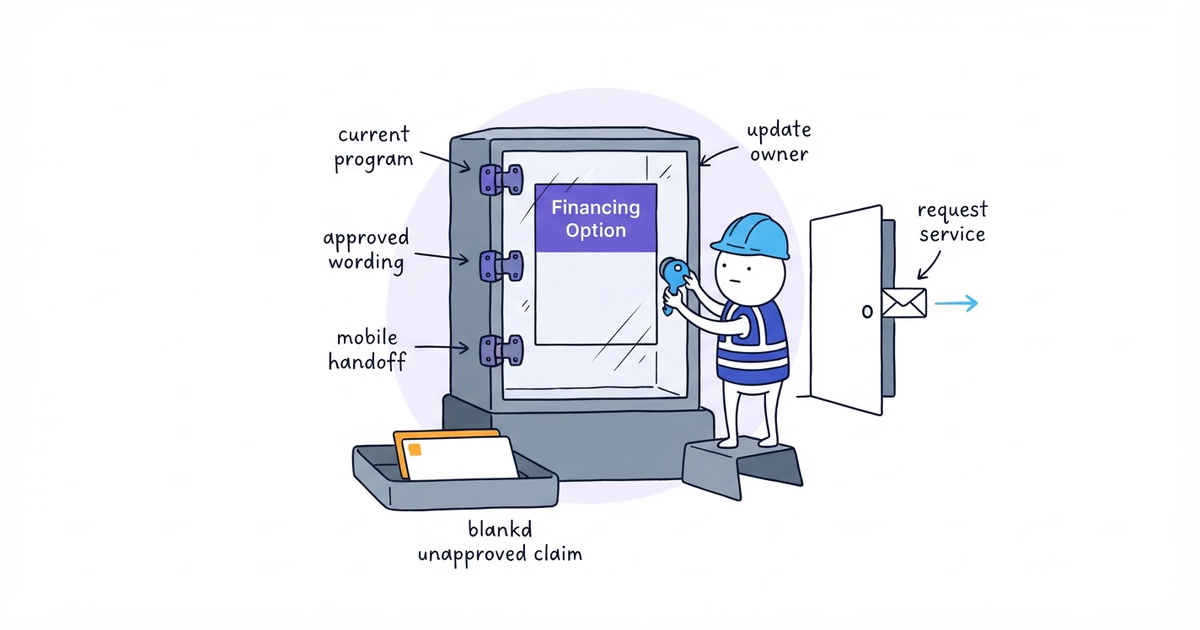
- “Contact us for pricing.” If a fee, minimum, range, or decision process exists, disclose it.
- “Starting at $99” when almost no ordinary job qualifies for $99.
- a range copied from a competitor or industry article;
- a price that leaves out unavoidable charges without saying so;
- “Free estimate” for a visit that actually carries a diagnostic or service-call fee;
- an old number with no one assigned to update it.
A starting price is defensible only when the business can describe the scope available at that price and sell it regularly. Otherwise, publish the diagnostic fee, a realistic range, or a minimum instead.
Where to Put Prices on a Contractor Website
Start on the relevant service page. A drain-clearing price belongs beside the drain scope and process. A recurring-clean package belongs beside its checklist and frequency rules.
To place that disclosure inside the rest of the customer decision, use the contractor service-page guide to organize the scope, process, proof, price, and next action around it.
A separate pricing page becomes useful when the business has several maintained packages, fees, or project ranges that customers genuinely need to compare. Do not create one to hold a single paragraph that would be clearer on the service page.
Add an internal review date and owner, for example:
Pricing reviewed: August 2026
Next review: November 2026
Owner: Service manager
That maintenance note does not need to appear publicly. It prevents the website from quoting last year’s fee after invoices have changed.
Contractor Website Pricing Checklist
Answer yes or no:
- Does the block match the way this service is actually priced?
- Does it contain a real price, range, fee, or minimum?
- Does it state the main inclusion, assumption, or starting scope?
- Does it name the variables or exclusions that change the total?
- Does the customer know when the final price is confirmed?
- Can an ordinary qualifying customer realistically receive the advertised figure?
- Is someone responsible for keeping it current?
Stop when one honest block answers those questions. Do not create a pricing page or add more examples unless customers need them and the business can maintain them.
Frequently Asked Questions About Contractor Website Pricing
What if competitors see the prices on my website?
They will see the same public information as customers. Do not let that concern force every customer to contact you for a fee, range, or minimum you can already explain accurately. Publish only the amount and scope you can stand behind; keep internal costs, margins, and estimating rules private.
What if contractor prices change often?
Use the pricing model that can stay accurate: a range with assumptions, a current diagnostic fee, or a project minimum may be safer than an exact total. Assign an owner and review date, and update or remove a number as soon as the business can no longer honor it for an ordinary qualifying customer.
Does putting prices on a website improve SEO?
Do not publish prices as a ranking tactic. Publish them when they help a customer decide whether the service fits and what happens before the final amount is known. The price still needs accurate scope, variables, and maintenance whether search engines see it or not.
- contractor-website
- website-pricing
- service-call-fee
- service-pages
- contractor