What Is Review Gating, and How Do I Avoid It?
Learn what review gating is, why asking only happy customers breaks Google policy, and how to replace sentiment filtering with one neutral review workflow.
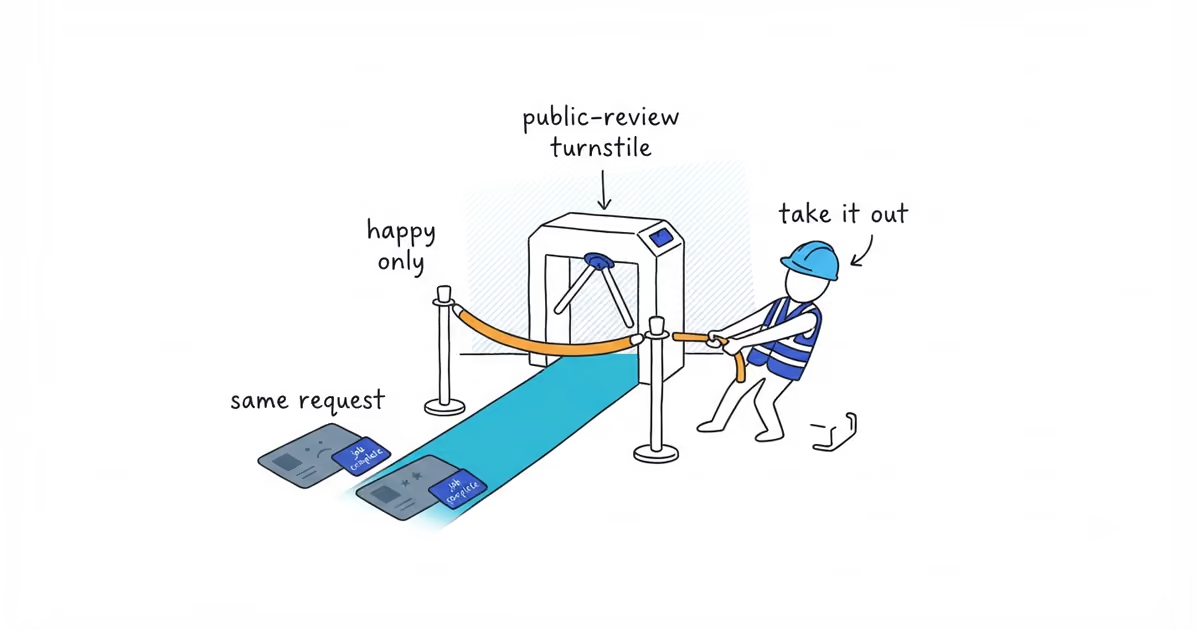
Review gating means deciding who reaches a public review request based on what you expect that person to say. Asking only happy customers is review gating. So is collecting a private score first and sending only the high scores to Google.
Google prohibits discouraging negative reviews and selectively soliciting positive ones. The fix is one neutral eligibility rule, not a friendlier satisfaction question.
Last verified: August 10, 2026 (United States).
What does a review-gating workflow look like?
This is the common gated workflow:
Job ends
   |
Ask "How did we do?"
   |
   +-- Positive answer --> Google review request
   |
   +-- Negative answer --> Private feedback only
The corrected version looks different:
Job reaches the same documented completion trigger
   |
Is there an unresolved service problem?
   |
   +-- Yes --> Resolve it, then return to the same rule
   |
   +-- No --> Send the same neutral review request
                  |
                  +-- Stop after review, opt-out, or final touch
The second flow does not promise positive reviews. It makes expected sentiment irrelevant to who can reach the public review link.
Where can review gating happen?
| Where to look | Fails | Passes |
|---|---|---|
| Recipient list | A technician chooses only customers who seemed pleased | Every customer who reaches the written completion trigger is eligible |
| Request wording | ”If we earned five stars, would you review us?" | "Would you leave a Google review about your experience?” |
| Feedback form | Four- and five-star answers open Google; lower scores open a private form | Private feedback does not control whether the public review request is available |
| Automation | A positive tag starts the review sequence | The documented job event starts it, regardless of predicted sentiment |
The request can sound polite and still be gated. “If you were happy with the work” fails for the same reason as a five-star filter: it tells a dissatisfied customer that the public review path is not for them.
Are private feedback surveys review gating?
A private feedback form is useful. A cleaner needs to hear about a missed room, and a plumber needs to know that the leak returned. The form becomes a gate only when the answer decides who gets the public-review opportunity.
Run two separate processes:
- Service recovery collects and resolves customer problems.
- Review requests use the same neutral eligibility rule for everyone.
Do not connect them with “positive goes public, negative stays private.” A different label or nicer design does not change the routing.
Can an unresolved complaint pause a review request?
Do not send an ordinary marketing message while a real complaint is being worked. Fix the job first.
Once the complaint is resolved, put the customer back under the same rule as everyone else. Define “resolved” in operational terms: a completed callback, corrected invoice, installed replacement part, or documented agreement with the customer.
Without a real completion point, a likely negative review can stay “paused” forever. At that point, the pause has become the gate.
How to fix review gating
- Map one completed job through every message, form, score, tag, redirect, and platform button.
- Find each decision based on happy, satisfied, excellent, five stars, promoter, or positive.
- Remove the branch that keeps unfavorable answers away from the public destination.
- Choose a real business event as the neutral trigger, such as a signed-off repair or recurring-service milestone.
- Ask for a genuine review without requesting a rating or specific content.
- Stop after a review, opt-out, or documented final request.
- Test one smooth job and one recovered complaint. Both should return to the same rule when the work is complete.
Open the actual automation and test every answer. A setting called “feedback” or “reputation” can still hide a gated redirect.
How to audit a review request for gating
Choose a recent customer who was not obviously delighted. Would that person appear on the recipient list, receive the same wording, and reach the same public destination? If there was a complaint, what completed event puts the customer back into the process?
Then inspect whether a private score changes any of those answers. If expected sentiment changes the route, remove that decision before the next request goes out.
Once the sentiment branch is gone, the review request rules check the other parts of the process, including incentives, platform destination, contact permission, and stop handling.
Frequently asked questions
Is review gating illegal?
Review gating is not a separate statutory term in the FTC Consumer Review Rule. Google prohibits discouraging negative reviews and selectively soliciting positive ones, and FTC staff says selective solicitation may violate the broader FTC Act depending on how it is used.
Can review management software create review gating?
Yes. A survey, thumbs-up screen, sentiment score, or positive tag creates review gating when it sends favorable customers to a public review page and keeps the others private. The vendor’s label for the feature does not change the route.
Sources
- review-gating
- google-reviews
- review-requests
- review-compliance
- home-services