What Are the Rules for Asking Customers for Reviews?
Use one neutral process to ask real customers for reviews without incentives, review gating, prohibited destinations, or broken contact and stop handling.
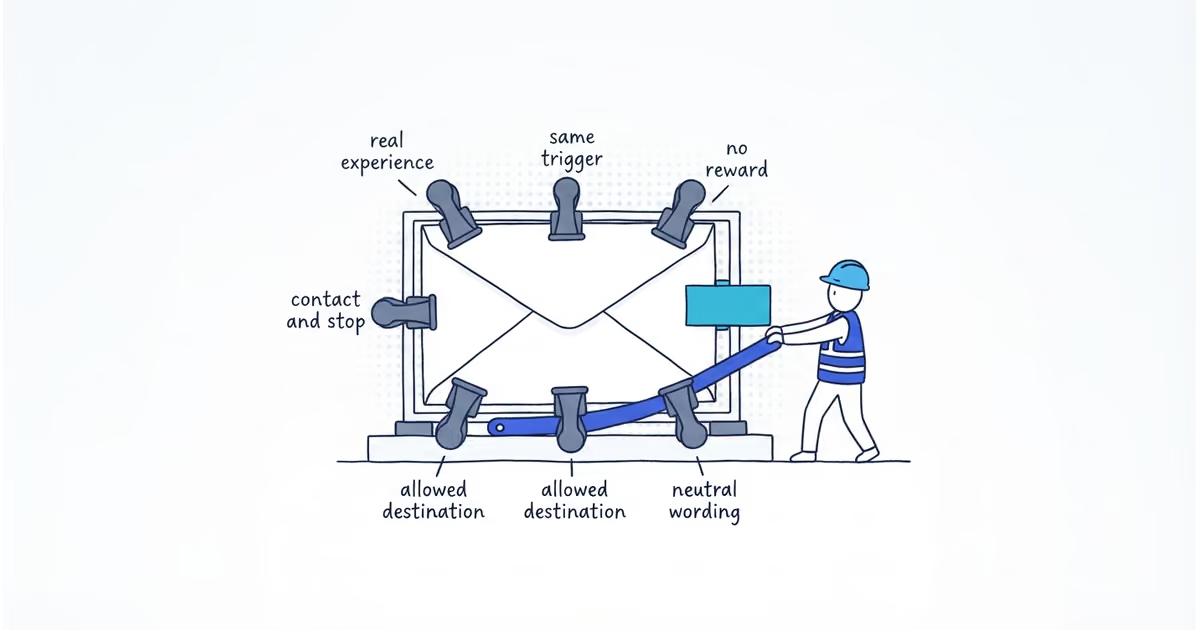
Ask real customers through one neutral process. Offer nothing for the review, do not steer the rating or wording, do not filter people by how positive you expect them to be, and confirm that the destination platform allows businesses to ask.
Google permits neutral requests for genuine reviews. Yelp tells businesses not to ask for Yelp reviews.
Last verified: August 10, 2026 (United States).
Review request compliance checklist
| Check | It passes when | It fails when | Owner action |
|---|---|---|---|
| Genuine experience | The person actually dealt with the business | A team member, relative, vendor, or invented customer is presented as independent | Confirm the customer and the experience |
| Neutral trigger | The same documented job event makes each eligible customer ready | A private score, a crew member’s prediction, or the customer’s mood decides who gets asked | Write down one eligibility rule and use it consistently |
| No incentive | The customer receives nothing for posting, changing, or removing a review | Cash, a discount, gift card, free work, credit, or a prize entry depends on the review | Separate the offer from the review request |
| Neutral wording | The request asks for a genuine review without steering the answer | It asks for five stars or tells the customer what service, city, result, or team member to mention | Remove the requested rating and content |
| Permitted destination | The platform allows the business to make the request | One generic campaign sends customers to Yelp or another platform that prohibits solicitation | Check the destination’s current rule |
| Permitted contact | The business may use the channel, identifies itself, and stops when required | The sender is unclear, an opt-out is ignored, or messages continue after the customer reviewed | Confirm permission, identity, and stop handling |
| Live workflow | A test record passes every check in the actual automation | A vendor says “compliant” but cannot show its recipient rule, branches, destination, permissions, or log | Test one customer from trigger through export |
A request is ready only when the first six rows pass. Better wording does not rescue a bad recipient list.
Who should receive a review request?
A genuine experience need not be a completed, paid job. A customer can review an estimate visit they received. A cleaner might use a recurring-service milestone; a plumber might use completion of the repair.
Pick the event that fits the service, write it down, and apply it consistently. These are not neutral triggers:
- Send only when the technician marks the customer as happy.
- Ask only customers who gave private feedback of four or five stars.
- Use “If we earned five stars, would you review us?”
- Remove someone from the list because the business fears what they might write.
Pause ordinary marketing contact while a real complaint is being fixed. Once it is resolved, return the customer to the same rule as everyone else. “Unhappy” cannot become a permanent exclusion.
What should a review request say?
Google allows requests for reviews that represent genuine experiences, without an incentive or an attempt to influence the rating or content. It also prohibits pressure to review on the premises and requests for specific content, including prompts that ask customers to name a team member.
One neutral message is enough:
Hi Dana - Miguel from Northside Plumbing. Thanks for having us out to replace the kitchen faucet today. Would you leave us a Google review? [link]
The job detail identifies the visit without telling Dana what to write. If the neutral line needs to fit different job types, the Google review request templates provide wording for service calls, installs, estimates, and recurring work.
Once the first ask is ready, the review reminder schedule gives the follow-up timing and a hard stop rule.
Do not turn review collection into a crew quota or contest. Give the team one completion rule, not a target that encourages pressure or prompts asking customers to name an employee.
Can you ask for reviews on Google and Yelp?
Google lets a business share a review link or QR code when the request passes the checks above.
Yelp says businesses should not ask anyone for reviews, including customers, mailing-list subscribers, friends, and family. Leave Yelp out of post-job texts, emails, and “choose where to review us” pages. A second platform button does not stop the page from being a request.
Use the dedicated guides when a check fails because of review gating, an incentive, an employee or family relationship, or possible illegal review conduct. Those issues need more than a rewritten sentence.
When should review requests and follow-ups stop?
Use only a customer channel the business is permitted to use. Identify the person and business before the customer has to guess who sent the message.
Then confirm that the workflow stops after a review, after an opt-out, and after the documented final request. The stop must carry across connected channels so another team member or system does not start the sequence again.
The applicable messaging and consent rules depend on the channel and setup. A completed invoice or existing customer relationship is not a reason to skip that check.
Before the campaign goes live, the Owner or Manager should be able to answer six questions without opening a vendor sales deck:
- Who receives the request?
- Why do they qualify?
- What exact message do they receive?
- Where does it lead?
- What stops the next message?
- Where are the request, review, and opt-out recorded?
If any answer is missing, the request is not ready.
Frequently asked questions
Can I send a Google review request by text?
Only through a channel the business is permitted to use. Identify the sender and business, honor an opt-out across connected channels, and stop the sequence after the customer reviews or reaches the final documented touch.
Can an estimate-only customer leave a review?
Yes, when the review describes the estimate visit or other genuine experience the customer actually received. Do not imply that paid work was completed, and apply the same written eligibility rule to comparable customers.
Sources
- review-requests
- review-compliance
- google-reviews
- yelp-reviews
- review-gating
- home-services