Can AI Catch Time Theft on Your Crew Before It Costs You
Time theft on a field crew is rarely a movie. It is ten padded minutes a day and a clock-in from the truck a mile out. You cannot watch every punch. Here is what AI can see across all of them that you cannot.
It is never the dramatic version
You run a field crew. When someone says “time theft” you picture a person clocking in from home in their pajamas. That happens, but it is not what is actually costing you. What costs you is small, constant, and boring.
It is the crew that clocks in from the truck in the lot, ten minutes before they are actually on site, every single day. It is the eight-hour shift that is really seven and three-quarters once you account for the long lunch nobody logged. It is one person on the crew tapping in their buddy who is running late, twice a week, because it has never once been caught. None of these is a scandal. Each one is a few dollars. Multiply a few dollars by a crew, by every working day, by a year, and it is a real number you are paying and cannot see.
You cannot catch this by watching, because watching does not scale. You are not standing at every job site at 7am. The punches pile up faster than anyone can read them, exactly like the timesheets do, and the result is the same: it probably looks fine, so it gets paid.
What time theft actually looks like in the data
Be precise about the patterns, because a useful check has to know what it is looking for.
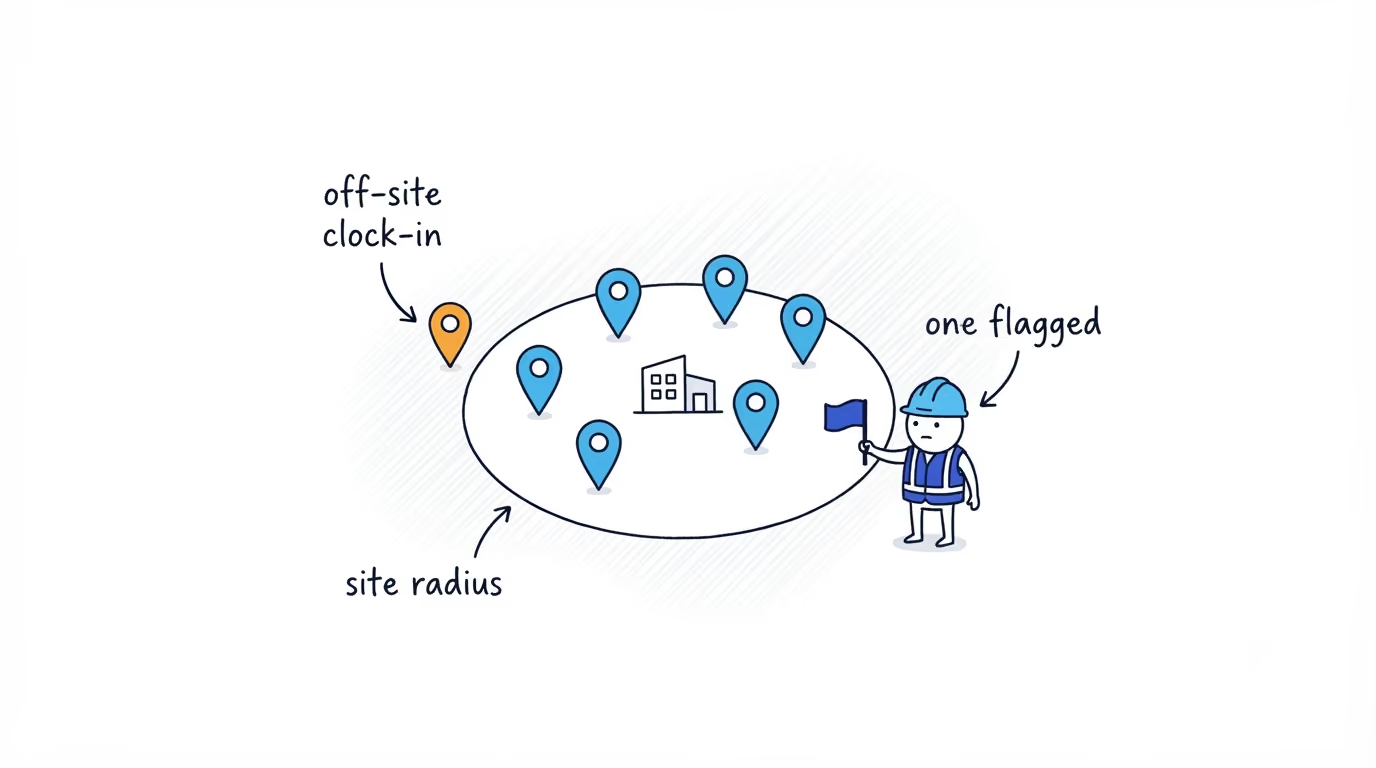
The first is location drift. A clock-in is recorded, but the coordinates are not at the job site. Once, that is a dead phone or a supply run. The same person, the same quarter-mile-away spot, every Monday, is a pattern. The second is rounding creep: shifts that consistently land a few minutes on the profitable side of a threshold, never the other way, which random human behavior does not do. The third is the buddy punch: two or more clock-ins at the same coordinates inside the same minute, or one person reliably clocked in while their own phone says they were across town.
The honest part: none of these is proof of anything on its own. They are signals. The reason they go uncaught is not that they are invisible in the data. It is that nobody has time to read thousands of punches looking for them.
Why AI can see what you cannot
This is where it stops being a watching problem. ShiftFlow already captures the raw material. Each work site can have a geofence, a set radius. When the crew clocks in, the entry can carry the GPS point, the resolved address, and the work site it was selected or matched against. The hours are already reconciled, unpaid breaks already removed, time split by job. That data is exposed, read-only, through ShiftFlow’s Axiom feed, which means an AI tool can read the entire crew’s punches the way you would read one, except it does not get tired at punch thirty.
That is the actual unlock, and it is worth being plain about it. The human limit was never judgment, it was volume. AI does not out-think you about whether a clock-in is suspicious. It reads all of them, every period, and ranks the handful that break a pattern, so your judgment gets spent on six entries instead of nowhere. You do not build this. The point of having clean, location-stamped, AI-readable punch data is that the reading stops being a job nobody has time to do.

What the patterns look like ranked
Each thing AI surfaces is one item, and the item carries its own evidence so the question takes seconds, not an investigation.
| Pattern AI surfaces | What it actually saw | Why it is worth a question |
|---|---|---|
| Off-site clock-in, repeated | Coordinates well outside the site radius, same person | A pattern, not a one-off glitch |
| Same spot, same minute | Several people clocked in at identical coordinates | A buddy-punch signal |
| One-way rounding creep | Shifts consistently end just past a paid threshold | Random behavior does not do this |
| Location missing often | One person’s punches rarely carry a GPS point at all | Worth understanding why |
The value is the ranking. “This person, this site, four Mondays running, clocked in from the same spot a half-mile out” is a sentence you can act on in the time it takes to read it. You were never going to find that by scrolling.
A flag is a question, not a verdict
This has to be non-negotiable, because it is exactly where this goes wrong if you let it. Nothing here proves anything, and nothing should auto-dock a paycheck.
A clock-in far from the site might be a tech who started at the supply house. A missing GPS point is usually a dead battery three hours into a shift, not a cover-up. Identical coordinates can be two people who genuinely carpool and walk up together. The check does not know which, and it should not pretend to. It surfaces the pattern with the evidence attached, and a person, usually you, decides whether it is nothing, a conversation, or a real problem. The accountability stays human. What changed is that the question now reaches you at all.
Where this honestly stops
Worth being straight about the edges, because overpromising this is how you end up accusing a good employee over a phone that died.
It only sees what was captured. GPS and address can be absent on any punch, and absence is not evidence. The work site on an entry is the one selected or matched, which you read against the coordinates rather than treat as a sealed proof. It cannot see the device or the person, so it cannot tell you who tapped the phone, only that a pattern looks off. And it works against the thresholds and site radii you set; draw the geofence sloppily and it will confidently flag honest people. This narrows where you look. It does not replace a clean clock-in setup, and it does not replace the conversation.
Where to go next
Catching it is the back half. The front half is making it hard to do in the first place: how to prevent time theft in the workplace and, for cleaning crews specifically, stopping buddy punching at the source cover the clock-in setup this detection sits on top of. The same reconciled punch data is what lets an AI check every timesheet before payroll for the money side. If your crew is still clocking in on a system that does not stamp where they were, the place to start is the one that does — see how ShiftFlow time tracking ties clock-ins to a work-site geofence, or talk to our team about what this looks like for your crew.
- time-theft
- buddy-punching
- ai-workforce-analytics
- gps-time-tracking
- payroll-accuracy