How a Malaysian SME Automated Attendance and Cut HR Admin Time
An illustrative case study of a 22-person PJ cleaning services SME automating attendance with a Malaysian stack. The before/after HR admin hours and the workflow.
Note: This is an illustrative case study based on common patterns across Malaysian cleaning services, security firms, and small multi-site SMEs. Numbers reflect realistic baselines grounded in EA 1955 rules, the RM 1,700 minimum wage (effective 1 February 2025 for employers with ≥5 workers; universal from 1 August 2025), October 2024 SOCSO/EIS ceiling change (from RM 5,000 to RM 6,000), October 2025 foreign worker EPF rules, and published vendor pricing. The business profile is composite — not a specific named customer.
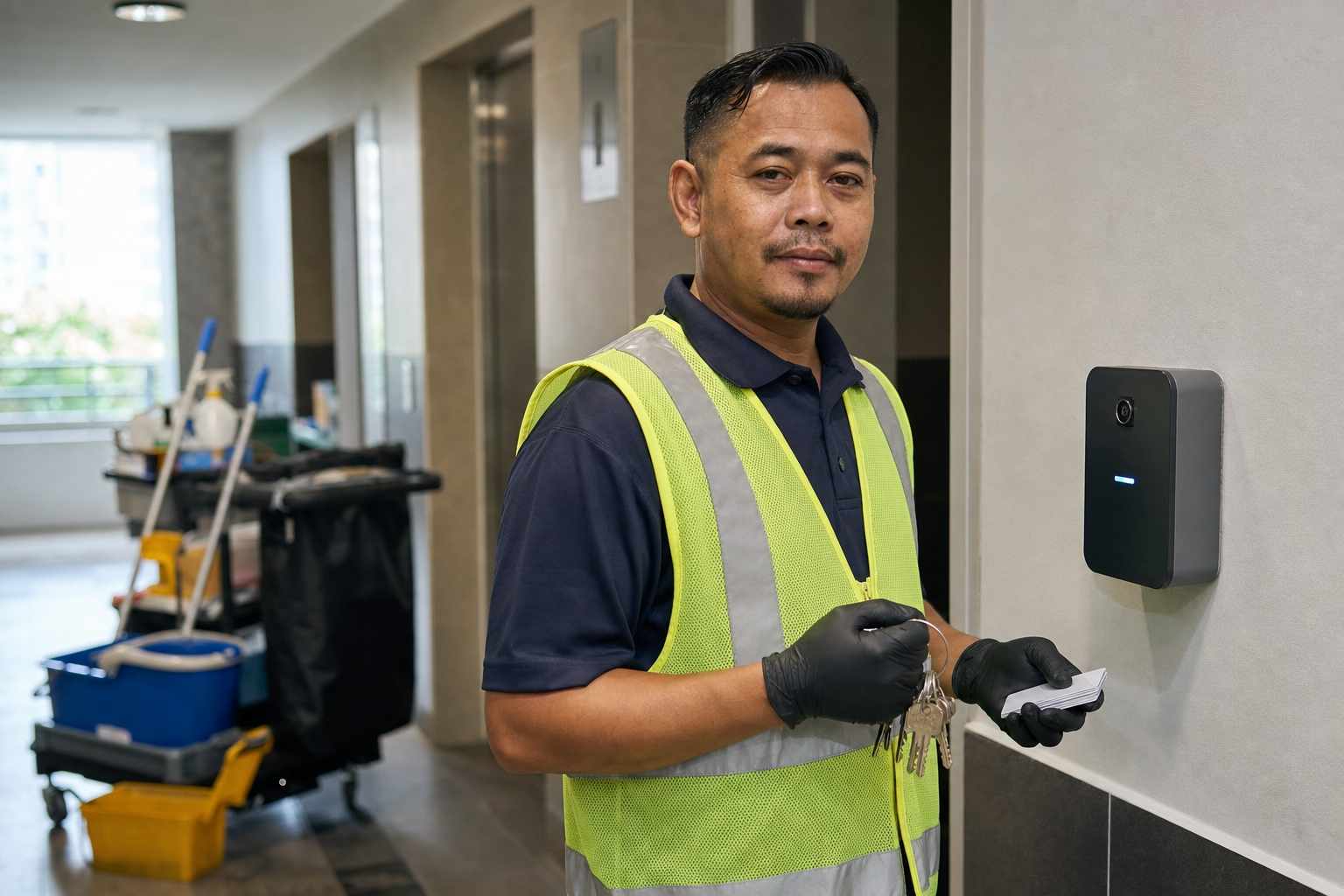
A 22-person cleaning services SME based in Petaling Jaya. Condominium and small-office accounts across PJ, Subang, and Damansara. Six client buildings, rotating crews, mixed local and foreign staff. The owner has been running the business for seven years. Attendance, until recently, ran on three things. A punch card machine at the HQ office. A WhatsApp group for daily check-ins from site supervisors. And an Excel sheet the HR coordinator updated every Friday. Here is what changed when this kind of operation moved to a Malaysian-built stack, the HR time it freed up, and what shifted in the cut-off cycle.
What attendance and payroll looked like before
The 22-person team broke down as:
- 16 cleaning crew rotating across six client buildings (2-3 staff per site, weekly schedule)
- 3 site supervisors managing 2 buildings each
- 2 administrative staff at HQ (one HR coordinator, one accounts)
- 1 owner / operations manager
The workflow before automation:
- Cleaners did not visit HQ daily, so the punch card machine captured only the 5 office staff. Site supervisors texted in the daily attendance summary for their two buildings each morning.
- The HR coordinator logged the WhatsApp updates into Excel each afternoon, reconciled against client building access logs once a week, and ran the payroll cycle on the 1st and 15th.
- EPF, SOCSO, EIS, and PCB filings got prepared manually on the LHDN e-filing portal each month. The October 2024 SOCSO/EIS ceiling change from RM 5,000 to RM 6,000 took the coordinator three weeks to fully implement. She had to update contribution calculations for everyone above the old ceiling.
- The four foreign workers on the team lived in a separate workbook for EPF tracking. That got harder when the October 2025 rule required 2% employer and 2% employee contributions for them.
What the business was quietly absorbing each month:
- HR coordinator time on attendance + payroll cycle: ≈28 hours/month
- Monthly EPF filing on-time rate: ≈70%; the other 30% landed within 1-2 days of the 15th deadline due to reconciliation delays
- Average payroll error rate: ≈1.5%, mostly from miscalculated rest-day OT and misclassified shift types
- One EPF filing late penalty in the prior 12 months, costing roughly RM 200 plus the administrative time to resolve
At RM 1,700/month minimum wage (Malay Mail, citing the Human Resources Ministry, 2025) and 22 staff, the monthly payroll base sat around RM 50,000. A 1.5% error rate meant roughly RM 750/month in miscalculations being absorbed.
What finally forced the switch
The October 2025 foreign worker EPF rule was the inflection point. With four foreign workers now needing 2%/2% contributions, the manual workbook tracking was not going to scale. And the existing Excel-based system was already producing late filings. The HR coordinator was spending most of her time on reconciliation instead of the actual HR work she was hired for. Recruitment, training, performance reviews — all of it was getting squeezed.
The owner asked her to spend two days evaluating automation options. She came back with a short list.
How the HR coordinator evaluated attendance software
Four options for a 22-person Malaysian cleaning services SME:
- Jibble Free + PayrollPanda Free (the RM 0 stack): same parent company, attendance tracking with GPS for site work, real-time integration with payroll, native EPF/SOCSO/EIS/PCB filing and LHDN e-filing. Free for unlimited employees. Limitation: two geofences on Jibble Free (the business has six sites).
- Jibble Premium + PayrollPanda Free: same setup with multi-geofence support. ≈RM 18 per user × 22 = RM 396/month.
- ShiftFlow + PayrollPanda Free: RM 14.9 per seat × 22 = RM 328/month for attendance plus the free payroll stack.
- Kakitangan modular: full Malaysian HR suite consolidating attendance and payroll. ≈RM 200-300/month for the modules the business actually needed.
After comparing all four against the real operational requirement (six sites, foreign worker EPF, free if possible), she recommended Jibble Premium + PayrollPanda Free. The Premium tier removed the two-geofence cap. PayrollPanda Free handled all statutory filing, foreign worker EPF rules and SOCSO/EIS ceiling logic included. Total cost: RM 396/month for attendance, RM 0 for payroll. Best free time tracking software for Malaysian SMEs covers the free-stack path and when Premium upgrades make sense.
How the four-week rollout actually went
Four weeks across two parallel pay periods.
Week 1. Setup. The HR coordinator configured EA 1955 rules in PayrollPanda — 45-hour weekly cap, 1.5x OT, 2x rest-day excess, 30-minute break after 5 hours. Added the six client buildings as geofences in Jibble. Registered each worker against their assigned site for that week. Applied the foreign worker EPF 2%/2% contributions for the four affected staff. The October 2024 SOCSO/EIS RM 6,000 ceiling logic was already preconfigured by PayrollPanda, which saved a step.
Week 2. Worker training. A 20-minute briefing per crew. Installing the Jibble app, setting up facial recognition, clocking in at the start of each site visit. Foreign workers got the briefing in Bahasa Malaysia (Jibble’s UI supports this). Local workers preferred English. The three supervisors trained on the Jibble admin view for approving exceptions.
Week 3. First parallel period. The reconciliation discoveries below reflect typical patterns from similar composite scenarios, not a specific named customer. Jibble ran live alongside the existing punch card / WhatsApp / Excel system. End of pay cycle, the HR coordinator reconciled the two systems worker by worker. The parallel run surfaced things nobody wanted to see:
- One cleaner whose recorded hours in WhatsApp had been silently rounded down for months, costing her about RM 80/month
- Two foreign workers whose EPF contributions had been calculated under the old flat RM 5/month employee regime rather than the October 2025 2%/2% rule
- Three rest-day misclassifications across the cleaning crews (Wednesday-off staff being treated as Sunday-off)
The corrections totalled about RM 1,400 in back-pay across affected workers for the prior two pay cycles. The owner paid it voluntarily, framing it as the catch from a system upgrade rather than a complaint resolution. Workers received it well.
Week 4. Second parallel period. Cleaner this time. One exception, a forgotten clock-out, resolved within 24 hours. Full cutover at end of week 4.
What changed after three months
- HR coordinator time on attendance + payroll: ≈6 hours/month, down from 28. The remaining hours go to reviewing exceptions in Jibble, approving PayrollPanda’s calculated payroll, and handling worker queries via the audit trail. Net savings: ≈22 hours/month.
- EPF filing on-time rate: 100% over the three months post-cutover. PayrollPanda generates the LHDN filing ready to submit on the 15th of each month.
- Payroll error rate: ≈0.4%, down from 1.5%. What is left traces to one-off events — a missed clock-out, a supervisor approving an exception — not systemic miscalculation.
- Foreign worker EPF compliance: clean. The 2%/2% rule applies automatically to the registered foreign workers.
- Total monthly stack cost: RM 396 (Jibble Premium for 22 users) + RM 0 (PayrollPanda Free) = RM 396/month.
The HR coordinator now spends the 22 recovered hours each month on recruitment screening, training material updates, and the kind of HR work the business actually needed her doing in the first place. That redirection of her time was the real return on the RM 396 subscription, in the owner’s framing.
Get ShiftFlow on iOS or Android
What changed in the payroll cut-off cycle
| Stage | Before (manual) | After (automated) |
|---|---|---|
| Daily attendance reconciliation | 30 min × 22 days = 11 hours | 0 min (real-time) |
| WhatsApp-to-Excel transcription | 4 hours per cycle | 0 min |
| Manual EPF/SOCSO/EIS/PCB calculation | 6 hours per cycle | 30 min (review) |
| LHDN e-filing preparation | 3 hours per cycle | 5 min (auto-generated) |
| Worker dispute resolution | ≈2 hours per cycle | under 30 min |
| Total per pay cycle (2 cycles / mo) | ≈28 hours | ≈6 hours |
The bulk of the savings came from killing the daily WhatsApp-to-Excel transcription and the manual statutory calculation. The audit trail in Jibble + PayrollPanda also meant the dispute-resolution step shrank from a multi-day reconstruction to a same-day review.
What the HR coordinator took away from the transition
Three things HR coordinators in this position usually say.
“The October 2025 foreign worker EPF rule was the forcing function.” Without the regulatory trigger, the business probably would have absorbed the manual overhead for another year or two. The new rule made the existing Excel system untenable.
“Free was the right starting point. Premium paid back inside the first month.” The two-geofence limit on Jibble Free was a hard blocker for a 6-site operation. The Premium upgrade at RM 396/month was an obvious buy once the operational benefits showed up.
“The back-pay was an awkward conversation, but the right one.” Discovering that Excel had been silently rounding hours and miscalculating rest-day OT for months — that was a real moment. Paying the back-pay voluntarily turned a potential grievance into goodwill.
When this case study does not apply to your business
This composite represents a realistic outcome for a 22-person Malaysian SME with multi-site operations, mixed local/foreign workforce, and moderate compliance complexity. It is not every operator’s path. Three factors that change the math:
- Single-site operators save less in absolute hours because the WhatsApp-to-Excel step is smaller to begin with. The HR coordinator time still drops, just by a smaller percentage.
- Operators with no foreign workers have less complexity in the EPF calculation. That removes one source of manual error.
- Operators with heavier OT or shift complexity (24/7 security firms, F&B with late closing crews) see larger error-rate reductions because the manual multiplier math compounds errors faster.
Attendance management for SMEs in Malaysia covers the broader operational setup; How to track attendance for compliance with Malaysian labour law covers the compliance details. Time tracking software that works alongside Malaysian payroll covers the payroll handoff patterns referenced in the workflow, and Best time tracking software in Malaysia for SMEs compares the full vendor set.
Sources
- Employment Act 1955 (Akta Kerja, PDF from MoHR) for the 45-hour cap, 104-hour OT ceiling, and break rules used in the example
- DOSM MSMEs Performance 2024 for SME employment baseline
- Malay Mail on RM 1,700 minimum wage nationwide enforcement from 1 Aug 2025 — effective 1 Feb 2025 for employers with ≥5 workers; universal from 1 Aug 2025
- Foundingbird guide to EPF, SOCSO, and EIS for contribution rates, the RM 6,000 ceiling, and October 2025 foreign worker rules
- PayrollPanda and Jibble pricing for the free-stack and Premium tier pricing
- malaysia
- case-study
- attendance
- time-tracking
- sme
- hr-admin-time
- mofu