How to Track Attendance for Compliance with Malaysian Labour Law (EA 1955, EPF, SOCSO)
How Malaysian SMEs track attendance for EA 1955, EPF, SOCSO, and PCB compliance. What the law requires, what your time tracker must do, and three setups.
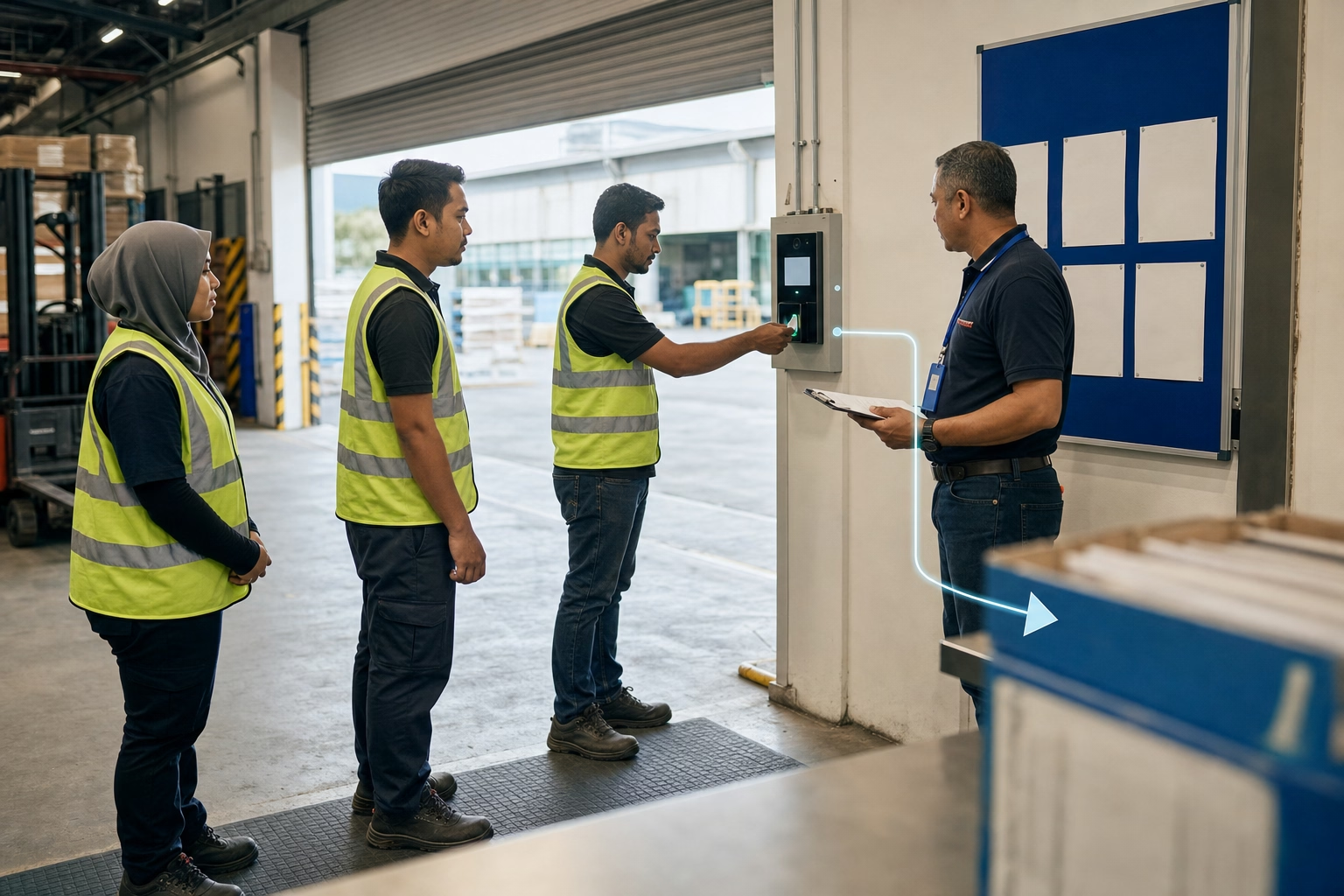
Compliance is where Malaysian SMEs lose the most money on bad attendance systems. Most only find out after a payroll error has already propagated through EPF, SOCSO, and PCB filings. The Employment Act 1955 (Amendment) 2022 caps standard work at 45 hours per week and 8 per day, with monthly overtime capped at 104 hours. Non-compliance fines reach RM 50,000 per offence. The RM 1,700 national minimum wage took effect 1 February 2025 for employers with at least five workers, and became universal on 1 August 2025 when the small-employer exemption was removed (Malay Mail, citing the Human Resources Ministry, 2025). This guide walks through what Malaysian labour law actually requires from your timesheet system, how the attendance data flows into EPF/SOCSO/EIS/PCB filings, and the three setups Malaysian SMEs use to stay compliant.
What EA 1955 actually requires from your timesheet system
The Employment Act 1955, as amended in 2022 and effective 1 January 2023, sets out the working-time rules every Malaysian employer has to enforce.
- Standard hours: 45 per week and 8 per day, down from the prior 48-hour cap.
- Overtime rate: at least 1.5x the hourly rate on ordinary days.
- Rest-day excess rate: 2x the hourly rate for hours worked beyond the normal shift on a rest day.
- Monthly overtime cap: 104 hours.
- Rest break: mandatory 30 minutes after five consecutive hours of work.
- Penalty: up to RM 50,000 per offence for non-compliance.
Your timesheet system has to record enough data to enforce all of these rules and to prove enforcement on inspection. That means each clock-in event needs four things at minimum. Worker identity (verified, not self-reported). Date and time (server timestamp, not editable). Location if the shift requires it (GPS or geofence). And a link to the assigned shift type (ordinary day, rest day, public holiday).
A punch card machine captures one of those, weakly (date and time). A fingerprint scanner captures two (identity and time). A modern mobile time tracker captures all four, plus the metadata to produce reports against EA 1955 thresholds in real time. Why Malaysian businesses are switching from manual attendance tracking covers what the manual systems specifically miss.
How attendance data flows into EPF, SOCSO, and EIS
Malaysian statutory contributions are calculated against the worker’s wages for the contribution month. “Wages” includes basic salary plus overtime plus most allowances. Wrong attendance data produces wrong wages. Wrong wages produces wrong contributions. Wrong contributions produces a correction filing for every affected month.
The contribution rates as of late 2025.
- EPF: employer 13% for wages below RM 5,000 and 12% above, employee 11%. Foreign workers became required to contribute at 2% employer and 2% employee from October 2025.
- SOCSO: combined employer-employee contribution against wages up to the RM 6,000 ceiling (raised from RM 5,000 effective October 2024). Covers the Employment Injury Scheme and Invalidity Scheme.
- EIS (Employment Insurance System): 0.2% employer plus 0.2% employee against the same RM 6,000 ceiling.
- Payment deadline: 15th of the following month.
The attendance system feeds into payroll, and payroll computes the wages figure. If overtime hours are missed or miscategorized, the wage is wrong. EPF/SOCSO/EIS contributions filed with KWSP and PERKESO are wrong. Correcting a contribution filing after the fact requires submitting a Form A correction with EPF and a separate amendment with SOCSO, plus explaining the discrepancy to the affected worker.
This is where the case for a system that auto-applies EA 1955 rules at the timesheet level, rather than asking HR to reconcile in Excel each month, stops being theoretical and starts being economic.
How PCB and LHDN e-filing tie into attendance
PCB (Potongan Cukai Bulanan, the monthly tax deduction) is calculated against the worker’s annual taxable income projected from monthly wages. The same wages figure that drives EPF and SOCSO drives PCB. Wrong overtime, wrong wages, wrong PCB, LHDN e-filing correction.
LHDN’s e-filing portal (ezHasil) accepts monthly PCB submissions and annual EA Form filings. Most Malaysian payroll products (Kakitangan, BrioHR, Swingvy, PayrollPanda, altHR) push these submissions natively. Foreign time trackers (Jibble, ShiftFlow, Hubstaff, Connecteam) export to CSV that imports into payroll, which then handles the LHDN side.
The compliance perimeter is the same either way. The attendance data has to be right at the timesheet level, because every downstream filing is calculated from it.
What your time tracker has to do at a minimum
Use this as a vendor evaluation list when choosing or auditing a system.
- Server-side timestamp on every clock-in event, not a value that the worker or admin can edit after the fact
- Identity verification via fingerprint, facial recognition, or selfie, not just a username and password
- Shift type assignment per shift (ordinary day, rest day, public holiday) so the OT rules apply correctly
- Rolling overtime tracker that warns when a worker is approaching the 45-hour weekly cap or the 104-hour monthly OT ceiling
- Mandatory rest break logic that flags shifts exceeding 5 consecutive hours without a 30-minute break
- Audit trail that records every edit, who made it, and when, for any retroactive adjustment
- Native or CSV export into a Malaysian payroll system (PayrollPanda, Kakitangan, SQL Payroll, Info-Tech, BrioHR, Swingvy)
- Configurable EPF/SOCSO/EIS ceiling logic (RM 6,000 since October 2024) if your time tracker also handles payroll
- Foreign-worker EPF rules (2%/2% from October 2025) if you employ foreign labour
If a vendor cannot demonstrate all of these on a live demo, score them down. What to check before buying attendance software for your Malaysian business has the full buyer’s checklist.
Get ShiftFlow on iOS or Android
Three compliance-friendly setups Malaysian SMEs actually run
Most Malaysian SMEs that get this right run one of three setups.
Setup A. Free Malaysian stack. Jibble Free (attendance, GPS, kiosk, facial recognition, unlimited users) plus PayrollPanda Free (EPF, SOCSO, EIS, PCB, LHDN e-filing). Same parent company. Integration is tight. Best for teams under 30 that want zero monthly cost. The tradeoff is feature scope on the HR side. No recruitment, basic leave, minimal performance.
Setup B. Focused time tracker plus Malaysian payroll. A focused time tracker (ShiftFlow at RM 14.9 per seat, Jibble Premium, Connecteam) plus a Malaysian payroll product (Kakitangan, SQL Payroll, Info-Tech) for statutory filings. Best for teams that need stronger shift rules, multi-location support, or features the free stack does not cover. Time tracking software that works alongside Malaysian payroll covers the integration patterns.
Setup C. Malaysian-built HR suite, one vendor. Kakitangan, BrioHR, Swingvy, or altHR handles attendance, leave, payroll, EPF/SOCSO/EIS/PCB filings, and LHDN e-filing inside a single product. Best for teams that want vendor consolidation and have an HR manager who can actually run an HRIS. Monthly cost typically starts around RM 50 (Kakitangan modular) and tops out around RM 200 (BrioHR minimum) for a 20-person team.
The right pick comes down to team size, geographic spread, and how much HR functionality beyond attendance you actually need. The pillar comparison at Best time tracking software in Malaysia for SMEs runs the math for a 20-employee team across all three setups. Attendance management for SMEs in Malaysia covers the operational discipline that supports each setup, and How to choose an attendance system for Malaysian SMEs walks through the decision framework.
What to validate before going live
Before cutting over from a manual system, run two parallel pay periods and check three things.
- Wages match. Run the new system and the old system side by side. Reconcile worker by worker. Differences usually trace to a misconfigured rest-day flag or an off-by-one on the 45-hour weekly cap.
- EPF and SOCSO contributions match. Pull the contribution summary from each system. Differences here usually trace to the RM 6,000 ceiling being applied differently, or the wrong worker category being set.
- OT thresholds fire correctly. Push one test worker over 45 hours in a week and over 104 hours in a month. Verify the system flags both. If it does not, the rules engine is misconfigured.
Once those three pass, cut over fully. Keep the old system’s last three months of data for audit purposes. Do not delete it.
The total cost of getting attendance compliance wrong in 2026 is materially higher than it was three years ago. RM 1,700 minimum wage. The 45-hour weekly cap. The RM 6,000 SOCSO/EIS ceiling. Mandatory foreign worker EPF contributions. The RM 50,000 EA 1955 fine. They all stack. The cost of a system that gets it right ranges from RM 0 to RM 298 a month for a 20-person SME. The math is one-sided.
Sources
- Employment Act 1955 (Akta Kerja, PDF from MoHR) for the 45-hour weekly cap, 104-hour OT ceiling, and break rules
- Malay Mail on RM 1,700 minimum wage nationwide enforcement from 1 Aug 2025 for nationwide enforcement
- Foundingbird guide to EPF, SOCSO, and EIS for contribution rates, the RM 6,000 ceiling, and foreign worker rules
- QuickHR mandatory payroll deductions Malaysia for the EPF, SOCSO, EIS, and PCB contribution detail
- DOSM MSMEs Performance 2024 for SME employment baseline
- malaysia
- compliance
- attendance
- time-tracking
- ea-1955
- epf-socso
- mofu