Why Malaysian Businesses Are Switching from Manual Attendance Tracking
Manual attendance tracking costs Malaysian SMEs EA 1955 fines, EPF/SOCSO errors, and weeks of HR time. Here is what fails and what businesses are switching to.
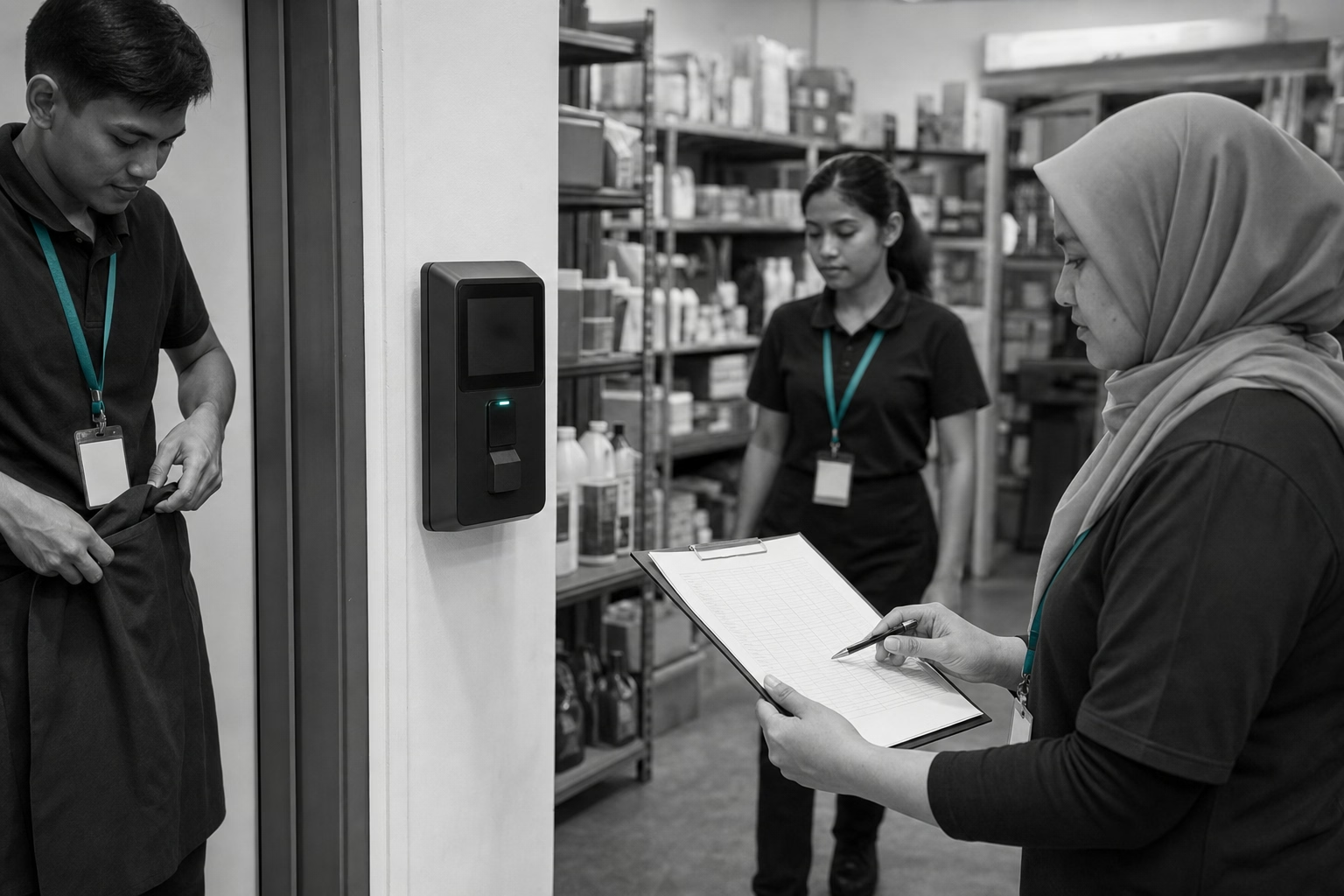
For two decades, manual attendance in Malaysia has meant the same three options. A punch card machine bolted to the wall. A fingerprint scanner at the office entrance. A paper sign-in sheet on the receptionist’s desk. None of them survive 2026 compliance.
The Employment Act 1955 (Amendment) 2022 caps work at 45 hours per week with a 104-hour monthly overtime ceiling. The RM 1,700 national minimum wage took effect 1 February 2025 for employers with at least five workers, and became universal on 1 August 2025 when the small-employer exemption was removed (Malay Mail, citing the Human Resources Ministry, 2025). Fines reach RM 50,000 per offence for EA 1955 violations and up to RM 10,000 per affected employee for minimum wage breaches. Manual systems were never built for any of this. They were built when “overtime tracking” meant a clerk adding hours by hand on a clipboard and nobody was checking.
Why punch cards cannot enforce the 45-hour cap
The legal stake is concrete. The Employment Act 1955 (Amendment) 2022, effective 1 January 2023, caps standard working hours at 45 per week and 8 per day. Overtime pays at no less than 1.5x the hourly rate on ordinary days and 2x for rest-day excess hours. Monthly overtime cannot exceed 104 hours. A 30-minute rest is mandatory after five consecutive hours of work. Fines run up to RM 50,000 per offence.
A punch card machine records two events. Time in. Time out. It does not tell you that worker A is closing in on the 45-hour weekly cap. It does not flag that worker B has already hit the 104-hour monthly OT ceiling. It does not warn that worker C is about to cross the five-consecutive-hour line that triggers a mandatory break. The HR manager finds out at the end of the pay period by manually adding up cards. By then the law has already been broken and the only question is how visible it becomes.
So the shift Malaysian SMEs are making is from after-the-fact accounting to in-shift enforcement. The time tracking app warns the manager before a worker crosses a threshold, not after. How to track attendance for compliance with Malaysian labour law covers the rule configuration in detail.
Why fingerprint scanners stop one failure mode and miss the rest
Fingerprint scanners are common in Malaysian SMEs because they stop buddy punching at the office door. That solves one problem. It leaves the rest standing. A fingerprint scanner does not:
- Verify that the worker is actually on the job site (only that they touched the scanner at the office)
- Capture work that happens off-site, at a client location, or remotely
- Record GPS location, which matters for field teams, multi-site cleaning crews, and security guards
- Sync with payroll software in any structured way (most output a CSV that requires manual import)
- Track overtime cumulatively against EA 1955 thresholds
For a security firm with 25 guards rotating across three malls, a cleaning company servicing six client sites, or a construction crew working five active projects, the fingerprint scanner at HQ is theatre. The workers were never going to be there. What replaces it is mobile GPS clock-in with selfie verification, which captures location, identity, and time in a single event that ties cleanly into payroll. Attendance management for SMEs in Malaysia walks through the field-team setup.
How EPF, SOCSO, and EIS errors cost more than any software ever will
Malaysian statutory contributions are not small. Employer EPF is 13% for wages below RM 5,000 (12% above). Employer SOCSO contributions cover both the Employment Injury Scheme and the Invalidity Scheme. EIS adds another 0.2%. As of October 2024 the SOCSO and EIS ceiling rose from RM 5,000 to RM 6,000. From October 2025, foreign workers contribute to EPF at 2% employer and 2% employee.
One miscalculated overtime hour propagates the whole way through. Wrong hours feed a wrong wage figure. Wrong wage feeds wrong EPF and SOCSO. Wrong contribution math feeds a wrong LHDN PCB calculation. Find this three months later and you are filing one correction with EPF, another with SOCSO, another with LHDN, and explaining the discrepancy to the worker whose deposits did not land where they should have.
One such error easily clears RM 1,000 to RM 2,000 once you total the reconciliation time, the corrected filings, and the relationship hit. A time tracker that prevents the source error costs RM 0 (Jibble Free plus PayrollPanda Free) up to RM 298 a month (ShiftFlow at RM 14.9 per seat for 20 staff). The math is not close.
Grab the ShiftFlow app, no card needed
Why hybrid work breaks manual systems outright
The Malaysian Employers Federation reported in 2025 that more than 70% of Malaysian companies have increased adoption of flexible work routines post-pandemic (The Star, MEF, 2025). A punch card machine bolted to a wall in Damansara cannot record a marketing executive working from home on Tuesday and Thursday. A fingerprint scanner at reception cannot tell you whether a sales engineer is actually at a client site in Penang or eating lunch in his car.
The standard workaround is a Google Sheet staff are supposed to update each day. Same failure modes as Excel timesheets, plus two new ones. Nobody trusts the entries, because they are self-reported with zero verification. And the manager has no way to enforce break compliance under EA 1955 from a sheet that gets filled in retroactively on Friday.
What replaces it is a mobile time tracker that handles office and remote modes natively, with optional GPS for shifts that legally require location verification and a kiosk mode for shared-device clock-in at the office. How Malaysian companies manage hybrid work attendance covers the setup.
What Malaysian SMEs are actually moving to
Three setups account for most Malaysian SMEs that come off manual attendance.
- A free Malaysian-built stack (Jibble Free for attendance plus PayrollPanda Free for EPF, SOCSO, EIS, PCB filing) for teams under 30 that want zero monthly cost
- A focused time tracker (ShiftFlow at RM 14.9 per seat, Connecteam, Jibble Premium) plus a separate payroll system for statutory, for teams that need stronger shift rules and multi-location coverage
- A Malaysian-built HR suite (Kakitangan, BrioHR, Swingvy, altHR) that handles both attendance and statutory filings in one product, for teams that want consolidation
Which one fits depends on team size, geographic spread, and how much HR functionality (recruitment, performance reviews, claims) you actually want beyond attendance. Best time tracking software in Malaysia for SMEs compares the nine platforms Malaysian SMEs shortlist most often, with real monthly bill math for a 20-person team.
The case for switching is not that punch cards or fingerprint scanners are inherently bad tools. It is that the compliance environment has tightened materially since they were good enough. RM 1,700 minimum wage. 45-hour weekly cap. 104-hour monthly OT ceiling. Raised SOCSO/EIS ceilings. Mandatory foreign worker EPF contributions. Every one of those rules raises the cost of a manual-system error in 2026 above what it has ever been. And in most cases the cost of replacing the manual system is less than the cost of one compliance error you avoid.
Sources
- DOSM MSMEs Performance 2024 for SME employment baseline
- Employment Act 1955 (Akta Kerja, PDF from MoHR) for the 45-hour cap, 104-hour OT ceiling, and break rules
- Malay Mail on RM 1,700 minimum wage nationwide enforcement from 1 Aug 2025 for nationwide enforcement
- Foundingbird guide to EPF, SOCSO, and EIS for contribution rates, the RM 6,000 ceiling, and foreign worker rules
- The Star on MEF hybrid work data for the 70%+ flexible-work adoption figure
- malaysia
- manual-attendance
- attendance
- time-tracking
- ea-1955
- sme
- tofu