How Do Reviews Affect Google Maps Ranking?
Understand what Google confirms about reviews and local ranking, separate ranking evidence from customer-choice research, and build genuine reviews without invented targets or policy shortcuts.
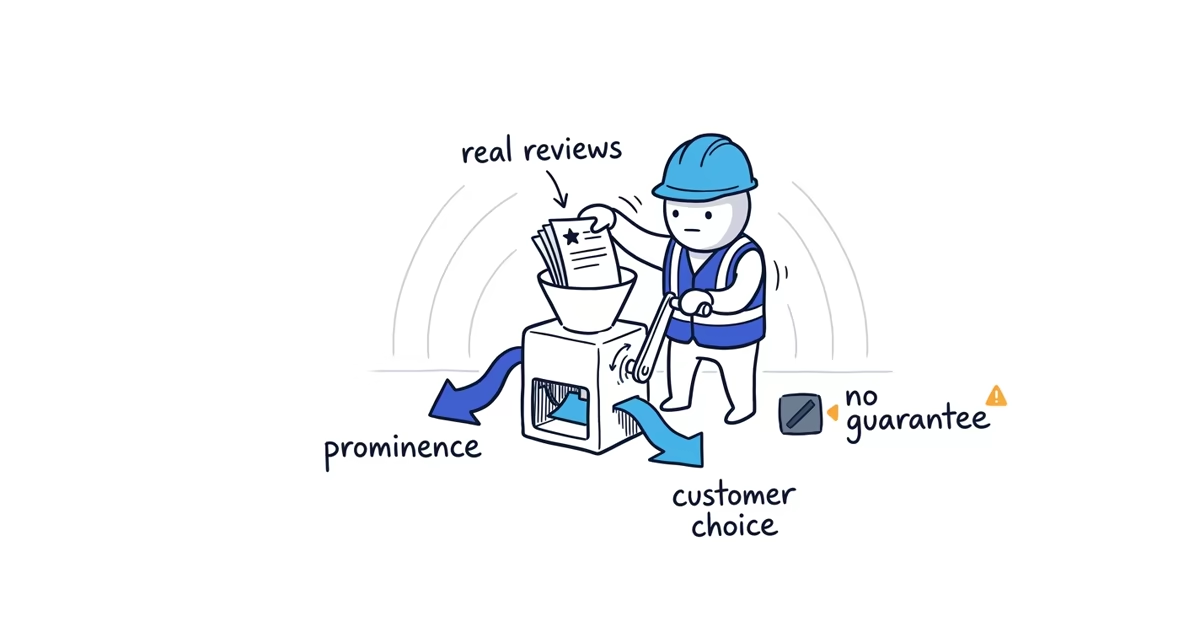
Yes. Google says more reviews and positive ratings can help a business’s local ranking. Google discusses reviews under prominence, its term for how well known a business appears.
Reviews also affect a separate decision: whether a customer chooses the business after seeing it. Keep those two effects apart. Google does not publish an ideal review count, weekly pace, rating threshold, response percentage, review-text formula, or algorithm weight.
How Google reviews affect ranking and customer choice
The consumer findings below come from BrightLocal’s 2026 survey of 1,002 US adults. They describe how those surveyed consumers use reviews; they are not rules in Google’s ranking system.
| Review question | Evidence and owner action |
|---|---|
| Count | Google: More reviews can help local ranking. Consumers: 97% read reviews; 47% would not use a business with fewer than 20. Unknown: No ideal total or competitor gap guarantees a position. Action: Ask real customers after completed jobs without chasing a magic number. |
| Average rating | Google: Positive ratings can help local ranking. Consumers: 31% required at least 4.5 stars. Unknown: No Google ranking threshold or perfect rating. Action: Improve the real customer experience rather than managing toward a formula. |
| Recency | Google: No published ranking cutoff. Consumers: 74% cared about reviews from the last three months. Unknown: No confirmed weekly pace or freshness window. Action: Keep asking as genuine jobs finish. |
| Owner replies | Google: Replies are recommended and show that the business values feedback. Consumers: Replies reveal how the owner handles praise and problems. Unknown: No required response rate or keyword benefit. Action: Reply briefly when it helps the customer. |
| Review wording | Google: Reviews must reflect genuine experiences; no service- or city-word formula is published. Consumers: First-hand details can clarify the job. Unknown: No confirmed keyword count or phrase pattern. Action: Ask for an honest review without coaching the wording. |
| Incentives | Google: Incentives for posting, changing, or removing a review are prohibited. Consumers: Incentives can make the evidence less trustworthy. Unknown: Disclosure elsewhere does not make an incentivized Google review acceptable. Action: Do not offer a benefit for a Google review. |
The table gives an owner something more useful than a universal target. It shows which conclusions are supported, which numbers describe consumer choice, and where an SEO claim goes beyond the evidence.
Why reviews cannot guarantee a Google Maps ranking
Reviews sit within Google’s prominence discussion: how well known and credible a business appears. They do not erase relevance or distance.
Imagine Bright Room Cleaning has 85 recent, authentic reviews from completed residential jobs. A nearby competitor has 42. Bright Room’s review profile can support its prominence and reassure a customer comparing the two businesses.
Those reviews can help and can reassure customers, but they do not guarantee Bright Room will outrank a closer or more relevant competitor. Review 86 is not a map-pack trigger.
How to compare competitor Google reviews
A nearby comparison can reveal context. Across three to five legitimate businesses with similar core work, compare visible count, average rating, newest-review dates, and response behavior. If established cleaners show recent customer activity while the business’s newest review is two years old, the proof is stale.
Do not turn the comparison into top competitor + 10. Matching one number does not recreate the competitor’s distance, relevance, history, or customer experience.
How to build Google reviews from completed jobs
Ask genuine customers after genuine completed work through a process the team can sustain. Use a neutral completion point, keep a record so customers are not repeatedly asked, and request an honest account rather than five stars or specific service and city wording. This keeps evidence current without inventing a weekly pace.
Google also recommends replies. Keep them short, specific, and useful to customers; do not turn them into promotional paragraphs or keyword containers. The request scripts, follow-up timing, QR-code setup, and response templates belong in the separate review-acquisition process.
Google review practices to avoid
Avoid four shortcuts:
- Review gating: Do not ask only customers expected to be positive or route unhappy customers away from Google.
- Incentives: Google prohibits benefits offered in exchange for posting, changing, or removing a review.
- Hidden connections: Employee, family, or vendor involvement must not masquerade as independent customer opinion; hiring a vendor does not transfer responsibility for deceptive work.
- Coached wording: Do not tell customers which services, cities, or phrases to include.
The FTC separately says incentives must not depend on positive sentiment, material connections need disclosure, and selective solicitation can be deceptive. Google can still prohibit an incentivized review on its platform. For a Google review, the practical rule is simple: do not offer the incentive.
What to do based on your Google review problem
Use the review evidence to choose the next process:
- Few genuine reviews or long gaps: Build a policy-compliant request system tied to completed jobs. If the team needs a repeatable way to ask and respond, our Google review management can help set up that process.
- Recurring poor feedback: Fix the service, communication, scheduling, or billing problem before asking more customers.
- Reviews are healthy but Maps visibility is weak: The Google Maps ranking guide helps you check relevance, distance, and the rest of prominence instead of chasing another review target.
- The profile appears but produces few calls or website actions: The call and website guide helps you find the first break between visibility, customer action, and booked work.
Reviews deserve consistent attention because Google says they can help local ranking and because customers use them to choose. They do not deserve invented precision. There is no Google-published magic count, pace, rating, response rate, wording pattern, or algorithm weight.
Frequently asked questions
Can one bad Google review lower my Maps ranking?
Google does not publish a rule that one negative review causes a specific ranking drop. One review can change the visible average and influence customer choice, so respond usefully and fix any real service problem instead of trying to offset it with a burst of solicited reviews.
Should I reply to every Google review?
Google recommends replying to reviews because it shows that the business values feedback, but it publishes no required response rate or ranking benefit for replying to every one. Prioritize concise, useful responses and never turn replies into keyword-filled promotions.
Sources
- google-reviews
- google-maps-ranking
- review-recency
- review-replies
- local-seo