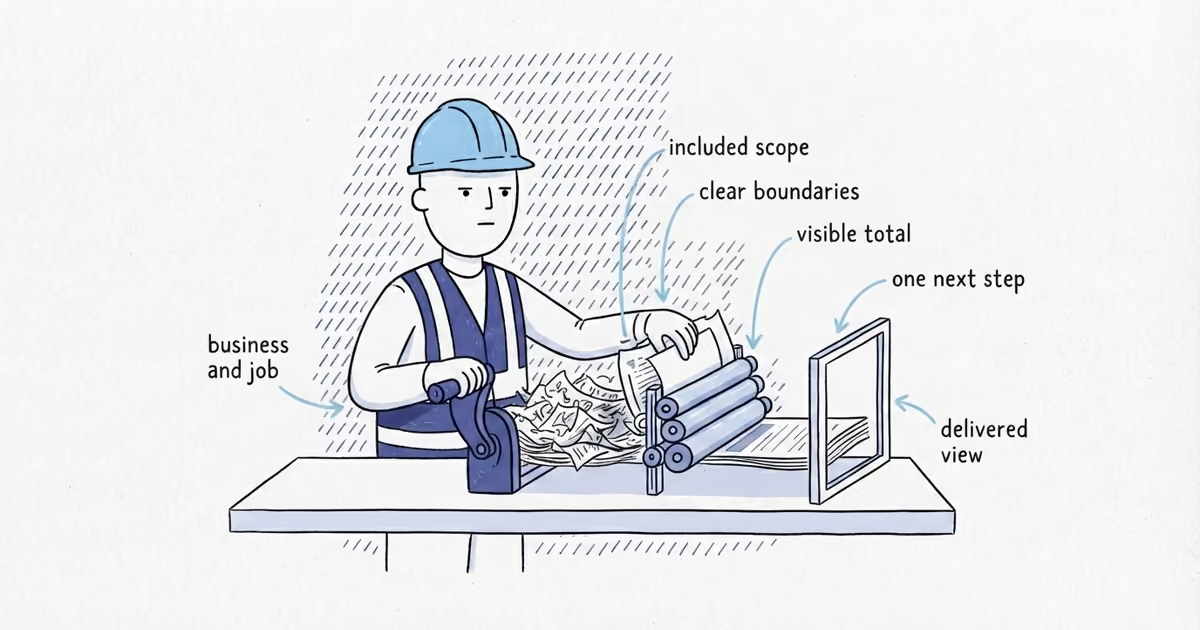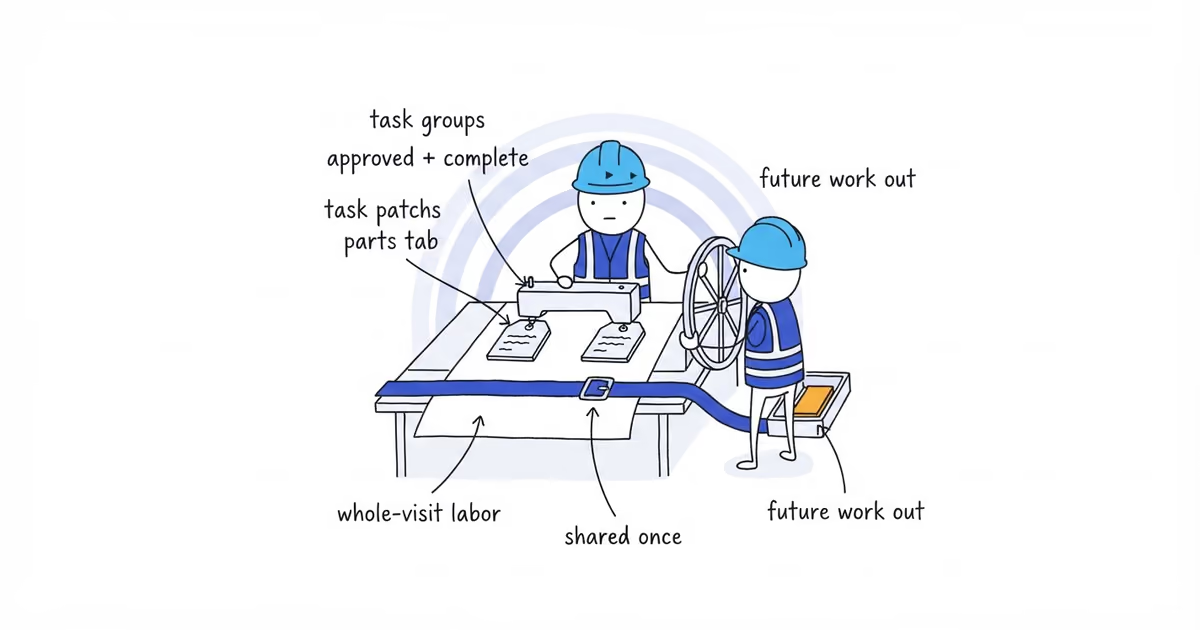

How Much Do Handyman Business Owners Make?
How much do handyman business owners make? Model billable hours, collected revenue, helper payroll, overhead, owner compensation, and retained cash each year.
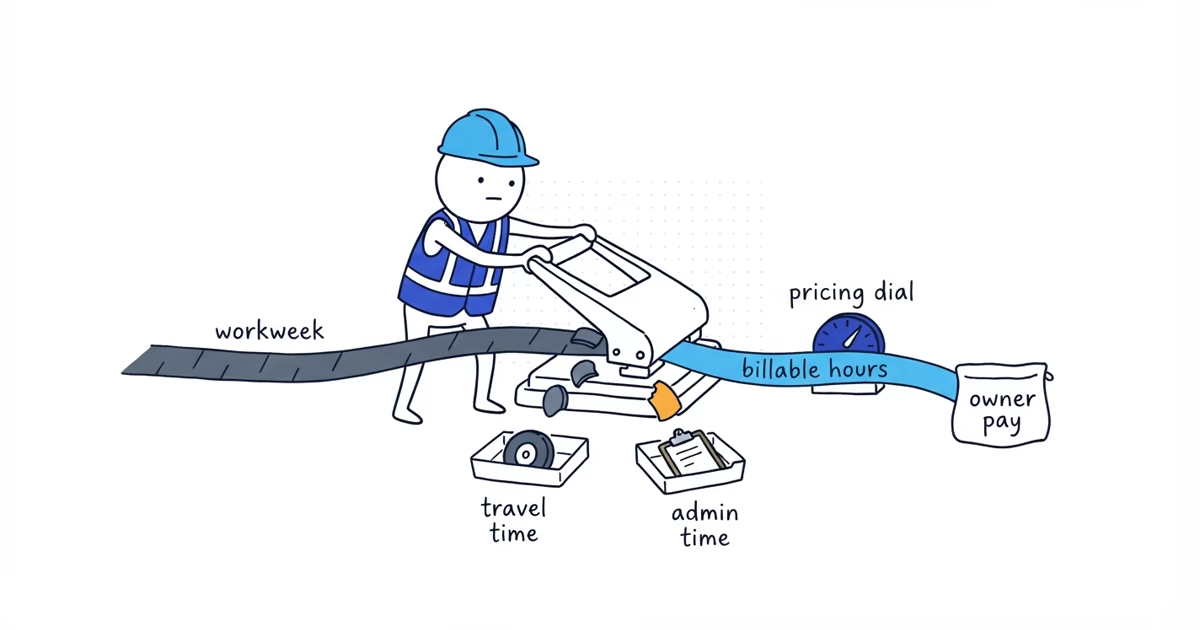
A $95 customer rate does not create a $197,600 owner salary. In the solo planning model below, a 40-hour week becomes 24 billable hours, $109,440 in annual collections, $67,908 in planned owner compensation, and $11,984 left in the business.
That is one illustration, not an industry benchmark. The public BLS and Census data reviewed for this guide do not provide a defensible national average for handyman-owner take-home pay. The useful answer has to come from the owner’s working capacity, collected jobs, costs, and retained cash.
How billable hours affect handyman owner income
The shortcut fails because it assumes every working hour is sold, every invoice is collected, the owner takes no time away, and the business has no expenses.
A solo owner’s week does not work that way. Here is one disclosed capacity model for a small-repair operator:
| Where a 40-hour week goes | Hours |
|---|---|
| Customer work | 24 |
| Travel between jobs | 5.5 |
| Supply runs | 3 |
| Estimates and admin | 4 |
| Callbacks and schedule gaps | 3.5 |
| Available working time | 40 |
Only the 24 customer-work hours are billed in this example. At a $95 blended collected rate, they produce $2,280 for the week. “Collected” matters: a quoted price, sent invoice, or booked project is not cash until the customer pays.
The same week then has to carry the business:
| Solo weekly cash waterfall | Amount |
|---|---|
| Collected customer work: 24 hours x $95 | $2,280 |
| Materials, merchant fees, and callback allowance: 8% | -$182 |
| Vehicle, tools, insurance, licenses, marketing, software, and other overhead: 19% | -$433 |
| Cash before owner compensation | $1,664 |
| Planned owner compensation: 85% of pre-owner cash | -$1,415 |
| Retained cash | $250 |
Illustrative planning model, not an industry average. The $95 is a blended rate actually collected across hourly and project work, not national pricing advice. A minimum charge would be another replaceable pricing input; this article does not prescribe one.
The capacity table and cash waterfall treat callbacks differently. The 3.5-hour row captures owner time lost to a callback or an unusable schedule gap. The 2% cash allowance covers callback materials, fees, or other out-of-pocket cost.
In the modeled 48-week year, the owner allocates about $67,908 to compensation and leaves about $11,984 in the business. That compensation is before personal tax and pays for both field work and ownership. The retained amount is not a second paycheck. It may be needed for slow weeks, tools, vehicle repairs, debt, taxes, or another obligation not represented in the simplified model.
Handyman business revenue, profit, and owner pay
Six lines do different jobs in this model:
| Term | Meaning |
|---|---|
| Collected revenue | Customer money received for owner and helper work |
| Non-owner direct costs | Helper payroll plus materials, merchant fees, and callback costs tied to delivering jobs |
| Overhead | Vehicle, tools, insurance, licenses, marketing, software, admin, and other operating cost |
| Cash before owner compensation | Collected revenue minus non-owner direct costs and overhead |
| Owner compensation | The selected share of pre-owner cash allocated to the owner before personal tax |
| Retained cash | The share left in the business after that allocation |
The model does not decide whether owner compensation should be a salary, draw, or distribution. That depends on the business entity and the owner’s tax situation. It only stops sales, business cash, personal pay, and retained cash from being called the same thing.
Handyman business owner income examples
The next examples are different service setups, not stages every business should follow.
The solo small-repair operator handles all field work and admin. The busy solo owner with limited helper labor still performs 28 customer hours each week while a helper completes 18 customer hours. The helper is paid for 24 hours, because loading, travel, supply handling, and gaps do not disappear from payroll. In the small mixed-job team, the owner performs 12 customer hours and handles estimates, scheduling, quality checks, and management while team members complete 70 customer hours. The team is paid for 88 hours.
Annual scenario inputs use the same editorial planning model.
| Annual input | Solo small-repair operator | Busy solo + limited helper | Small mixed-job team |
|---|---|---|---|
| Owner customer hours per week | 24 | 28 | 12 |
| Non-owner customer hours per week | 0 | 18 | 70 |
| Non-owner paid hours per week | 0 | 24 | 88 |
| Blended collected rate | $95 | $105 | $110 |
| Working weeks | 48 | 48 | 48 |
| Loaded non-owner hourly cost | N/A | $28 | $29 |
| Materials, fees, and callback allowance | 8% | 9% | 10% |
| Overhead | 19% | 21% | 22% |
| Share allocated to owner compensation | 85% | 80% | 70% |
For transparency, the direct-cost percentages combine materials at 4%/5%/6%, merchant fees at 2%, and a callback allowance at 2%. The overhead percentages combine vehicle and tools at 8%/7%/6%, insurance and licenses at 3%, marketing at 4%/5%/6%, software and admin at 2%/3%/4%, and other overhead at 2%/3%/3%. These are editorial assumptions, not published handyman cost benchmarks.
The calculation is:
Customer hours x blended collected rate x working weeks = collected revenue
Then:
Collected revenue - helper payroll - other direct costs - overhead = cash before owner compensation
Annual model outputs:
| Annual model output | Solo small-repair operator | Busy solo + limited helper | Small mixed-job team |
|---|---|---|---|
| Collected revenue | $109,440 | $231,840 | $432,960 |
| Helper payroll | $0 | $32,256 | $122,496 |
| Other direct costs | $8,755 | $20,866 | $43,296 |
| Overhead | $20,794 | $48,686 | $95,251 |
| Cash before owner compensation | $79,891 | $130,032 | $171,917 |
| Planned owner compensation | $67,908 | $104,026 | $120,342 |
| Retained cash | $11,984 | $26,006 | $51,575 |
The largest business in the table collects almost four times the solo operator’s revenue, but modeled owner compensation is not four times as large. Paid team hours and operating costs consume cash, and this example deliberately retains 30% of pre-owner cash to support a larger operation.
Personal tax, debt principal, owner benefits, depreciation, major tool or vehicle purchases, and reserves beyond the retained-cash line are outside the model. Add any that apply before treating its output as available pay.
How two more billable hours affect owner income
The solo model sells 24 of 40 available hours. If better routing or fewer schedule gaps moved two existing weekly hours into paid customer work, with no longer workweek, annual collected revenue would rise by $9,120 at the same rate over 48 weeks.
The marginal cash result depends on which costs actually change. The model’s 8% direct-cost allowance would consume about $730, leaving $8,390 before any additional overhead. If the full 19% overhead ratio also rose with that revenue, the increase in cash before owner compensation would instead be $6,658.
At the 85% owner allocation, those two cost treatments produce about $7,132 or $5,659 in additional owner compensation. The exact result requires the owner’s actual fuel, tool, marketing, admin, and other incremental costs. This is why fixed and variable overhead should be separated before using reclaimed hours for a pay decision.
The exercise does not promise that every route can recover two hours. A wider travel radius, a same-day supply run, a no-show gap, or a callback can remove saleable capacity even when the advertised rate never changes.
Helper time needs the same treatment. In the busy-solo example, the helper completes 18 customer hours but receives 24 paid hours. Multiplying only the 18 customer hours by the loaded wage would understate payroll and overstate owner cash.
Small jobs make the capacity problem especially visible. Travel, setup, diagnosis, supply handling, cleanup, invoicing, and collection work can surround a short repair. A minimum charge or project price may address that commercially, but the owner still needs to measure whether the job produced the collected blended rate assumed in the model.
If the blended rate or minimum charge is still a guess, use the handyman job pricing guide to turn realistic billable hours, desired owner pay, overhead, and target margin into an internal rate and customer quote.
Why there is no average handyman owner salary
There is no single Census industry code that cleanly contains every business called a handyman service. Depending on the work, records may sit within residential remodeling, other specialty trade contracting, building services, or another category. Combining those broad industries would not create a representative handyman-owner population.
Even a perfectly matched receipts figure would measure business money before expenses, not owner compensation after costs. The BLS employee wage series answers a different question and excludes self-employed workers and owners or partners of unincorporated businesses.
If you need an employee benchmark for a general maintenance role, use the handyman salary guide to compare against May 2025 wage data without substituting that figure for the return on ownership or a customer rate for an employee wage.
How to calculate handyman owner compensation
Use one trailing-12-month period so the calendar, invoices, payroll, and expenses describe the same business year.
- Pull working hours from the owner’s calendar, then separate customer work, travel, supply runs, estimates, admin, callbacks, and schedule gaps.
- Use deposits for completed work to find collected revenue. Keep quoted, booked, invoiced, and collected values separate.
- Divide collections by owner and helper customer hours to calculate the blended collected rate actually achieved.
- Pull all non-owner paid hours and loaded labor cost from payroll, including paid time that was not customer-billable.
- Total materials, merchant fees, callback or rework costs, vehicle and tools, insurance and licenses, marketing, software, admin, and other overhead for the same period.
- Subtract those costs from collections to find cash before owner compensation.
- Set the retained-cash requirement before deciding what remains available for owner compensation.
The records may produce a lower or higher result than any example here. That is the point: the owner’s answer should come from hours sold, cash collected, costs paid, and cash deliberately retained, not from an advertised rate multiplied by an imaginary 40-hour invoice.
Frequently asked questions
How many billable hours should a handyman have each week?
There is no defensible national benchmark. The solo example uses 24 billable hours from a 40-hour working week, but the right input should come from the owner’s calendar after separating travel, supply runs, estimates, admin, callbacks, and schedule gaps.
What should a handyman charge per hour to reach an income goal?
Work backward from planned owner compensation, retained cash, helper payroll, direct costs, overhead, and realistic billable hours. Use the blended rate actually collected across jobs; a quoted rate that is not consistently billed and collected cannot support the target.
Sources
- handyman
- business-owner-earnings
- owner-compensation
- billable-hours
- business-revenue