

How Do I Price Handyman Jobs?
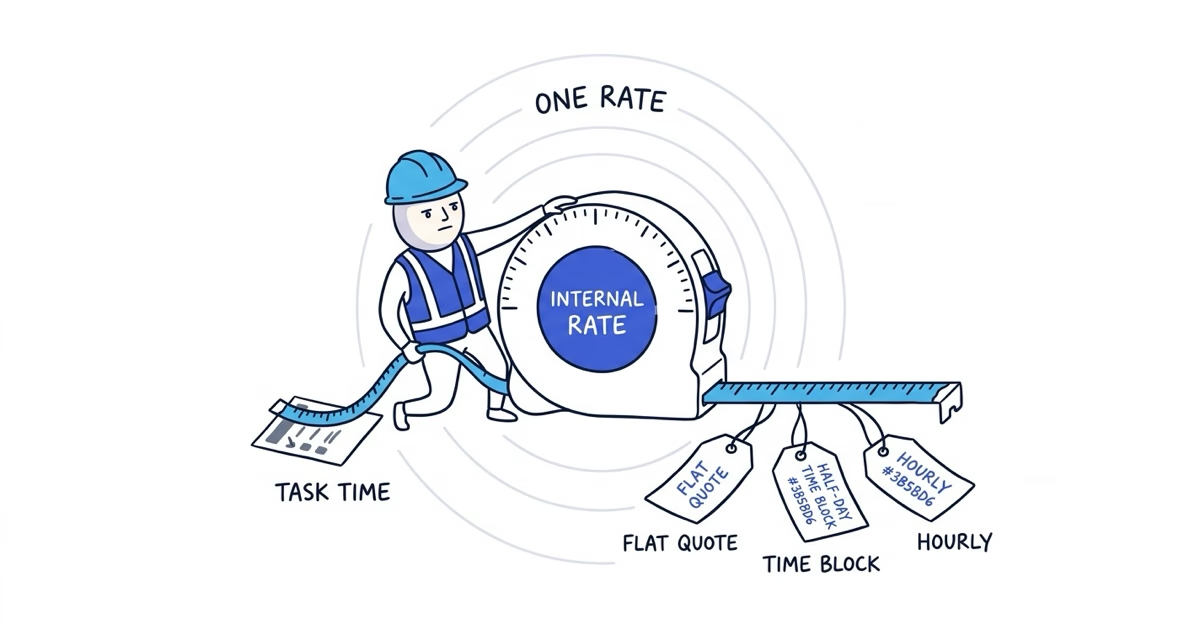
Use one internal billable-hour rate underneath every handyman quote. Turn a mixed task list into a flat quote, time block, or authorized hourly job without losing the visit minimum.
A handyman rarely loses money because the screw cost more than expected. The loss is usually in the spaces between tasks: the second trip for hardware, the shelf that found no stud, the door that needed three adjustments, and the cleanup that never made it into the quote.
Use one internal billable-hour rate underneath the job, then price the task list in the order you will perform it. The customer can receive a flat quote, a capped time block, or hourly authorization. All three come from the same rate and the same field notes.
How to calculate a handyman hourly rate
Do this at the business level, not from scratch in the customer’s driveway:
Hourly cost = desired owner pay per billable hour + monthly overhead ÷ realistic monthly billable hours
Internal billable rate = hourly cost ÷ (1 − target margin)
For a hypothetical solo handyman:
Desired owner pay: $35 per billable hour
Monthly overhead: $1,800
Realistic billable time: 90 hours per month
The owner may work 160 hours, but driving, estimates, material runs, messages, bookkeeping, and gaps are not customer labor. Spread the overhead across the 90 hours that actually appear on jobs:
$1,800 ÷ 90 = $20 overhead per billable hour
$35 owner pay + $20 overhead = $55 hourly cost
At a 25% target margin:
$55 ÷ 0.75 = $73.33
Round the internal rate to $75 per hour. Compare it with genuinely comparable local providers as a final reasonableness check, but do not let another business’s advertised number replace this business’s cost calculation.
How to estimate time for a handyman task list
Do not write “miscellaneous handyman work — four hours.” Break the visit into tasks and record what makes each task finishable.
| Task | Condition inspected | Included work | Time | Materials/job cost | Stop condition |
|---|---|---|---|---|---|
| Sticking door | Hinge/strike adjustment appears sufficient | Protect, adjust, test, clean | 0.75 hr | Hardware if needed | Stop if rot, framing, or major slab work appears |
| Two shelves | Approved location and mounting method | Layout, mount, level, clean | 1.25 hr | Anchors/hardware | Stop at electrical/plumbing conflict or unsuitable substrate |
| Small drywall hole | Size and accessible condition confirmed | Protect, patch to agreed finish, clean | 1.25 hr | Patch materials | Stop if hidden moisture or larger damage appears |
| Visit transitions | All three tasks | Setup, tool changes, room protection, final cleanup | 0.75 hr | — | — |
The transition row is where mixed-task work differs from repeating one service all day. A four-task list contains four starts and stops. Count layout, protection, moving tools, testing, cleanup, and the conversation needed before changing rooms.
Price materials with the same discipline. If the job requires a store run, count the pickup time as labor or use a disclosed procurement charge. If common hardware rides on the truck, use the business’s material-markup policy to price inventory and handling. Do not charge twice for the same pickup.
Put disposal, parking, equipment rental, and permits on the sheet when they exist. A blank or zero is better than remembering the cost after the quote is accepted.
The walkthrough also has a legal stop. Licensing and permit requirements depend on the work and location. Refer electrical, plumbing, HVAC, structural, roofing, or other regulated work when the business is not authorized to perform it. Do not hide a licensed-trade problem inside “miscellaneous repair.”
When to use flat-rate, time-block, or hourly handyman pricing
The worksheet tells you how certain the scope is:
| What you know | Quote format | Boundary |
|---|---|---|
| Task and completion condition are visible | Flat quote | Listed assumptions and change-order triggers |
| The punch list is bounded but exact completion varies | Half-day or full-day block | Tasks ranked in writing; time block is the limit |
| The condition is hidden or diagnostic | Hourly or time and materials | Written authorization cap before more work |
If choosing between those formats is still unclear, use our hourly-or-flat-rate guide to match price certainty to scope uncertainty before writing the quote. This is the handyman application of that rule, not three separate pricing systems. A four-hour block is still four hours at the internal rate. A flat task still starts with expected time at that rate.
Set the visit minimum from the same number. At $75 per hour, a two-hour floor is $150:
“My minimum residential visit is $150. That covers the first visit and work within the agreed small-job scope. If you have a few other items, send the list and I can group them into the same visit.”
The minimum is a gate. It keeps one 20-minute visible fix from consuming a 90-minute slot at a loss. It is not permission to invent work or promise two hours on site. For a longer list you cannot bound confidently, use our unknown-scope pricing guide to choose a capped authorization or quoted range before booking the work.
A $365 mixed handyman quote example
Use the inspected door, shelves, and drywall patch from the worksheet.
Door: 0.75 hour
Shelves: 1.25 hours
Drywall patch: 1.25 hours
Setup, transitions, and cleanup: 0.75 hour
Total: 4 hours
At the $75 internal rate:
4 hours × $75 = $300 labor
Customer-priced anchors, shelf hardware, patch material, and consumables total $65. The job creates no disposal charge.
Labor: $300
Materials: $65
Disposal: $0
Flat quote: $365
The calculated quote is above the $150 minimum, so the minimum does not change it.
Now write the conditions that made the task times possible:
Price assumes sound framing or approved anchors at the shelf locations, an interior door correctable by ordinary hinge/strike adjustment, and a drywall hole no larger than the inspected area. Hidden damage, electrical or plumbing conflicts, customer changes, painting beyond the agreed patch finish, and work outside the three listed tasks require approval before added work.
That paragraph is part of the price. Without it, “install shelves” can become opening a wall, “adjust door” can become repairing rot, and a small patch can become repainting the room.
Update handyman prices from completed jobs
After the job, record actual time beside each task, not only the four-hour total. If shelf pairs estimated at 1.25 hours keep taking two, change the shelf time. If each task is accurate but every mixed visit loses another half hour to transitions, increase the transition allowance.
If small calls keep hitting the minimum, invite customers to batch tasks before booking. If a bounded list repeatedly overruns a half-day, narrow what the block promises or change the block length. If store runs are the leak, stock the repeat hardware or price procurement correctly.
The internal rate gives the quote a financial floor. The task-time sheet is what makes a handyman quote specific enough to trust.
Frequently asked questions
How should I price tasks a customer adds during the handyman visit?
Estimate the added time and materials from the same internal rate, then get approval before starting. If the new task does not fit the remaining time block or changes the licensed scope, schedule or refer it instead of squeezing it into the original quote.
What changes when the customer supplies the materials?
Remove only the material you no longer provide. Inspection, handling, installation time, missing-part delays, and any limits on workmanship coverage still need written terms; customer-supplied material does not make the labor or risk disappear.
Should estimate time be included in a handyman hourly rate?
Routine unpaid estimating time belongs in the realistic billable-hours and overhead calculation behind the rate. For an unusually detailed or diagnostic estimate, charge a disclosed fee or authorization block instead of spreading unlimited pre-job work across every customer.
Sources
- pricing
- handyman
- handyman-business
- hourly-rate
- flat-rate-pricing
- small-business



