

How Do I Price Roof Repairs?
Price a roof repair from the visit, diagnosis, component, access, and hidden conditions, not the cost of the part. Build a defensible service-call floor with one complete pipe-boot example.
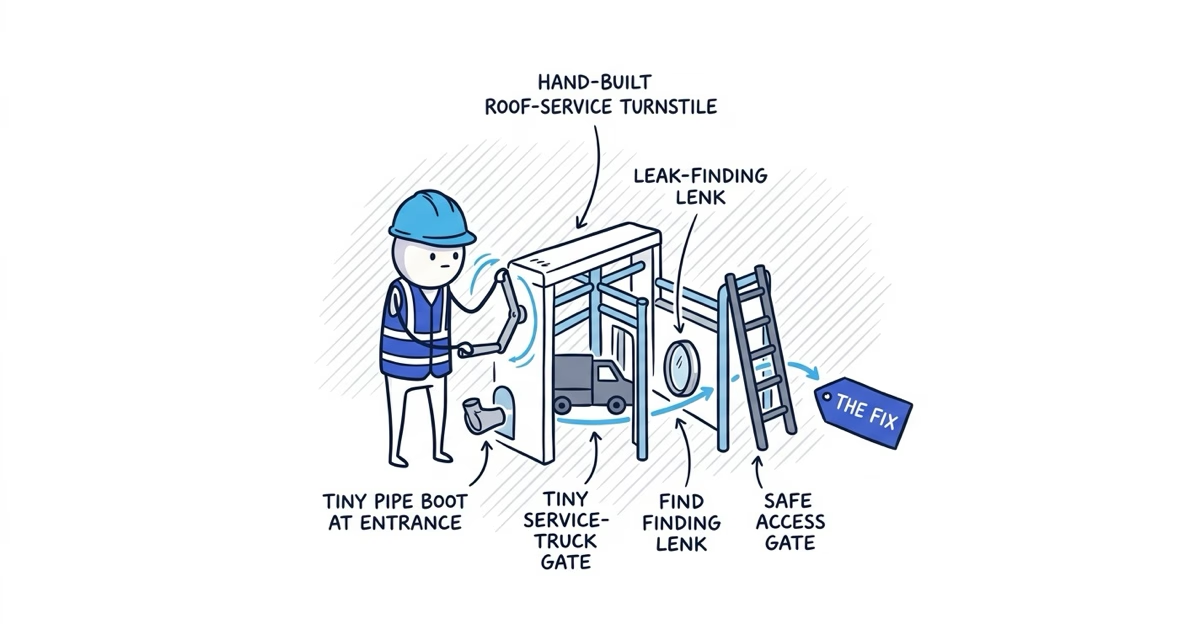
A pipe boot might cost $25. That does not make replacing it a $75 job. You still have to put an insured crew and a truck at the house, find the leak, get onto the roof, set up safely, make the repair, and stand behind it.
That is why a roof repair is not a small roof replacement. A replacement is driven by area. A repair is driven by mobilization and uncertainty. Price the visit first, then the specific fix:
Repair quote = service-call floor + diagnosis + type-priced repair + access on labor + disclosed hidden conditions
The service-call price is a floor, not another fee stacked on top of every invoice. If the diagnosed repair comes in below that floor, the customer pays the floor. If it takes more work, the additional scope builds from there.
Set a minimum roof repair price
Your minimum has to cover the cost of showing up before a tool touches the roof:
- Scheduling and dispatch
- Drive time and truck cost
- Loading, ladder setup, and fall-protection setup
- The first block of loaded labor
- Insurance and overhead carried by the visit
- Cleanup, documentation, and warranty exposure
- Your target margin
If you have not set that floor yet, use our minimum service fee guide to total the full visit cost and turn it into a profitable minimum. Then compare the result with comparable local quotes without replacing your own cost calculation. A high-cost market, steep roof, or two-person safety requirement can put your real floor higher.
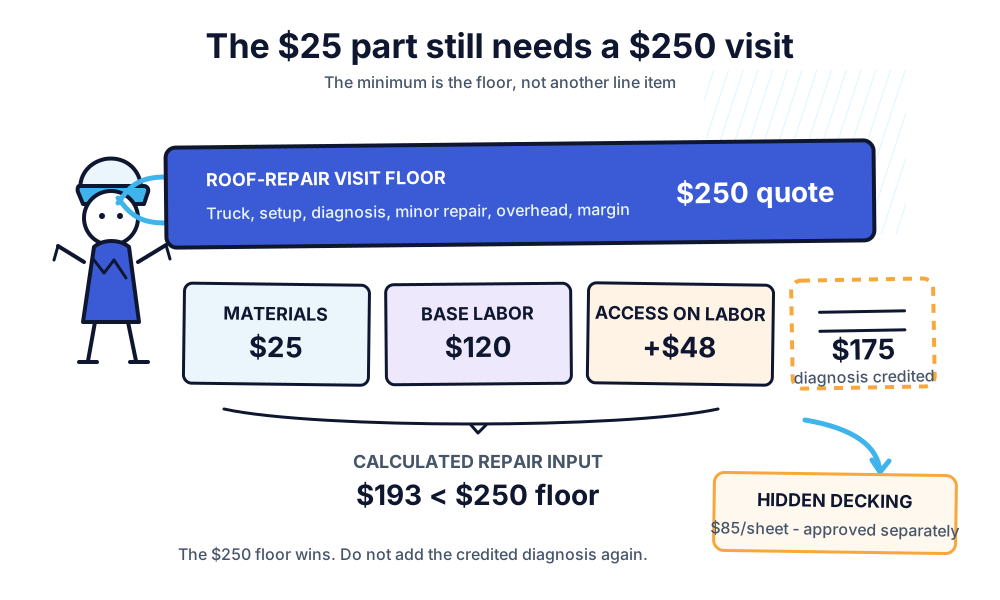
Suppose your minimum is $250. A minor repair that uses $25 in material and $120 in labor is not automatically a $145 sale. The visit still had to carry everything around those two visible lines. If the complete priced scope falls below $250, quote $250.
Do not call the minimum a trip fee if it also includes diagnosis and a minor repair. Tell the customer what the price covers. Confusing a trip fee, diagnostic fee, and service-call fee is how a simple policy turns into an argument.
How to price roof-leak diagnosis
A ceiling stain tells you where water finished, not where it entered. Water can travel along decking, rafters, fasteners, and underlayment before it shows inside. Finding the path may take longer than changing the failed boot or sealing the flashing.
Treat that work the way a mechanic treats diagnosis. The customer is paying you to identify the failure; the replacement part may be the cheap part.
Set the diagnostic price from the time, tools, documentation, and expertise involved. A visual inspection, an infrared or moisture-assisted investigation, and an investigation that requires opening a surface are different scopes. Name the included method and stopping point before assigning the price.
State the credit policy before you inspect:
“The leak diagnosis is $195. If you approve the repair while we are here, I apply that $195 toward the repair price. If you only want the findings, the diagnostic stands on its own.”
That wording separates a billable repair investigation from a free replacement estimate. A straightforward replacement estimate is often pre-sale work. Tracing an active leak is work the customer can use even if somebody else makes the repair.
Price roof repairs by component, not by roof square
A full re-roof scales with roof area. A pipe boot does not become twice as expensive because it sits on a 30-square roof instead of a 15-square roof. The setup, location, pitch, material, and hidden condition matter more than total roof size.
Use a short repair price book organized by the component and the work required. A useful entry records the component, material system, expected labor, setup, access, disposal, warranty exposure, and exclusions. “Flashing repair” might mean sealing one small failure or stripping shingles and rebuilding an entire flashing detail. The label alone is not a price.
Build each component from loaded labor, material, and allocated overhead, then use the standard margin formula:
Component price = component cost ÷ (1 − target margin)
Use the target margin your overhead and profit plan require. If your repair price book already includes that margin, do not add it again when assembling the quote.
Metal and tile also change the work. A metal panel may not be replaceable as one small patch. Walking a tile roof can break more material and expand the scope before the repair starts. Price what your crew must actually do, not the name of the damaged part.
For a complete re-roof, stop using the repair model. Use our roofing estimate guide to turn measured area, squares, waste, tear-off, system components, and replacement labor into the replacement scope.
How roof pitch and access affect repair labor
Access makes the crew slower. It does not make the pipe boot or sealant 40% more expensive.
Apply the steep or second-story adjustment to the affected labor:
Base repair labor: $120
Steep or difficult-access adjustment: 40% × $120 = $48
Adjusted labor: $168
Do not add 40% to a $300 total and call the extra $120 “pitch.” That inflates the material and any fixed fee along with the labor. In this example, 40% is the crew’s estimated additional labor for the inspected access. Replace it with the extra setup and production time your crew expects. Third-story access or rented equipment should be a named cost, not buried in a multiplier.
Count locations too. Three failed penetrations grouped together share setup. One failure by the chimney and another across a separate steep slope may require two moves, two tie-off positions, and more time. A repair price book should recognize that difference.
How to price hidden damage in a roof repair
The visible boot may be a $250 repair. Rotten decking below it can turn the visit into a much larger job. Do not silently add hundreds of dollars “just in case,” and do not promise that everything under the shingles is included.
Put the unknown in writing:
The quoted repair covers replacement of the failed pipe boot and surrounding shingles where the deck is sound. Concealed deck damage is not included. If found after removal, 4×8 decking sheets are replaced at $85 each with customer approval before installation.
Use your actual material, labor, disposal, and margin to set the decking unit price. On repairs with meaningful uncertainty, carry a disclosed allowance with a clear billing rule rather than hiding a contingency inside the base quote.
The stakes are easy to explain. A $300 boot repair today can prevent water from reaching the deck. It cannot make existing rot disappear. If the customer refuses the concealed work after you expose it, your estimate needs to say how the roof will be left and what work is still required.
A $250 pipe-boot repair example
Take one leaking pipe boot on a two-story asphalt roof. Your business has a $250 residential roof-repair minimum.
The diagnosis is $175, credited toward an approved repair. Once you find the failed boot, the direct repair looks like this:
| Repair input | Amount |
|---|---|
| New boot and repair materials | $25 |
| Base repair labor | $120 |
| Two-story access: 40% of labor | $48 |
| Calculated repair input | $193 |
The calculated work is below the $250 floor, so the quote is $250. The $175 diagnostic is not added again; it is credited into that price. The written quote still carries the concealed-deck unit price if removal exposes rot.
Now suppose the roof has two other aging boots within the same setup area. Replacing all three on the same visit might bring the total to $400–$500, depending on labor and material, instead of charging a $250 minimum on three future visits. The customer gets more useful work from one truck roll, and you do not give away the first repair.
This is the repair stack in one view:
- Floor: $250 service-call minimum
- Diagnosis: $175, credited when the repair is approved
- Fix: boot material plus repair labor
- Access: applied to the $120 labor, not the whole invoice
- Hidden condition: decking at the disclosed unit price, only if found and approved
When to repair or replace a roof
Do not turn the repair quote into a roof-condition guide. Give the customer one short decision record so they do not buy the same roof twice:
- Is the failure isolated, and is the surrounding roof sound?
- What has the customer already spent on recent repairs?
- How much useful life is a qualified inspection likely to support?
- Would the repair disturb enough material that replacement needs a separate estimate?
- Do leaks across several areas, sagging, widespread material loss, or rotten decking require a replacement-level assessment?
Show total cost over time beside the replacement option. The customer needs to see the repairs already paid, the new repair, and whether replacement still follows soon after. The full roofing estimate method owns the replacement scope once that becomes the better path.
Storm claims and after-hours dry-in are separate. Apply their insurance or emergency pricing methods instead of hiding adjuster work or urgent dispatch inside the ordinary repair minimum.
How to explain a roof repair minimum
Do not defend the price by talking about how expensive insurance is. Explain what the customer is buying:
“You are paying to safely put a licensed and insured crew, the truck, and the right gear on your roof. That setup costs the same whether the final fix takes 20 minutes or two hours. My $250 minimum covers the visit, diagnosis, and a minor repair within that scope.”
Then give them the useful option:
“If you have two other small roof items, show me while I am there. Grouping them into one visit is cheaper than paying for setup three separate times.”
A customer may still say no. That is better than sending a crew onto a roof for a price that never covered the visit.
Frequently asked questions
How should I price a roof leak I cannot locate on the first visit?
Set a limit on the initial diagnostic and stop when you reach it. Document what you ruled out, explain the next testing or opening step, and get approval for that additional diagnostic work before continuing.
How should I price an emergency tarp or storm-damage roof call?
Use a separate emergency or insurance-work method. Urgent dispatch, temporary dry-in, documentation, adjuster coordination, and permanent repair are different deliverables and should not be hidden inside the ordinary roof repair minimum.
Sources
- pricing
- roofing
- roof-repair
- service-call-minimum
- roof-leak-diagnosis
- small-business



