How Do I Avoid Duplicate City Pages?
Learn how to avoid duplicate city pages with a URL-level audit, then keep, rewrite, merge, or remove each page using evidence, traffic, and customer value.
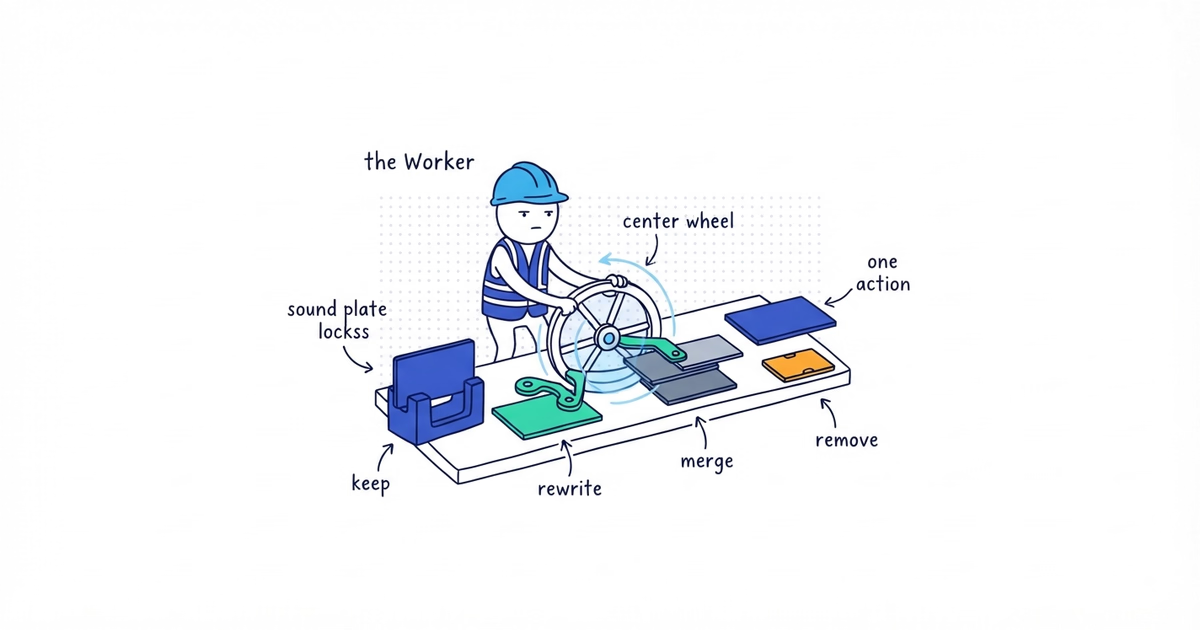
To avoid duplicate city pages, start with the job of each URL, not the shared layout. The problem is not that the buttons, service grid, or section order look alike. The problem is keeping separate URLs that serve the same customer intent, make unsupported local claims, or contain no useful reason to exist beyond a changed city name.
Give every existing city page one decision:
- Keep: The market is real, the page owns a clear intent, contains useful evidence or operating detail, and works as a complete customer destination.
- Rewrite: The city deserves a page and the missing evidence is available, but the current copy is generic or outdated.
- Merge: Two pages own the same intent, or several weak pages would serve customers better as one relevant destination.
- Remove: The market is not served, the page has no useful value, and no relevant replacement exists.
Do not fix a city-name swap by changing the title, adding synonyms, increasing the word count, or pointing a canonical tag at another page. Audit the reason each URL exists, then implement the matching content and URL action.
Google Search policy, canonical, redirect, status-code, and URL Inspection guidance checked: August 12, 2026 (United States).
Before you change any URL
Freeze new city-page publishing. Collect:
- Every current and redirected city or location URL
- Title, H1, indexability, canonical, sitemap status, and internal links
- Cities and services the business accepts today
- Projects, photos, reviews, coverage, and operating details by city
- Search Console queries and clicks by landing page
- Calls, forms, and qualified leads by page where available
- Links pointing to each URL
Do not delete first and investigate later. A weak page may still have a link, useful project material, or query intent that belongs on the surviving page.
The examples use fictional Clearline Plumbing URLs continuing the Round Rock scenario. They are instructions, not real performance data.
1. Inventory every city URL
Input: The CMS, sitemap, crawl, analytics, Search Console, redirects, canonicals, titles, H1s, and internal links.
Action: Create one row for every current or redirected city URL. Include pages absent from the menu or sitemap if they are still accessible, indexed, canonicalized, or receiving traffic.
Paste these fields into a spreadsheet:
URL | City and service intent | Title / H1 | Indexable? | User-declared / Google-selected canonical | Current service eligibility | Competing page | Local evidence | Customer-useful difference | Queries / clicks | Qualified leads | Links | Disposition | Destination or rewrite requirement | Owner / due date | Verification resultClearline’s inventory finds both /round-rock-plumber and /plumbing-round-rock-tx. Only the first appears in navigation, but the second is still accessible and receives impressions. Both belong in the audit.
Output: One complete sheet containing every city URL.
This step is complete when: Every accessible, indexed, canonicalized, or redirected city URL appears once.
If you do not have a crawler: Combine the CMS list, XML sitemap, Search Console Pages report, internal site search, and site: searches. Mark the inventory limitation instead of assuming the list is complete.
2. Test eligibility and page ownership
Input: Current operations, market economics, page titles, H1s, copy, and landing-page queries.
Action: Ask two questions for each URL.
Does the business genuinely serve this market?
Confirm that the team accepts normal qualified work there and wants more of it. A page is not eligible because the crew could make the drive once or because it used to serve the city.
If the market is no longer served, mark the page as a likely remove. It may instead merge into a broader service-area page only when that page accurately satisfies the visitor’s need. If the market decision itself is unclear, use the city-page qualification guide to test serviceability, economics, demand, and useful local proof before assigning the URL action.
Does this URL own a distinct customer intent?
Write the page’s job in one sentence:
Help a [city] customer with [service need] inspect [evidence] and [contact action].Compare pages with the same city and service. Clearline’s two Round Rock URLs both help the same homeowner find residential plumbing service. One can own that intent. The other needs to merge, even if its title uses a different word order.
Output: Service eligibility and competing-page findings for every URL.
This step is complete when: Every page has one stated customer intent and every duplicate owner is identified.
If serviceability is disputed: Pause the page and get an operating decision from the owner. Search traffic cannot decide whether the crew should accept the work.
3. Test evidence and customer value
Input: Each page, its evidence pack, project records, coverage, reviews, photos, operating details, and contact path.
Action: Run two practical checks.
First, remove the city name. Can you still identify the market through real work, coverage, or operating information? A shared layout can pass this test. A spun paragraph usually cannot.
Second, compare two pages side by side. Ask whether each customer can:
- Confirm the service is available in the city
- See real work or another supportable local module
- Understand coverage and service limits
- Inspect genuine proof
- Call, request an estimate, or book without being sent through an empty page
Do not use a required duplicate-content percentage. Google does not publish one for city pages. Adding 300 words of city history or replacing repair with fix does not create customer value.
Clearline genuinely serves Cedar Park and has a project evidence pack, but the existing page contains only generic services. Mark it rewrite. Georgetown is also generic, but the business does not accept normal work there and has no evidence. More copy would not fix the market decision; mark it remove.
Google describes doorway abuse as pages created for similar searches that lead through less-useful intermediate pages, including substantially similar pages. Its spam policies separately list blocks of text naming cities or regions to rank for as keyword stuffing. Not every shared template is a doorway. The risk appears when the separate pages have no useful independent destination value.
Output: A named evidence or customer-value finding for each URL.
This step is complete when: Every failed page states what is missing and whether truthful evidence exists to repair it.
If evidence cannot be verified: Treat it as absent. A claim does not become reliable because it is already live.
4. Check queries, links, and leads
Input: Search Console landing queries and clicks, analytics, lead records, backlinks, internal links, and URL Inspection data.
Action: Record what the cleanup must preserve.
For each page, note:
- Queries that reveal the visitor’s intent
- Useful links pointing to the URL
- Calls, forms, booked work, or qualified leads
- Internal links that must be updated
- User-declared and Google-selected canonical when duplicate behavior is unclear
Use URL Inspection for Google’s indexed version and canonical evidence. A successful live test means the page may be accessible for indexing; it does not guarantee indexing or that Google will choose the declared canonical.
Performance shapes implementation, not truth. A misleading page does not earn keep because it has impressions. A useful new page does not earn remove because missing lead tracking shows zero conversions.
The second Round Rock URL has a few links and impressions. Its content still duplicates the stronger page, so the disposition remains merge. The evidence tells Clearline to preserve useful material, update links, and redirect rather than deleting the URL without a plan.
Output: A preservation note for every page with query, link, or business evidence.
This step is complete when: No page with material evidence will change without a preservation or intentional-loss decision.
If tracking is absent: Check Search Console, links, call records, and form history. Record the remaining uncertainty; do not translate missing tracking into zero value.
5. Choose how to fix each duplicate city page
Input: Eligibility, ownership, evidence, customer-value, and performance findings.
Action: Choose keep, rewrite, merge, or remove. Put the reason and exact next action in the same row.
| URL | Finding | Decision | Required action |
|---|---|---|---|
/round-rock-plumber | Real market, clear owner, local project, working contact path | Keep | Retain URL and improve only named gaps |
/plumbing-round-rock-tx | Same market and intent; interchangeable copy | Merge | Preserve useful material and redirect to /round-rock-plumber |
/cedar-park-plumber | Real profitable market; generic current page; evidence exists | Rewrite | Rebuild on the same URL from the Cedar Park evidence pack |
/pflugerville-plumber | Some service history; weak route fit and standalone evidence | Merge | Preserve accurate coverage in the service-area hub and redirect there if it satisfies the intent |
/georgetown-plumber | Market not served; no useful material or relevant replacement | Remove | Remove links and sitemap entry; return 404 or 410 |
Use these decision rules:
- Keep only when the page is truthful, distinct, useful, and complete.
- Rewrite when the market deserves a page and the missing evidence can be supplied.
- Merge when another relevant page should own the intent.
- Remove when the page should not exist and no relevant destination replaces it.
“Make unique” is not a disposition. A rewrite row must name the missing project, coverage, proof, service boundary, or customer action. A merge row must name its destination.
Output: A complete URL disposition map.
This step is complete when: There are no maybe, make unique, or targetless redirect rows.
If a page falls between rewrite and merge: Give the missing evidence an owner and deadline. Merge the page when that evidence cannot be produced.
6. Implement the matching URL action
Input: The approved disposition map, replacement copy, redirect map, links, sitemap, and canonical configuration.
Action: Make all signals agree with the disposition.
Keep or rewrite
Keep the existing URL when practical. Publish the repaired page, point its canonical to itself, keep only that canonical URL in the sitemap, and link internally to the final URL. When a rewrite is needed, use the local landing page guide to rebuild the page from verified services, local work, coverage, proof, and a working customer action.
A canonical tag does not repair a thin standalone page. Google treats canonical as a signal for duplicate or very similar URL versions. If a city page has no independent purpose, merge or remove it.
Merge
Move useful copy, proof, and intent coverage into the relevant surviving page. Update internal links so they point directly to the survivor. Remove the retired URL from the sitemap, then use a permanent redirect to the relevant destination.
For Clearline:
/plumbing-round-rock-tx -> /round-rock-plumberAvoid redirect chains. The old URL should resolve directly to the final destination.
Remove without a replacement
Remove internal links and the sitemap entry. Return 404 or 410 when no relevant replacement exists. Do not redirect every retired city page to the homepage. An irrelevant destination does not satisfy the visitor and may be treated as a soft 404.
Clearline does not redirect /georgetown-plumber to the Austin homepage because the company no longer serves the Georgetown intent.
Do not create conflicting signals by redirecting to one URL, canonicalizing to another, and leaving the retired URL in the sitemap.
Output: Updated pages, redirects, removals, internal links, canonicals, and sitemap entries.
This step is complete when: Every old URL returns the intended status or direct destination and every surviving page is signaled consistently.
If no relevant destination exists: Use 404 or 410 and provide useful navigation on the site’s not-found page. Do not invent a target.
7. Verify the cleanup
Input: The changed site, redirect map, Search Console, analytics, and lead tracking.
Action: Test every source and destination on a phone and desktop.
Check that:
- Kept and rewritten pages load, self-canonicalize, and remain indexable
- Each merged URL resolves directly to the named survivor
- Removed pages return the intended status
- No internal links or sitemap entries point to retired URLs
- Forms, phone links, photos, and customer actions work
- Retained URLs show the expected indexed and canonical evidence over time
- Queries, calls, forms, and qualified leads are monitored by final URL
Submit the updated sitemap. Inspect retained URLs and test their live versions after the changes. Do not repeatedly request indexing as a substitute for fixing conflicting content, links, redirects, sitemap entries, or canonicals.
Output: A signed-off audit sheet with implementation and verification results.
This step is complete when: Every row has been implemented and tested, and unexpected behavior has an owner.
If Google selects an unexpected canonical or ignores a redirect: Recheck page similarity, target relevance, internal links, sitemap, and canonical signals. Fix the conflict before requesting another crawl.
The audit is finished when every city URL has a truthful purpose or a deliberate exit. The number of pages left is an outcome of that work, not a target.
Frequently asked questions
Can city pages use the same template?
Yes. Shared navigation, layouts, and conversion elements are not the problem. Each URL still needs its own customer purpose, truthful market evidence, and a useful reason to remain a standalone destination.
Should I delete a city page that gets no traffic?
Not for that reason alone. Check whether the market is served, whether the page owns a distinct intent, whether useful evidence exists, and whether tracking is complete before choosing rewrite, merge, or remove.
How long does duplicate city page cleanup take to affect Google?
There is no fixed timeline. Verify the redirects, canonicals, internal links, sitemap, and final pages first, then monitor crawling, selected canonicals, queries, and leads instead of promising a ranking date.
Sources
- duplicate-city-pages
- duplicate-location-pages
- doorway-pages
- city-page-audit
- local-seo