How do I get commercial landscaping contracts?
Learn how to get commercial landscaping contracts by finding named properties, qualifying buyers, checking scope, and choosing accounts your crew can deliver.
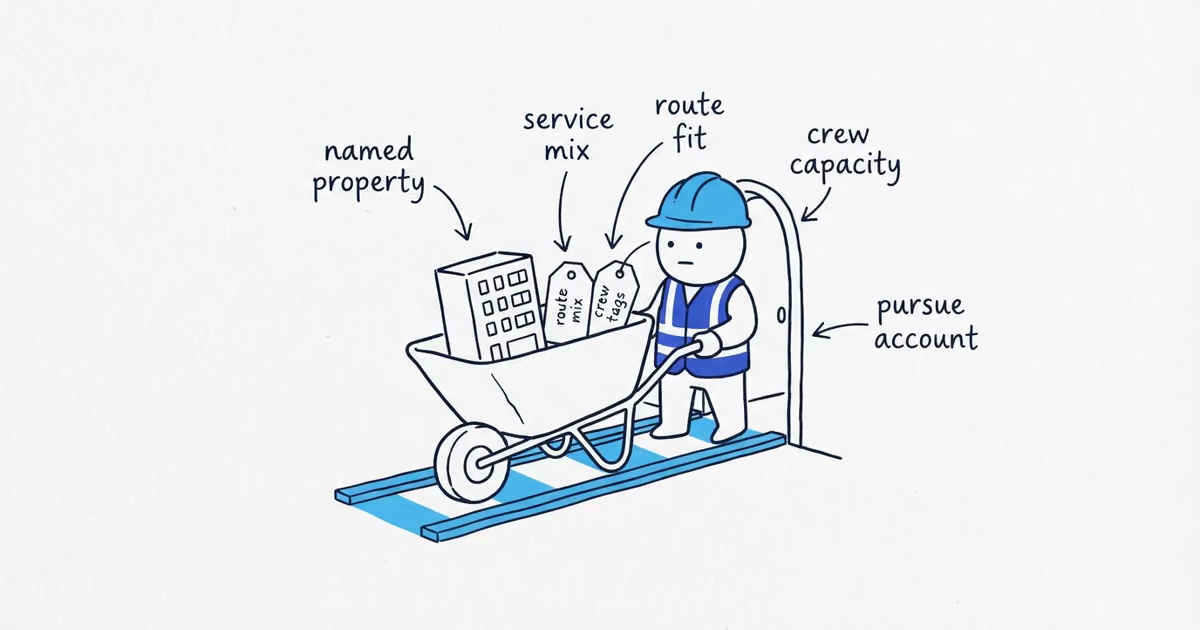
Get commercial landscaping contracts by choosing a property and service pattern you can deliver now, finding a named site and its buyers, showing truthful proof, qualifying and inspecting it, and advancing only accounts that pass scope, route, capacity, administration, and cost checks into pricing or proposal work. No step promises an award.
This covers private grounds, enhancement, renovation, or installation bought by businesses, managed properties, facilities, HOAs, multi-site operators, builders, general contractors, and nongovernment buyers. It excludes public procurement and legal drafting.
Recurring mowing and turf-care routes, stop density, scheduling, frequency, review timing, renewals, and route upsells belong in How do I get commercial lawn care contracts? Record mowing here only as part of a broader verified grounds scope.
Last verified: September 2, 2026 (United States).
How to choose commercial landscaping accounts
Start with job records, crew availability, and supplier history. No segment is always best. The SBA’s market-research guidance recommends checking demand, location, customers, alternatives, and saturation at named local properties.
Define one pattern: property type, service area and mix, buyer role, route or mobilization limit, normal window, crew and supervision capacity, equipment and supplier path, and relevant proof. Set no-fit rules for distance, windows, capacity, and unqualified specialist work.
The SBA says license and permit requirements vary by activity, location, and government rules. Verify the service, site, buyer, authority, and jurisdiction; there is no universal credential list.
Commercial Landscaping Account Pursuit Worksheet
Copy both tables into a spreadsheet, one row per property.
| Account field | Completion criteria |
|---|---|
| Account and site | Named account and exact property or locations. |
| Property and grounds pattern | Property type and grounds pattern relevant to supported work. |
| Buyer and stakeholder roles | Named people or confirmed roles for selection, access, approval, requirements, and invoices. |
| Verified opportunity or review trigger | Sourced and dated review, private opportunity, referral, property change, or invitation; never a guess. |
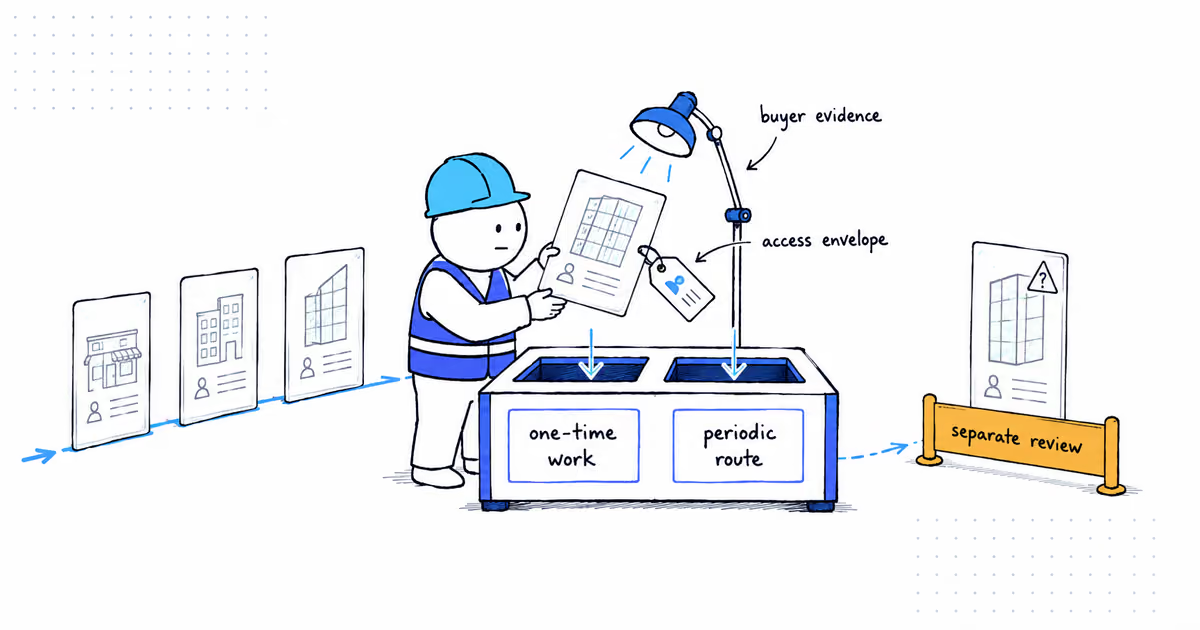
| Supported service mix | Tasks separated into broader recurring grounds, seasonal or periodic, one-time enhancement, and installation or renovation work. |
| Route or mobilization fit | Checked against travel limit, commitments, window, and mobilization ability. |
| Site, access, and seasonal constraints | Included zones, condition, access, traffic, staging, utilities, debris route, work window, season, and customer responsibilities recorded. |
| Relevant proof and current capacity | Permission-cleared, matched proof plus verified crew, supervision, equipment, supplier, seasonal, and backup capacity. |
| Buyer process and dates | Confirmed review steps, vendor conditions, key dates, access, and invoice path. |
| Opportunity stage | One observable stage: researched, contacted, qualifying, site visit, pricing handoff, proposal, hold, or declined. |
| Owner and next action/date | One named person, one specific action, and a calendar date. |
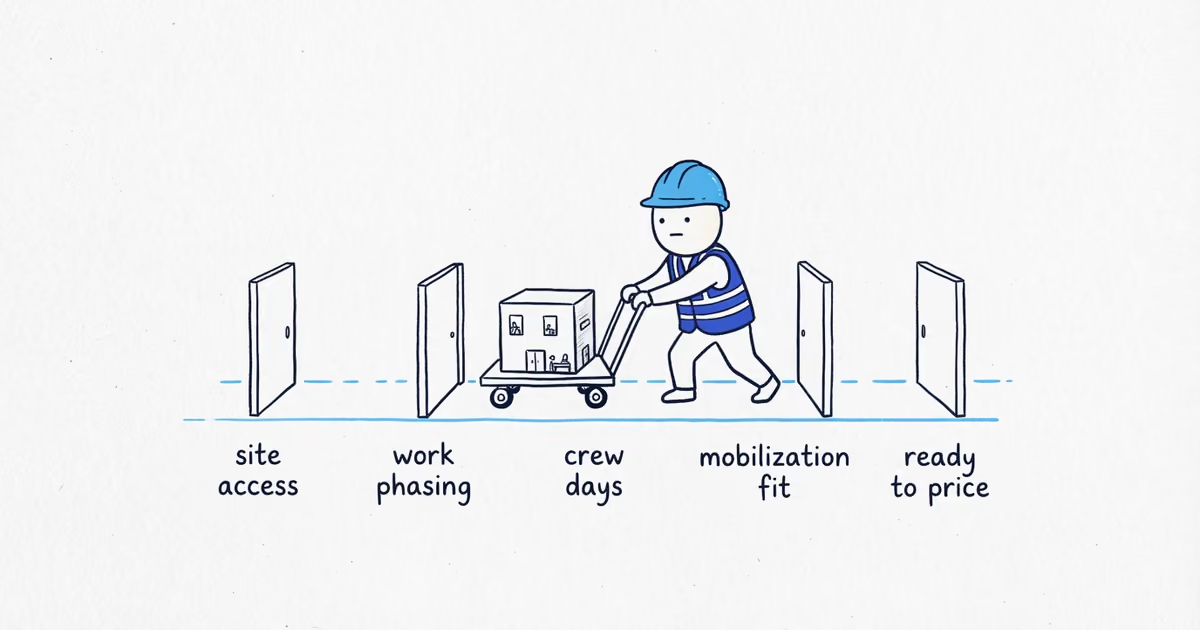
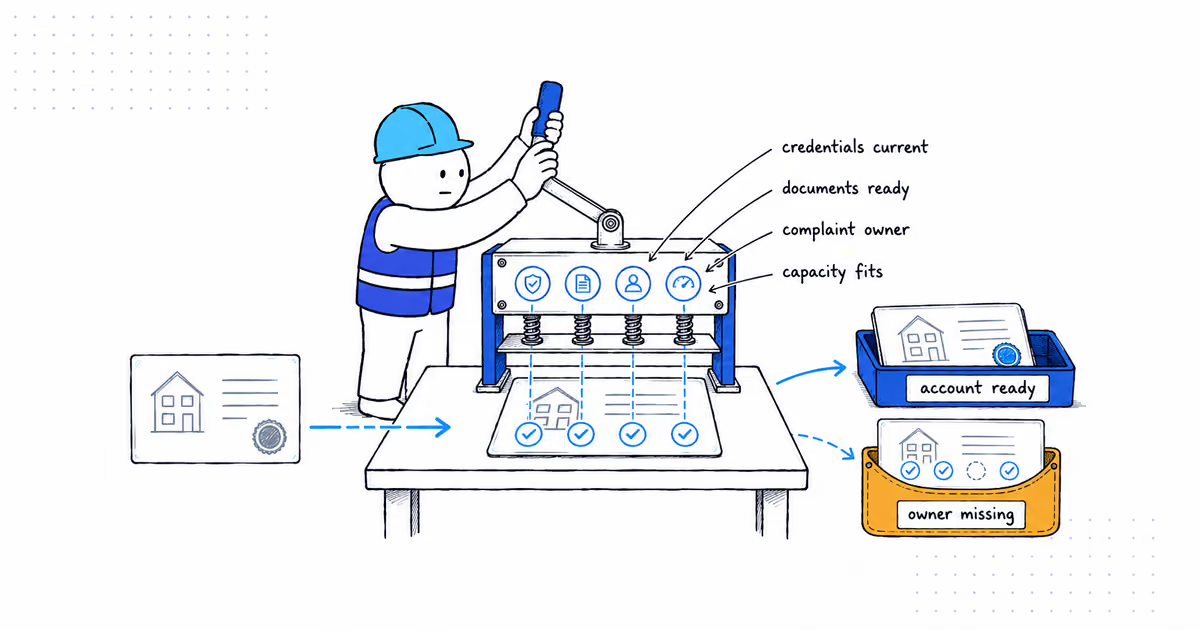
Run this gate before a proposal and before acceptance.
| Gate check | Evidence to record | Pass, hold, or decline reason |
|---|---|---|
| Scope | Zones, tasks, timing, options, exclusions, assumptions | Clear and supported or not. |
| Route or mobilization | Travel, loading, setup, current commitments | Inside the operating limit or not. |
| Site and service window | Access, traffic, staging, storage, utilities, debris route, season, buyer’s window | Constraints work or not. |
| Crew and supervision | Skills, reliable hours, supervisor, backup | Delivery capacity exists or not. |
| Equipment and suppliers | Available equipment and confirmed dependencies | Delivery path is dependable or not. |
| Specialist work | Irrigation, pesticide, drainage, grading, tree, or other specialist item; included, excluded, buyer-controlled, referred, or awaiting review | Boundaries resolved or not. |
| Buyer administration | Approval, requested documents, reporting, startup commitments | Known administration fits or not. |
| Invoice path | Recipient, method, evidence, review, payment process | Understood and workable or not. |
| Direct-cost check | Labor, supervision, travel, equipment, materials, suppliers, backup, administration | Company-record check supports pricing or not. |
| Remaining capacity | Commitments versus start, season, window, and project schedule | Can accept without displacing promised work or not. |
Where to find commercial landscaping contracts
Start with a named site and a sourced reason. Use customer or supplier introductions, permission-safe referrals, local relationships, relevant association directories or events, property and company websites, private opportunities, and buyer notices.
| Possible role | What to confirm | Named-account channel |
|---|---|---|
| Property or facility manager | Service selection, access, or review | Property site, management connection, notice, referral |
| Owner or operations manager | Need definition or approval | Company site, current relationship, business introduction |
| HOA or association contact | Grounds decision, access, or approval | Official route, relevant event, referral |
| General contractor or builder | Project scope, site coordination, approval | Trade or supplier relationship, company site, private opportunity |
| Procurement contact | Buyer requirements and review steps | Buyer notice, official vendor route, stakeholder introduction |
| Accounts-payable contact | Completion evidence and invoice process | Buyer or procurement introduction after qualification |
A building address is not an opportunity. Record the source and date for each review, private opportunity, referral, property change, invitation, or other trigger.
What commercial landscaping buyers need to verify
Check your business details, service area, mobilization reach, and current crew, equipment, supplier, seasonal, and supervision capacity. Share only permission-cleared proof matched to the property and work.
The FTC’s advertising guidance says claims must be truthful, nondeceptive, and evidence-based. Apply that to service, experience, results, credentials, environmental practices, response, and capacity. Delete unsupported claims; never invent a client, project size, result, license or insurance status, certification, response time, or guarantee.
Use only current, verified documents requested by the buyer or authority and suitable to disclose. When a buyer accepts a one-page company summary, use the contractor capability statement guide to package current services, capacity, and relevant proof without treating the document as approval. Property-management onboarding is separate, and vendor-list entry is not a contract.
How to contact commercial landscaping decision-makers
Hi Jordan, Pat at Greenway Supply suggested I contact you about the grounds and seasonal enhancement review at Cedar Gate Offices. We provide commercial bed, shrub, hardscape-edge, and seasonal enhancement work in the local area. Are you the person who owns that review, or could you point me to them? If the scope fits, I can take a short qualification call or arrange a site visit.
This is one-to-one, not a sequence. The FTC says CAN-SPAM has no business-to-business exception. Commercial email needs accurate sender and subject information, a valid postal address, a clear opt-out method, and honored opt-outs. This is not legal advice.
How to qualify a commercial landscaping opportunity
Confirm locations, stakeholders, grounds problem, service mix and timing, provider or trigger when shared, review process, key dates, vendor conditions, start, access, invoice path, and operating fit. Unknown locations or authority mean hold; name who resolves it.
At the site, identify included beds, planted areas, hardscape edges, trees or shrubs, turf within the broader scope, and seasonal or enhancement areas. Record condition, gaps, gates and keys, crew and equipment access, staging, loading, parking, storage, utilities, debris route, traffic, service window, weather or season, and customer responsibilities.
Record irrigation, pesticide, drainage, grading, tree, or other specialist work as present, excluded, buyer-controlled, referred, or requiring qualified review. Never assume it is included.
Split recurring grounds work, seasonal or periodic work, one-time enhancements, and installation or renovation into distinct scope, timing, capacity, and proof entries. “Full-service landscaping” is not a usable scope.
Hand the pricing owner the account, contacts, areas, service mix, buyer-supplied frequency or window, constraints, customer responsibilities, requested proof and documents, assumptions, options, decision dates, and next owner/action. Once those fields are verified, use the landscaping pricing guide to turn the scope, crew, materials, disposal, equipment, and overhead inputs into a job price. Proposal construction belongs in What should a contractor proposal include? The general sequence belongs in How do I get commercial contracts for my service business?
Which commercial landscaping accounts should you pursue
In this fictional entry, a supplier introduces Cedar Gate Offices for a grounds and seasonal enhancement review. The contact identifies selection, access, procurement, and invoice roles. The company has permission-cleared proof from comparable office work.
The owner separates recurring grounds from seasonal enhancements. The visit records zones, access, traffic, staging, window, debris route, season, and buyer responsibilities. Irrigation stays buyer-controlled. The estimator checks route, supervision, equipment, suppliers, backup, administration, invoices, costs, and capacity against company records.
The result is Pass. Owner: Maya, estimator. Next action/date: transfer the verified scope and assumptions to pricing on September 4, 2026. Unresolved irrigation responsibility means Hold. A window conflicting with reliable crew capacity means Decline, with the reason recorded.
After handoff, confirm receipt, record the decision process, answer requested questions, and keep one owner and dated action. Stop on a decline or opt-out. A contact, vendor-list entry, visit, or proposal is not a contract or earned revenue.
Frequently asked questions about commercial landscaping contracts
Do I need a capability statement to get commercial landscaping contracts?
Not for every account. Prepare accurate buyer-ready facts and relevant permission-cleared proof first. Use a capability statement when the buyer requests one or the channel supports it; it does not replace property qualification, a site visit, pricing, or a proposal.
How do I get HOA landscaping contracts?
Treat the HOA as one named private buyer, then verify who controls the grounds decision, approval, access, and invoice process. Pursue the property only when the service mix, review trigger, site constraints, and current capacity pass the same account gate.
- commercial-contracts
- how-to-get-commercial-landscaping-contracts
- commercial-landscaping-accounts
- commercial-landscape-maintenance-contracts
- commercial-landscaping-decision-makers
- landscaping