How do I get commercial roofing contracts?
Learn how to get commercial roofing contracts by finding named properties, verifying buyer needs, and qualifying commercial roofing opportunities that fit.
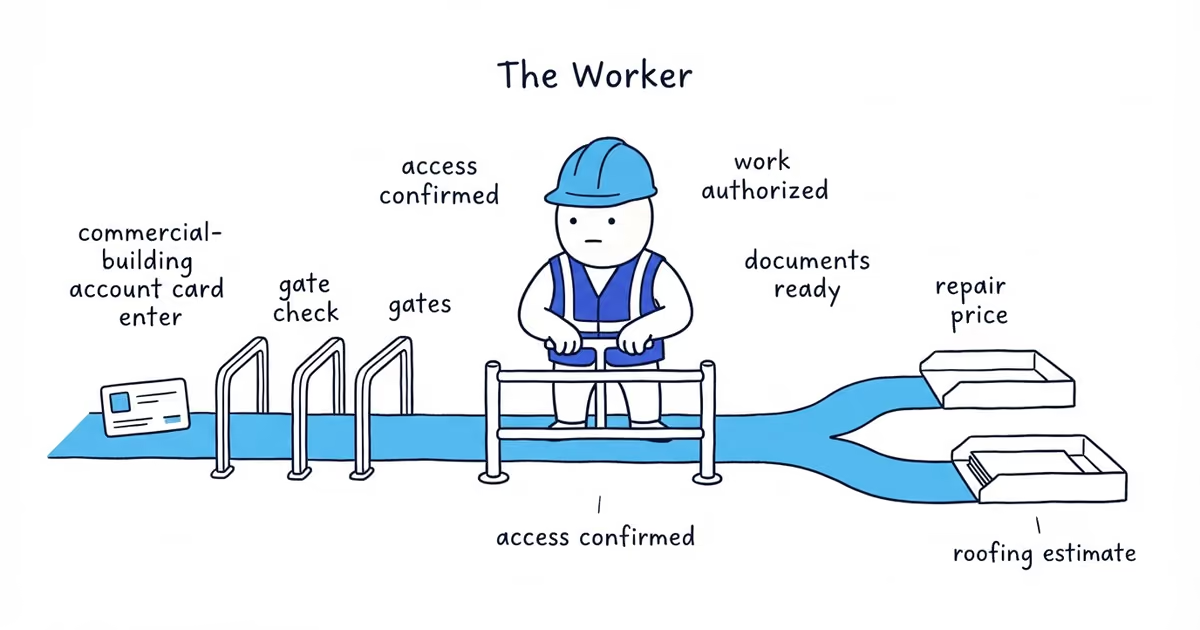
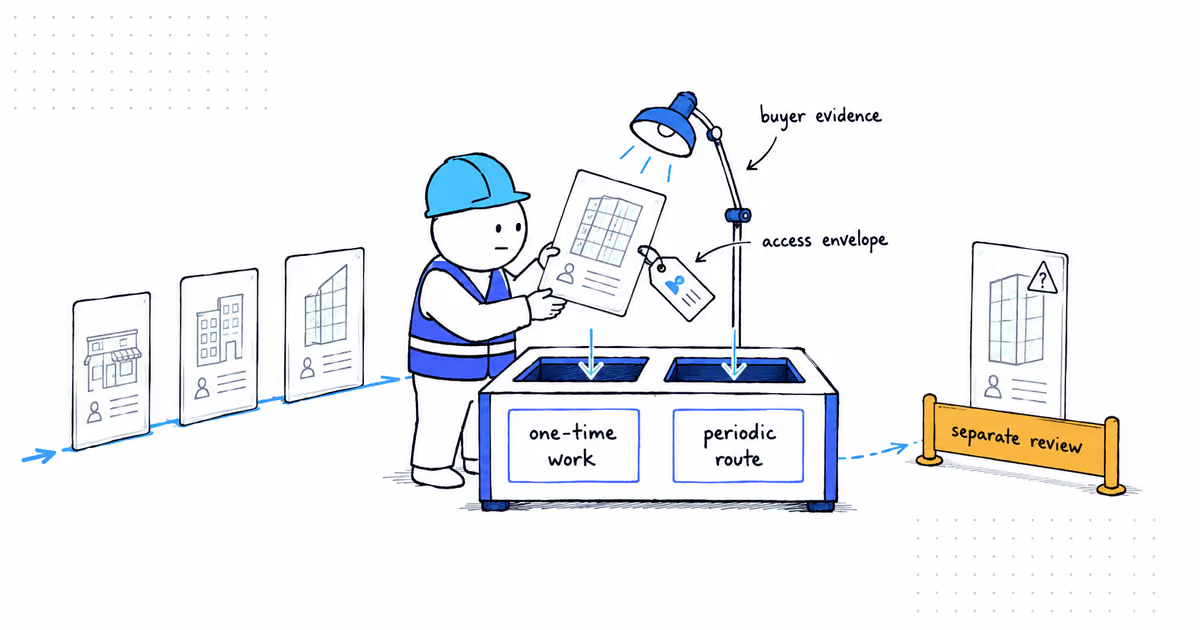
Get commercial roofing contracts by choosing a supportable private property and work pattern, finding named sites and buyers, requiring a verified trigger, showing relevant proof, and checking access, mobilization, scope, administration, direct costs, and capacity before estimating. This earns a pursuit decision, not an award.
The target is privately purchased service, maintenance, repair, replacement, or improvement work for nongovernment owners, managers, businesses, builders, or general contractors. Government procurement, claims, legal drafting, and technical or safety instruction are excluded.
A property is not an opportunity; a contact is not the buyer; vendor approval is not authorization. A visit is not a bid, and a proposal is not an agreement or earned revenue.
How to choose commercial roofing work to pursue
Start with company records, not a supposedly profitable property type. The US Small Business Administration’s market-research guidance recommends checking demand, location, target customer, saturation, alternatives, and entry conditions. Apply these to named properties and completed work.
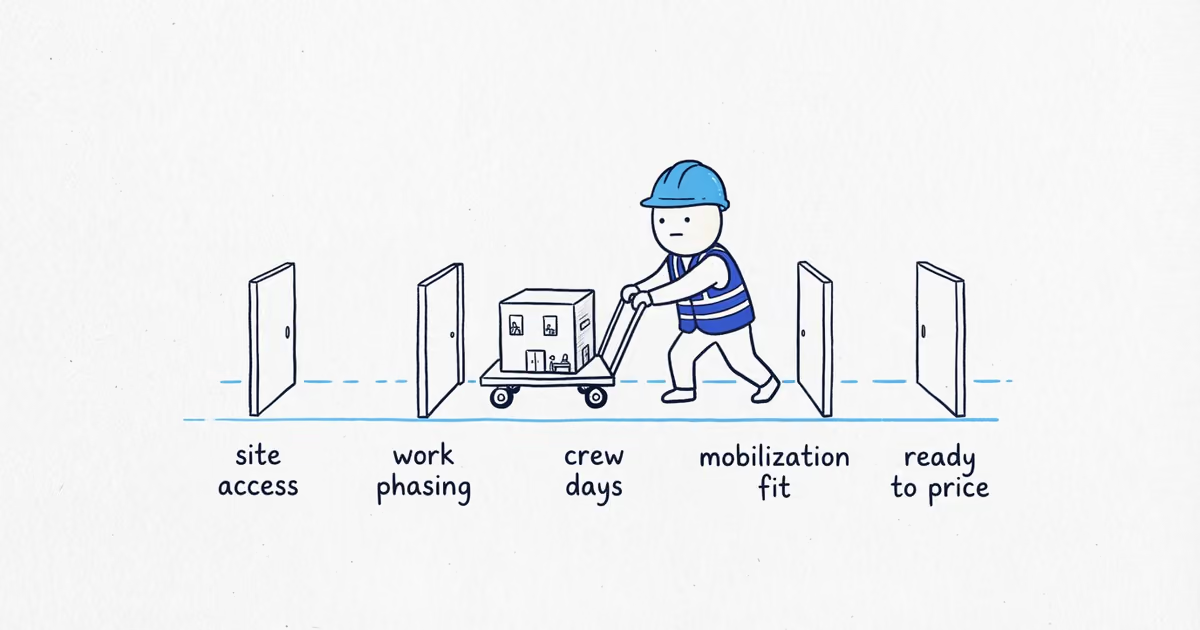
Define one starting pattern: geography, building use, supported work, documented asset pattern, access and work-window limits, travel and mobilization, crew and supervision, equipment and suppliers, subcontractors, proof, buyer, and no-fit conditions. Keep service, repair, replacement, and improvement paths separate. Every site in a multi-site opportunity must fit.
Commercial Roofing Opportunity Pursuit Board
Copy this table for each property. Any blank field means hold.
| Field | Complete when | Your entry |
|---|---|---|
| Account and site | Exact private account and site are recorded. | |
| Property and building-use pattern | Use and operating pattern have a source. | |
| Buyer and stakeholder roles | Selection, records, access, approval, requirements, operations, and invoice owners named. | |
| Verified account or project trigger plus source/date | Referral, invitation, opportunity, change, review, or buyer statement has source/date. | |
| Buyer-stated roofing need and project stage | Buyer’s exact need and stage, without diagnosis. | |
| Roof or asset facts plus document source | Known facts cite buyer records; unknowns remain marked. | |
| Supported work pattern | One supported work pattern is selected. | |
| Site, access, and occupied-use constraints | Authorization, occupancy, security, escort, and window recorded. | |
| Travel and mobilization fit | Limits checked against company records. | |
| Permission-cleared proof | Approved proof matches property, work, and need. | |
| Current delivery capacity | Crew hours, supervision, equipment, suppliers, subcontractors, and seasonal load are confirmed. | |
| Buyer process and dates | Review, due, decision, start, communication, and invoice owners/dates. | |
| Opportunity stage | Current observable stage is recorded. | |
| Owner plus next action/date | Owner, action, and date assigned. | |
| Pass, hold, or decline reason | Decision cites gate evidence. |
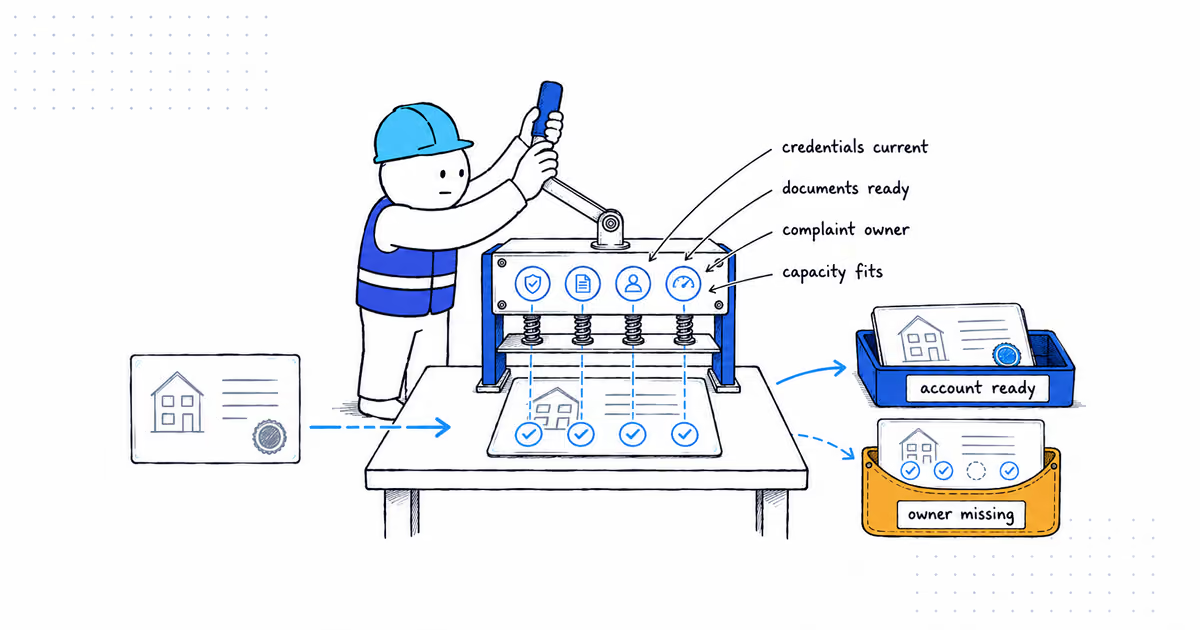
Run the opportunity through this gate before spending estimating or proposal time.
| Check | Evidence required | Pass, hold, or decline |
|---|---|---|
| Buyer and authority | Named people and actual authority | |
| Trigger | Verifiable source and date | |
| Supported work and property pattern | Company record matches the need and documented facts | |
| Scope or buyer documents | Available and missing files listed | |
| Authorized visit and access feasibility | Confirmed through the company’s qualified process | |
| Geography and travel | Actual route and travel burden checked | |
| Mobilization and site logistics | Parking, loading, staging, storage, movement, and debris route recorded | |
| Occupied use and work window | Operations, security, neighbors, season, and window recorded | |
| Crew skill and reliable hours | Current qualified crew availability documented | |
| Supervision and backup | Current supervision and any promised backup confirmed | |
| Equipment and staging | Availability and site fit recorded without prescribing methods | |
| Suppliers or subcontractors | Dependencies, availability, and unresolved conditions named | |
| Administration and invoice path | Requirements, authorization, communication, invoice, and payment route confirmed | |
| Claim or specialist boundary | Insurance-claim or unsupported specialist work is separated or declined | |
| Direct costs and startup cash | Company records support proceeding; no selling-price formula | |
| Remaining capacity | Available capacity fits the stated window |
How to find commercial roofing decision-makers
Map buyer functions instead of treating the first contact as the whole process.
| Possible role | Confirm this function |
|---|---|
| Building owner or asset manager | Selects or approves the contractor and work |
| Property or facility manager | Supplies records, requirements, and operating constraints |
| Operations or site contact | Controls practical access and site communication |
| General contractor or builder | Issues a private invitation and manages its review process |
| Buyer-appointed consultant or specifier | Supplies project documents or recommends a contractor |
| Procurement contact | Communicates buyer conditions and approval steps |
| Accounts payable contact | Confirms invoice and payment routing |
Start with a named property or relationship: customer or supplier introductions, permission-safe referrals, local owner or manager relationships, relevant association directories or events, official company sites, builder invitations, private opportunities, and buyer notices.
Require a sourced reason before contact. Imagery, weather, an assumed claim, or a guessed contract date does not qualify.
What commercial roofing buyers need to see
Use exact business details, supported work and geography, permission-cleared proof, and current capacity. Share only current verified documents requested by the buyer or authority. The Federal Trade Commission says claims must be truthful, nondeceptive, and evidence-based. Delete unsupported experience, credential, approval, relationship, safety, quality, warranty, response, savings, storm, insurance, or result claims.
In the fictional example below:
Jordan referred me regarding the buyer-confirmed roofing project review at the privately managed Harbor Point Offices. We support planned commercial roofing projects in the North District. Who owns the contractor review, and would a short qualification call or authorized site visit help with the next step?
Send it one to one, without a diagnosis, attachment, automation, or sequence. The FTC’s CAN-SPAM guidance says there is no business-to-business exception. Commercial email needs accurate sender and subject information, a valid postal address, a clear opt-out method, and honored opt-outs.
Last verified: September 2, 2026 (United States).
The SBA notes that license and permit needs vary by activity, location, and government rules. Verify the actual work, property, authority, and jurisdiction. Avoid universal credential lists.
How to qualify a commercial roofing opportunity
Before a visit or bid, confirm each building, buyer role, stated need, work pattern, stage, record, review process, dates, work window, vendor condition, access authorization, occupied-site constraint, communication route, invoice path, and fit. Record an incumbent only if the buyer shares it.
At an authorized qualification visit, record included buildings and areas, buyer-supplied records, visible scope boundaries without diagnosis, access authorization, keys or escort, occupancy, security, operations, parking, loading, staging, storage, material or equipment movement, debris route, work window, weather or season, nearby-property constraints, customer responsibilities, exclusions, and assumptions.
Do not improvise roof-access or safety procedures. OSHA’s construction fall-protection material supports recording only whether a visit is feasible under the company’s qualified safety process and applicable requirements. This article gives no access, inspection, staging, or roofing method.
Handoff: account, contacts, sites and areas, stated need, work pattern, document sources, constraints, customer responsibilities, requested proof and documents, assumptions, separate work, buyer process and dates, owner, and action. Confirm receipt, record the review path, keep one owner and date, and stop on a decline or opt-out. When a passed repair handoff is ready for a number, use the roof repair pricing guide to turn its verified visit, access, and repair inputs into a supportable price. When a passed replacement or improvement handoff has documented scope ready for estimating, use the roofing estimate guide to organize takeoff, scope, options, exclusions, and price into a customer-ready estimate. Generic acquisition stays with How do I get commercial contracts for my service business?; onboarding with How do I become a vendor for property management companies?; proof and proposal documents with What should a contractor capability statement include? and What should a contractor proposal include?; billing with How do I invoice a roofing job? Commercial bidding and agreements remain separate.
Frequently asked questions about commercial roofing contracts
Do I need a capability statement to get commercial roofing contracts?
Not for every opportunity. Start with current business details, permission-cleared proof matched to the property and work pattern, and verified delivery capacity. Use a capability statement only when the buyer asks for one or the channel calls for it; it does not replace site qualification.
How do I get commercial roofing maintenance contracts?
Start with a named property and a buyer-confirmed maintenance review or need. Qualify the requested work pattern, property facts, authorized access, mobilization, documentation, and current capacity as separate evidence; do not assume a standard visit frequency, price, or agreement.
How do I become a roofing vendor for a property management company?
Use the property management company’s official vendor route and confirm which current documents, approval steps, work-authorization controls, and invoice requirements apply. Vendor approval may place your company on a list, but it does not award a roofing project or authorize work.
When to pursue a commercial roofing contract
In this fictional example, Northline Roofing receives a permission-safe introduction to Harbor Point Offices after its manager confirms a project review. Maya maps selection, documents, access, approval, operations, and invoices. The buyer supplies available records and the project stage. Maya records access authorization, occupied use, parking, loading, staging, debris route, work window, and assumptions. She verifies matched proof permission, then checks travel, mobilization, crew hours, supervision, equipment, suppliers, subcontractors, seasonal load, direct costs, startup cash, and capacity.
The property, trigger, buyer, proof, and delivery pattern pass. The buyer has not yet confirmed the authorized roof-access route or who will provide the missing project document. That is not a reason to estimate around assumptions.
Decision: HOLD. Owner: Maya Ortiz. Next action: ask the property manager to confirm the authorized access route and document owner by September 4, 2026.
- commercial-contracts
- how-to-get-commercial-roofing-contracts
- commercial-roofing-opportunities
- commercial-roofing-maintenance-contracts
- commercial-roofing-decision-makers
- roofing