How do I grow a lawn care business?
Learn how to grow a lawn care business with a 90-day plan for recurring customers, route density, renewals, weather backlog, and reliable crew capacity.
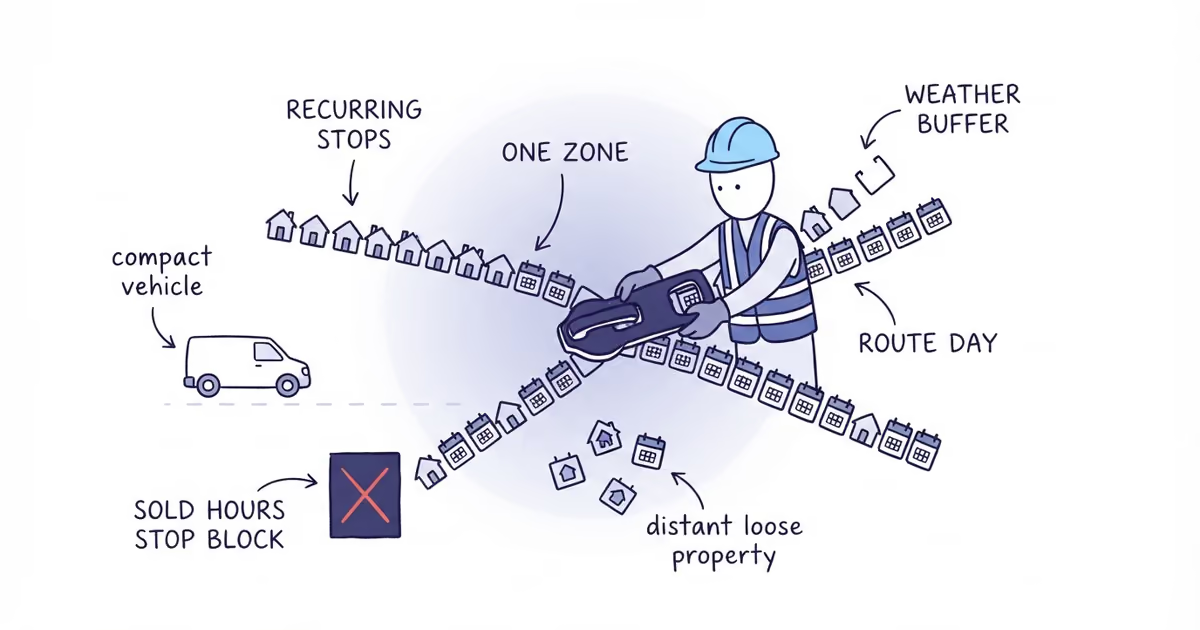
Grow a lawn-care business by building and retaining compact recurring routes, not collecting disconnected mowing jobs. Choose one recurring offer and target customer, assign real zones to service days, renew or onboard suitable customers, fill one weak route at a time, and add capacity only when sold work supports it. Healthy growth means more suitable properties completed reliably with less avoidable non-service time and enough crew, equipment, vehicle, weather, and schedule capacity to keep each promise.
Last verified: August 28, 2026 (United States).
This article owns recurring mowing and routine lawn-service packages, route days, stop density, renewal, retention, neighborhood filling, and supportable route add-ons. Project-led landscaping is separate: design, hardscape, grading, major planting or installation, irrigation installation, project estimates, visual portfolios, material staging, backlog, and project capacity do not count as recurring-route growth.
How to define a recurring lawn care service and route
Use one primary recurring offer for the next 90 days. Write down:
- Target customer or property and real service area
- Visit frequency and operating season
- What a routine visit includes and excludes
- Access requirements and promised service window
- Weather and reschedule rule
- Completion communication
- Renewal or continuation rule
- Pause or cancellation rule
- Payment timing under the existing policy
- Route days or zones with actual room
Do not copy a rate, discount, contract term, or margin from another company.
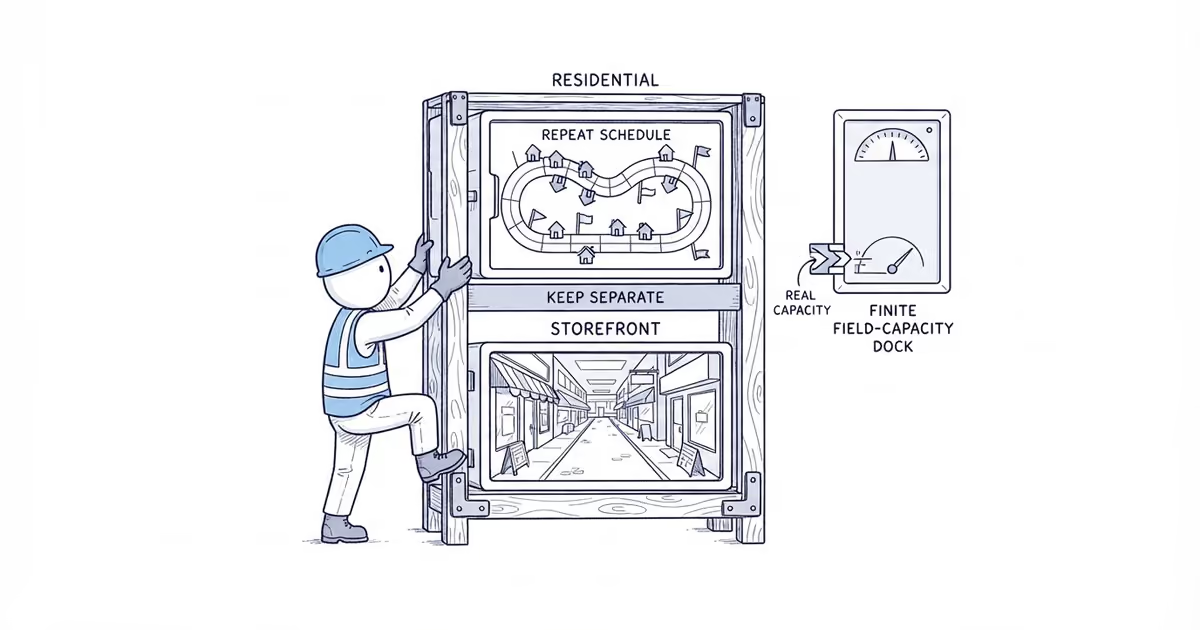
Keep residential work separate from small commercial or HOA accounts. An account fits only when its scope, frequency, buyer process, access, service window, reporting, geography, crew hours, equipment, and payment process fit the route. Commercial work is not an automatic next step.
Build one route-fill board. Give every recurring property a zone and service day, residential or fit commercial/HOA status, package and frequency, season, promised window, estimated and actual crew hours, drive and paid non-service time, weather backlog state, equipment or vehicle constraint, renewal or onboarding state, add-on state, pause or cancellation reason, source, owner, and next action.
Days 1-14 for lawn care route mapping and capacity
Audit active, recently canceled or paused, and relevant past customers. Put each property on the board. Mark unknown data instead of guessing.
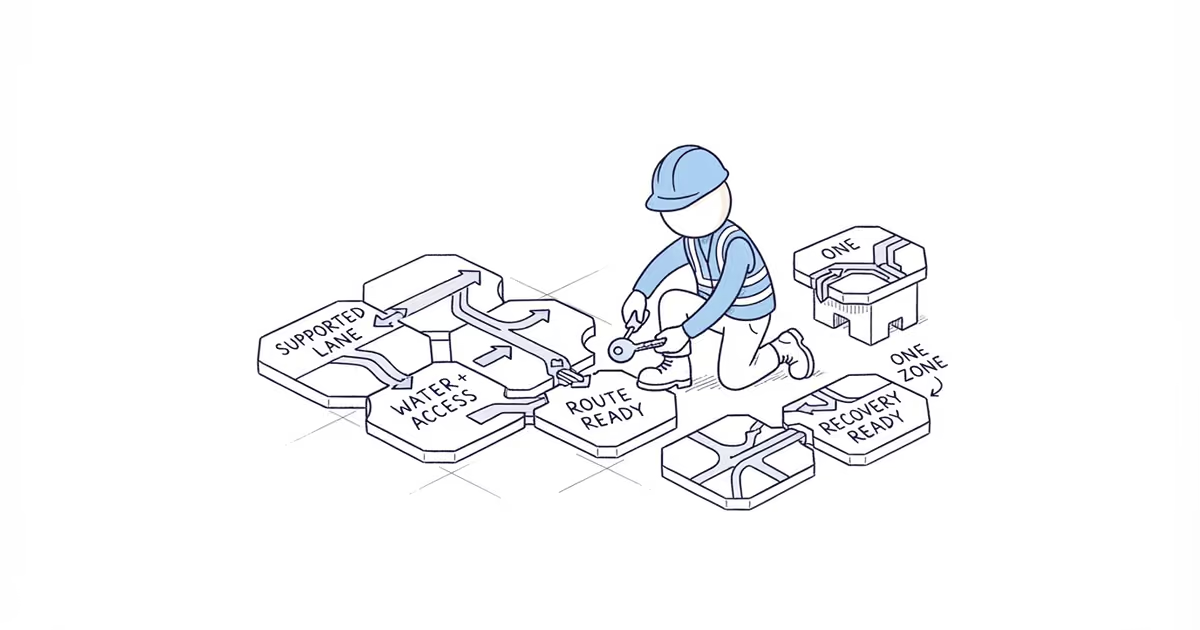
Group active properties into a few workable zones, assign each zone to a service day, and show the current sequence. Name the weakest route day using your own stops, service hours, drive time, and paid non-service time. One distant lead is not a reason to open a new service area.
Set a capacity baseline by route day. Compare sold recurring hours with reliable available crew hours after actual travel, loading, unloading, maintenance, weather, rescheduling, and other operating constraints. Record the crew skill, mower or other equipment, truck or trailer, access, and service-window constraint that can make nominal hours unusable.
Use this diagnostic:
Route-day service share = completed recurring service hours / total paid route-day crew hours
The denominator includes drive and other paid non-service time. Compare only your own zones, days, and weeks. This is not a universal route-density or utilization benchmark.
Also record stops or recurring service hours, route-day revenue from your records, drive minutes, and contribution or contribution per crew hour only when the business already uses one consistent accounting definition. A partial contribution measure is not net profit.
Deliverable by Day 14: a populated route board with one weak route named, available recurring slots visible, unknowns marked, and no landscaping project work inside the route results.
Days 15-30 for lawn care customer renewal and local SEO
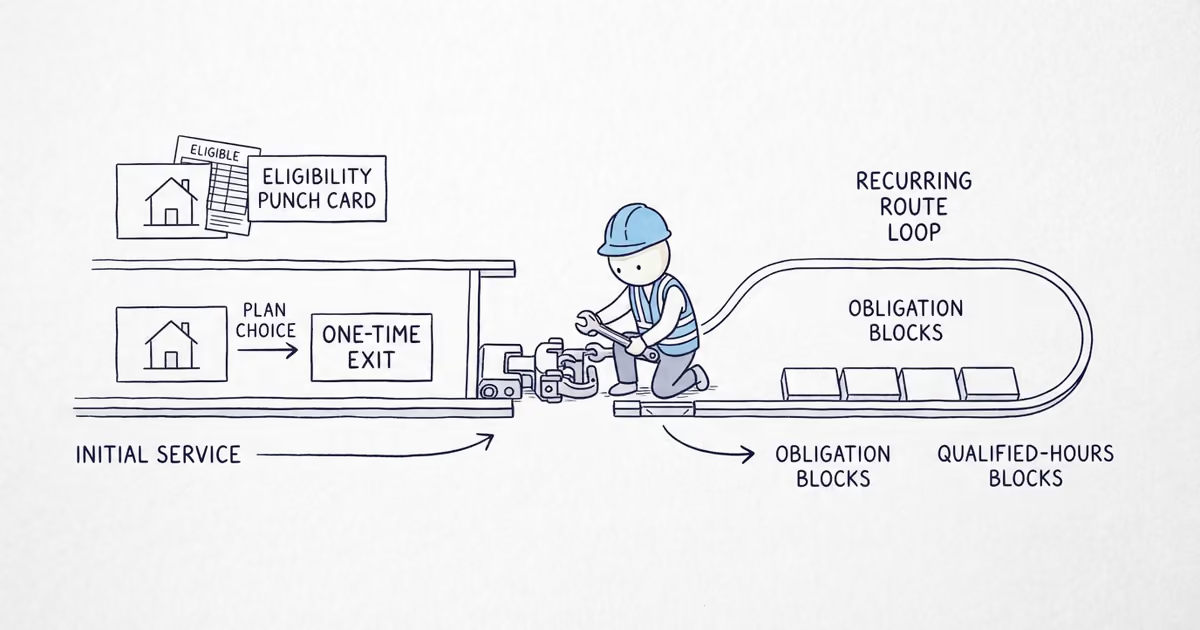
In a seasonal market, contact eligible prior recurring customers before or during the spring restart. Confirm the current scope, frequency, access, start window, and changed policies before assigning an accepted customer to a zone and day. In a market without a winter shutdown, use the next real renewal, customer-anniversary, or route-reset window instead of inventing a spring restart.
If the customer has a valid renewal trigger but the reminder and booking path is still unclear, the customer rebooking guide helps choose a confirmed booking, request-for-review, or call workflow.
Use a message like this:
Hi [name], our records show we previously provided [actual service and frequency] at [property]. For the upcoming [season or period], we are offering [current scope and frequency], which includes [included item] and excludes [excluded item]. If you want us to check availability for your zone, reply by [real next-step date]. We will confirm the service day and start window after checking route capacity.
Audit one eligible Google Business Profile. Check the real-world name, fewest accurate categories, hours, phone, website, address or service-area treatment, actual services, and permission-cleared photos. Use Lawn care service only when it describes the core business. Do not add Landscaper merely as a keyword.
Google says local results are mainly based on relevance, distance, and prominence. Accurate profile information helps it understand the business, but more service areas, categories, photos, or reviews do not guarantee rank.
If the profile is accurate but still does not produce enough suitable inquiries in the route zones being filled, ShiftFlow’s Google Maps ranking audit can show which profile, review, listing, and website signals need attention.
Build one useful page for the recurring service and only useful pages for genuine service areas. State who the service fits, scope, frequency or season, access, weather and rescheduling, what affects an estimate or start date at a high level, and the next contact step. Do not clone city pages.
Answer customer questions visibly: which areas are served, whether recurring service is available, what a visit includes, how weather delays and access work, whether restart is required, and how to request a quote. Use accurate, permission-safe proof from real crews, equipment, completed routine work, and company processes.
Treat AI-search work as accurate local SEO plus visible answers and first-party proof. Test the same real customer questions in search-enabled tools, note whether the public facts are accurate and which pages or profiles appear as sources, then correct owned facts. Google says no special AI markup is required. Crawlability, structured data, reviews, and direct answers do not guarantee a citation or recommendation.
Give every inquiry an owner and next action. Capture contact, property, requested work in the customer’s words, recurring or one-time intent, access, timing, zone fit, and route-day fit. Measure response against a staffed target the company can meet, then record booked, no-fit, deferred, lost, or no-response.
Deliverable by Day 30: eligible recurring customers assigned to real zones and days, one accurate local-to-booking path, and every suitable lead owned through an outcome.
Days 31-60 for lawn care route density
Choose one route gap. Prioritize suitable properties near existing stops through honest neighbor introductions, permission-cleared nearby proof, local discovery, referrals from customers with resolved experiences, and relevant past-customer reactivation. Every demand action should name the zone and day it is intended to fill.
Use a neighbor introduction without pressure or a rating request:
Thanks for having us care for [property]. We are filling limited recurring availability near your route on [day or window]. If a neighbor asks about [current service], you can share our contact details. There is no need to send anyone, and this is separate from any review request.
Reactivate from actual history:
Hi [name], we previously provided [actual service] at [property] in [real period]. We now have a current [scope and frequency] option for your zone around [available timing]. If you want us to check the property and route fit, reply here. If not, we will close this follow-up.
Use reviews as a quality and proof loop. Ask eligible customers for an honest review under one neutral rule, provide a direct link, keep reminders restrained, and never gate requests, request positive sentiment, or condition incentives on a review. Do not ask after every recurring visit. Google and FTC guidance require honest handling; complaints belong in service recovery, not a filtered list.
For retention, record visit completion, material weather or schedule changes, current property and access notes, the issue owner, and recovery under the real policy. Code pauses and cancellations by reason. Review callbacks, rework, credits, and weather backlog before adding work.
Recurring retention = accounts active at period start and still active at period end / accounts active at period start
Use one consistent rule for declared pauses and seasonal shutdowns. Keep renewal or onboarding acceptance separate, and compare only your own periods.
Deliverable by Day 60: a denser target route measured against its baseline, with source, booking, retention, drive time, quality leakage, and weather backlog visible.
Days 61-90 for weather backlog and route capacity
Compare planned with actual crew hours. Examine drive and non-service time, move customers only when real commitments allow it, adjust future slot promises, and keep a visible weather-reschedule backlog. Routing software can help, but traffic, access, equipment, conditions, and customer commitments still need owner review.
Test an add-on only after the primary route is stable. It must be a service the company actually offers, can perform competently and lawfully, can describe truthfully, and can fit without breaking recurring commitments. Do not treat fertilizer, pesticide, herbicide, irrigation, or another regulated or technical service as a default growth move. Requirements vary by activity and location; verify applicable rules, credentials, insurance, and operational capability with the relevant authorities before offering or advertising such work.
Before adding crew hours, a truck, trailer, mower, or another route, require a practical block of sold recurring work that the current route cannot absorb reliably. Onboarding, supervision, cash before collection, equipment, storage, maintenance, weather buffer, and service recovery must also be ready.
Deliverable by Day 90: keep, fix, stop, or defer decisions for each route, source, account type, add-on, and capacity change, plus the next route-fill priority.
Lawn care route metrics to track weekly
| Measure | Definition and use |
|---|---|
| Qualified leads by zone and source | Count leads fitting the offer, area, customer, target route gap, and capacity; retain no-fit and deferred reasons. |
| Useful response and booking outcome | Record staffed response against the company’s target, then booked, deferred, no-fit, lost, or no-response. |
| Renewal or onboarding acceptance | Eligible recurring accounts accepting the current offer / eligible accounts contacted under one rule. Keep this separate from retention. |
| Recurring retention | Use the formula above with one pause and shutdown rule; compare only the owner’s periods. |
| Route-day service share | Use the formula above to compare zones and days, never as an industry target. |
| Route-day production | Track stops or recurring hours, revenue, drive or non-service minutes, and owner-defined contribution only when consistently calculated. |
| Reliable capacity coverage | Compare sold recurring hours with reliable crew hours after travel, weather, rescheduling, loading, maintenance, equipment, vehicle, service-window, onboarding, and supervision constraints. |
| Schedule and quality leakage | Track planned versus actual hours, weather backlog, callbacks, rework, credits, cancellations, and pauses with consistent reasons. |
Use the board to decide. Weak renewal means fix the offer, eligibility, start-window promise, or follow-up before widening. Unowned nearby leads mean fix intake before buying demand. Excess non-service time means fill or consolidate the target route before opening a zone. Falling retention or rising callbacks, credits, or weather backlog means pause and repair recovery. Defer any commercial/HOA account or add-on that disrupts geography, windows, equipment, or recurring commitments, regardless of revenue. Add capacity only when sold work forms a useful block and cash, onboarding, supervision, maintenance, weather buffer, and recovery are ready.
Do not open a new area for one lead, mix landscaping projects into route results, promise a slot before checking capacity, add an unverified service, buy equipment for hoped-for work, hire against lead volume, hide weather backlog or drive time, chase fake reviews or AI shortcuts, or send paid demand into slow, unowned intake.
Frequently asked questions about growing a lawn care business
How many customers should a lawn care route have?
There is no universal stop count. A route is full when recurring service, travel, loading, weather and reschedule allowance, equipment, vehicle, service windows, and supervision use the reliable capacity available for that day.
How should a lawn care business handle weather delays?
Keep a visible weather-reschedule backlog, communicate material schedule changes, and move customers only when their real commitments allow it. Review planned versus actual hours, callbacks, and recovery before adding more work to the affected route.
Should I add commercial lawn care accounts to a residential route?
Only when the scope, frequency, buyer process, access, service window, reporting, geography, crew hours, equipment, and payment process fit the route. Track commercial or HOA work separately and defer it when it disrupts recurring commitments.
Sources
- Google Business Profile: Guidelines for representing your business
- Google Business Profile: Tips to improve your local ranking
- Google Business Profile: Manage your service areas and categories
- Google Business Profile: Ask for and manage reviews
- Federal Trade Commission: Soliciting and Paying for Online Reviews
- Google Search Central: AI features and your website
- US Small Business Administration: Licenses and permits
How to decide whether to expand a lawn care route
Keep what improves the route without breaking delivery. Fix one named bottleneck: offer, renewal, intake, route gap, retention, weather recovery, or capacity. Stop repeated no-fit work. Defer unsupported expansion.
- local-seo-foundations
- how-to-grow-a-lawn-care-business
- lawn-care-route-density
- get-recurring-lawn-care-clients
- lawn-care-customer-retention
- lawn-care-route-planning