How Much Do Plumbing Business Owners Make?
No reliable national average exists. Compare three plumbing scenarios modeling $107,827, $146,244, and $276,660 in owner compensation.
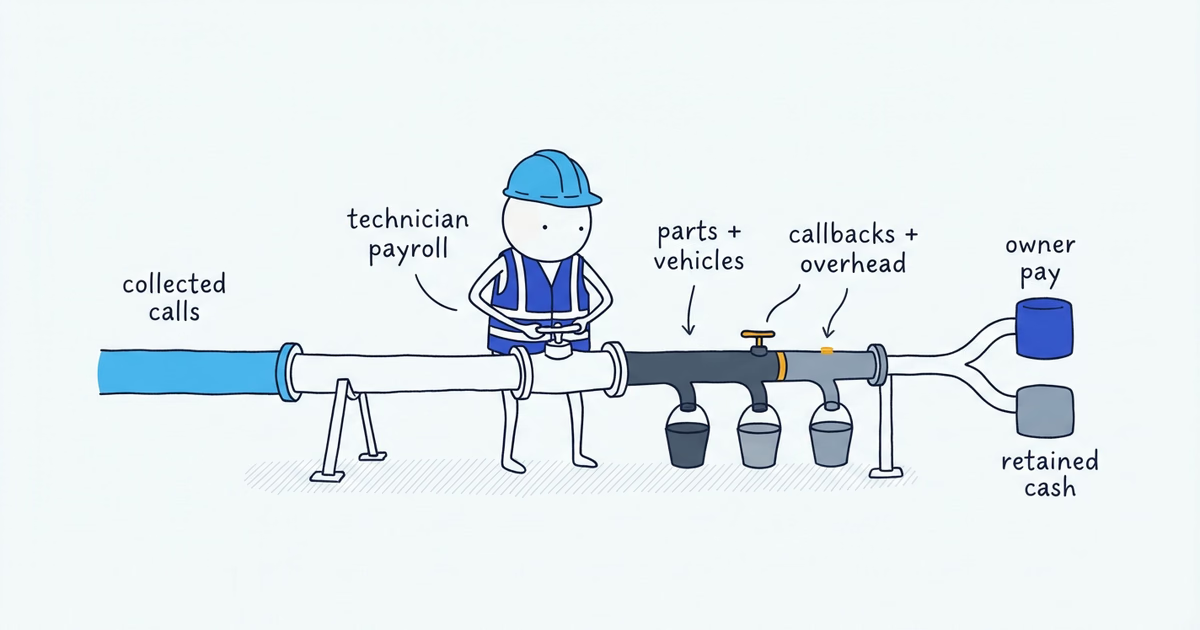
There is no reliable national average salary for a plumbing business owner in the public datasets we reviewed. Census reports business receipts, BLS reports employee wages, and salary websites publish estimates without a representative view of company books. None of those sources directly measures what plumbing owners pay themselves and leave in the business.
A transparent operating model gives a more useful answer. In three service-plumbing scenarios, the business supports $107,827, $146,244, or $276,660 in planned annual owner compensation before personal tax.
| Planning scenario | Collected revenue | Owner compensation | Retained cash | Owner field hours |
|---|---|---|---|---|
| Owner-operator | $259,200 | $107,827 | $26,957 | 120/month |
| Small service team | $756,000 | $146,244 | $62,676 | 40/month |
| Established service team | $2,070,000 | $276,660 | $184,440 | 0 |
These are three different business shapes, not low, average, and high owner salaries. The model covers dispatched residential and light-commercial service calls. It does not model new construction, large bid projects, excavation, or HVAC work. In the first two scenarios, owner compensation pays for both management and the owner’s field labor.
Is Plumbing Business Revenue the Same as Owner Income?
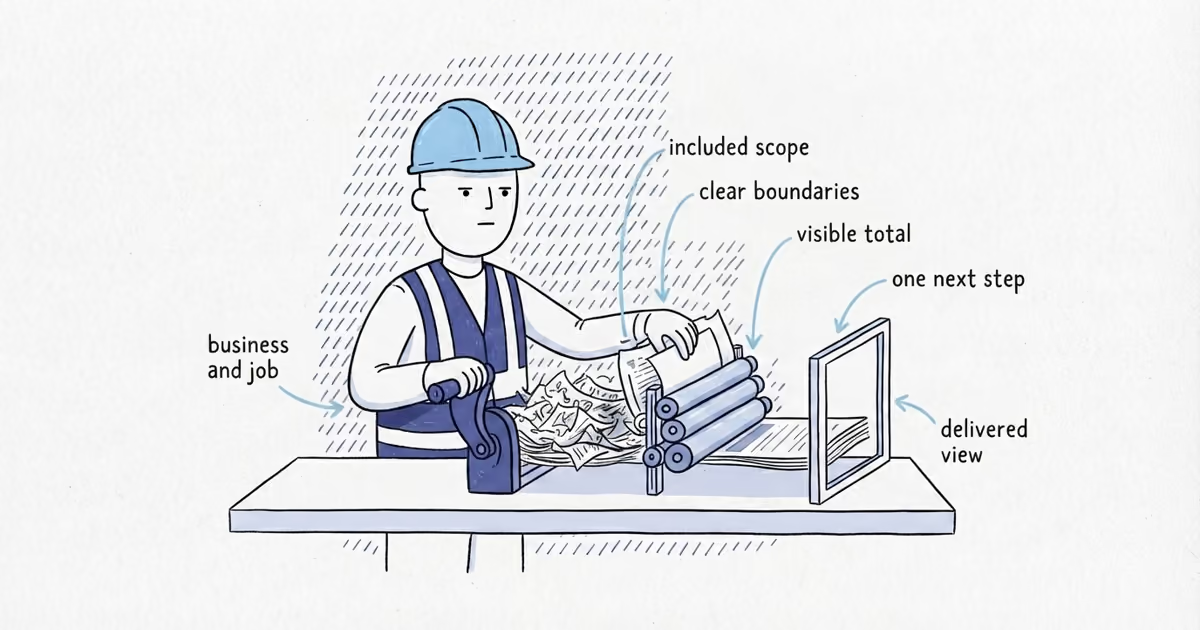
Five numbers keep the answer from drifting.
Collected revenue is customer money that has actually been paid, not quotes sent or invoices still outstanding.
Technician payroll is the loaded cost of non-owner field labor, including the wage plus the employer costs included in the scenario rate.
Other operating costs include parts, vehicles, fuel, merchant fees, permits, callbacks, insurance, marketing, dispatch, software, bookkeeping, and other overhead.
Owner compensation is the planned wage, draw, or distribution paid to the owner. The model does not prescribe the correct entity or payment method for a specific business.
Retained cash remains after the planned owner payment. It helps fund slow collections, truck repairs, hiring gaps, and future investment, but it is not a complete tax or capital plan.
How Much Can a Small Plumbing Business Owner Make?
The small-team example uses two paid technicians completing three calls per working day over 48 weeks. That produces 1,440 completed calls per year. At a $525 average collected ticket, annual revenue is $756,000.
Where $756,000 of Small-Team Revenue Goes
Source: ShiftFlow planning model. Percentages use collected revenue; inputs are shown below.
The payroll line uses 3,840 paid technician hours at a loaded rate of $46 per hour. Parts take 22% of collected revenue. Vehicles, fuel, merchant fees, permits, and callbacks take 9%. Overhead takes 18%. That leaves $208,920 before owner compensation. The model pays 70% of that subtotal to the owner and retains 30%.
The $208,920 subtotal is not labeled profit because the owner still contributes about 40 field hours per month for estimates, difficult jobs, overflow, and callbacks. Owner field labor appears only in the compensation line.
Plumbing Business Owner Earnings Model Assumptions
The assumptions were prepared in August 2026 as replaceable planning inputs. They are not a representative survey or a promise of performance. An owner should substitute trailing 12-month call, payroll, parts, overhead, and collection records before using the output for a decision.
| Input | Owner-operator | Small service team | Established service team |
|---|---|---|---|
| Completed calls per year | 576 | 1,440 | 3,600 |
| Average collected ticket | $450 | $525 | $575 |
| Paid non-owner field hours | 0 | 3,840 | 9,600 |
| Loaded technician cost | N/A | $46/hour | $49/hour |
| Parts and materials | 20% | 22% | 25% |
| Vehicles and other direct costs | 10% | 9% | 10% |
| Overhead | 18% | 18% | 20% |
| Owner field hours | 120/month | 40/month | 0 |
| Pre-owner cash paid to owner | 80% | 70% | 60% |
The owner-operator case is roughly three calls per day, four days per week, over 48 weeks. The team cases are three calls per paid technician day over the same 48-week operating year. Actual tickets and call capacity vary sharply by market, job mix, emergency work, technician skill, dispatch distance, and parts content.
The calculation is intentionally short:
collected revenue
  = completed calls x average collected ticket

cash before owner compensation
  = revenue - technician payroll - parts - other direct costs - overhead

owner compensation
  = cash before owner compensation x planned owner share

retained cash
  = cash before owner compensation - owner compensation
What Census Data Shows About Plumbing Contractors
The 2023 Census Nonemployer Statistics data contains 178,663 U.S. nonemployer establishments and $14.01 billion in aggregate receipts for NAICS 238220. Dividing those figures gives an arithmetic mean of $78,389 in receipts per establishment.
That number is not an owner salary, profit figure, or typical full-time revenue. Nonemployer records can represent part-time businesses, and receipts are measured before expenses. More importantly, NAICS 238220 combines plumbing, heating, and air-conditioning contractors. It cannot be described as a plumbing-only sample.
The official data is useful because it shows why a national take-home average is not available. It is not useful as a replacement for the service-call model above.
If the number you need is employee pay rather than ownership income, the plumber salary guide compares the $30.67 national median with hourly and annual wages across every state.
What Changes Plumbing Business Owner Earnings?
Collected ticket. The booked or invoiced ticket does not pay costs until the customer pays it. In the small-team model, a 10% increase in the collected ticket with call volume unchanged adds $75,600 in revenue. After the model’s percentage-based costs, about $38,556 reaches cash before owner compensation.
Calls per paid hour. Ten percent more paid technician hours with no extra calls removes $17,664 from small-team pre-owner cash. The first place to inspect is not wrench time. It is drive time, parts runs, schedule gaps, late starts, and jobs that were estimated incorrectly.
Parts and callbacks. Parts-heavy replacements produce more revenue but also more pass-through cost. Callbacks are worse because they consume payroll, fuel, and parts without a new collected ticket. Reducing the modeled other-direct cost allocation from 9% to 8% adds $7,560 before owner compensation. When repeat visits disappear into ordinary job time, the callback and warranty hours guide explains how to separate them from revenue-producing capacity.
Retained cash. A truck failure or slow receivable month can absorb a large owner draw quickly. The examples retain 20%, 30%, and 40% of cash before owner compensation as the team grows. Those are model choices, not universal targets.
When paid technician hours are difficult to connect with the call that produced them, time tracking for plumbing crews makes travel, callbacks, and low-recovery jobs visible before they quietly lower owner pay.
How to Calculate Your Plumbing Business Owner Income
Start with the last 12 months of collected revenue and completed calls. Dividing the first number by the second gives your collected ticket. Next, total paid non-owner field hours and use a loaded hourly cost that includes the employer payroll costs you actually incur.
Group the remaining spending into parts, other direct costs, and overhead using the same definitions every month. Record owner field hours even when they are not on payroll; otherwise the model can mistake unpaid owner labor for business profit. Then choose how much pre-owner cash to retain before testing an owner compensation amount.
Run the calculation once with trailing results and once with a conservative next-year forecast. If the forecast depends on more calls, confirm that the schedule has the technician capacity to complete them. If it depends on a higher ticket, check whether the proposed job mix and close rate support it. The purpose is not a precise prediction. It is to make the assumptions visible enough to challenge before cash leaves the business.
Frequently Asked Questions
How much does a plumbing business owner make?
No public national dataset provides a reliable average. The three service-call examples here produce $107,827, $146,244, and $276,660 in planned owner compensation before personal tax. They are separate models, not a market salary range.
How much can a solo plumbing business owner make?
The owner-operator example produces $259,200 in collected revenue, $107,827 in owner compensation, and $26,957 in retained cash. It assumes 576 completed calls at a $450 average collected ticket.
Is plumbing business revenue the same as owner income?
No. Revenue comes before technician payroll, parts, vehicles, permits, callbacks, insurance, marketing, dispatch, and overhead. Owner compensation and retained cash come after those costs.
What affects plumbing business owner earnings most?
Collected ticket, calls per paid hour, parts usage, callbacks, travel, overhead, and retained cash policy are major levers. Revenue alone does not answer what the owner can take home.
Sources
- plumbing-business-owner
- plumbing-business-income
- owner-earnings
- plumbing
- job-costing