What Is Local SEO for Contractors?
Learn how local SEO helps contractors appear in Maps and search, fix customer-facing problems first, build trust over time, and measure real booked jobs.
Local SEO is the work that helps a nearby customer find your business, decide that you are a credible choice, and contact you.
For a contractor, that journey spans several screens. A homeowner may find plumbers in Google Maps, open websites, check reviews and license information, then call the business whose phone, availability, and service page make sense. Local SEO covers the whole path, not just a Google profile.
Google local ranking guidance checked: July 30, 2026 (United States).
How local SEO works for contractors
The first mistake owners make is judging local visibility from one search on one phone. Google can show the same business in three different ways.
Google Maps and the local pack show nearby businesses with categories, reviews, hours, photos, and contact actions. This is where location has its strongest visible effect.
Ordinary search results send customers to websites. A useful drain-cleaning or roof-inspection page can appear below the map results even when the business is absent from the three listings above.
Branded results appear after the customer knows the name. The website, reviews, license records, social profiles, and directories help them check whether the business’s information and reputation hold together.
That creates a path:
nearby search -> map result or website -> proof -> call or estimate -> booked jobThe business can lose the customer at every arrow. A top listing with an old number is worse than a lower result with a working call path. A page that never explains who the company serves produces visits, not useful demand.
What affects local SEO rankings?
Google currently describes three main local ranking factors:
- Relevance: how well the business matches the search
- Distance: how far the business is from the customer’s search location
- Prominence: how well known the business appears to be
Complete information helps Google understand relevance. Distance depends on the business and searcher locations. Prominence also uses information such as links and reviews. If an accurate profile is still weak, the Google Maps ranking guide helps identify which factor needs work.
Google does not publish factor weights or sell better local rankings. Service-area cities do not change distance, generic directory packages do not buy map positions, and false offices create eligibility problems.
What should contractors fix first for local SEO?
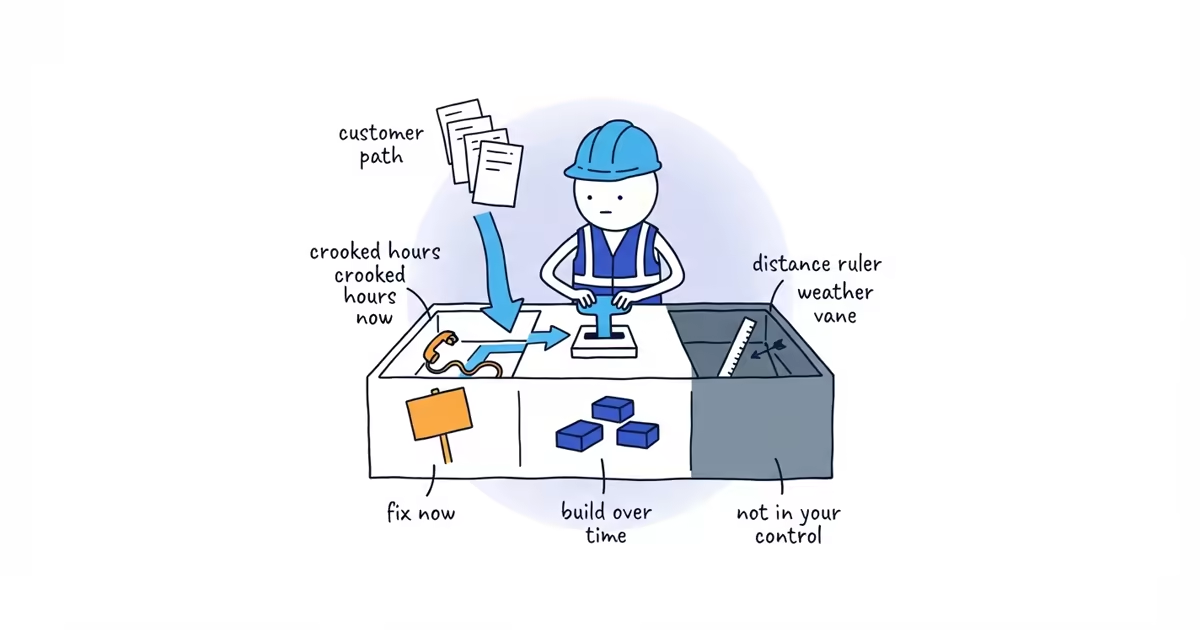
Use this priority matrix before paying for an SEO tool or starting another content project.
| Fix now | Build over time | You cannot directly control |
|---|---|---|
| Wrong phone, website, hours, address, map pin, or closed status | A steady record of genuine reviews | The searcher’s location |
| An ineligible or inaccurate Google Business Profile | Useful service and service-area pages | The business’s real distance from that searcher |
| A broken form, call button, voicemail, or booking path | Approved job photos and specific project proof | Competitors’ locations and existing strength |
| A website page that does not match the service promised in the result | Relevant local and trade links or mentions | Google’s undisclosed weighting of signals |
| A customer-facing listing that sends people to old information | A short set of accurate, maintained listings | Immediate ranking movement after an edit |
The left column protects current demand, the middle builds future demand, and the right prevents risky shortcuts.
Start with the most expensive visible failure. If calls reach a former advertising provider, fix the number before asking for reviews. If the profile is accurate but the roofing page contains no project proof or estimate path, improve that page before creating ten city pages.
How local SEO priorities change by trade
The same checklist does not fit every contractor.
An emergency plumber should test the public phone number, hours, dispatch promise, and mobile page first. The customer may call within minutes. A detailed article about pipe materials cannot recover a call routed to an old voicemail.
An HVAC company has a capacity problem during a heat wave as much as a visibility problem. If the schedule is full, “same-day service” on Google or the website creates bad leads and angry customers. In the slower season, maintenance and replacement pages, current photos, and review follow-up can be built before demand returns.
A roofer usually supports a longer decision. Customers compare inspections, warranties, financing, licenses, project photos, and reviews. The website and branded results need to survive that comparison. Creating a profile in every city served does not solve the distance constraint.
A recurring cleaning business should care about route density and retention. Ten inquiries scattered across a metro can be less valuable than three recurring customers near an existing route. Its local SEO reporting should keep that operational reality visible.
These are not cosmetic variations. Urgency, ticket size, seasonality, repeat work, and drive time change which local-search problem deserves attention first.
30-day local SEO plan for contractors
Use the month to repair one customer path and establish one repeatable proof habit.
Week 1: see what customers see
Search the business name and three priority services while signed out. Check Search and Maps. Record the phone, website, hours, location presentation, reviews, and pages that appear.
Then call the displayed number and submit the website form. Note where it rings, what the voicemail says, whether the form confirms delivery, and who receives it. This baseline costs nothing and often exposes a more urgent problem than ranking position.
Week 2: fix the worst break
Correct the highest-risk factual error on the website and the relevant core profile. If the information is already accurate, repair the weakest conversion point: a dead form, generic homepage destination, confusing service page, or unanswered call route.
Do not spread the week across twenty small edits. Finish one customer path from result to response.
Week 3: improve one service destination
Choose one service the business can sell and fulfill now. The page should state what the service covers, who it is for, where the company provides it, what proof supports the claim, and what the customer should do next.
One complete page for panel upgrades is more useful than five near-identical pages that replace only the city name.
Week 4: create one proof routine
Choose an action the team can repeat after appropriate jobs: save approved before-and-after photos, record the service and area, request a review through a platform that permits it, or write down the facts of an instructive project.
The routine matters more than a one-time upload. Prominence and customer trust are built from a real operating history, not a burst of activity followed by six quiet months.
How to measure local SEO results
Rankings, profile views, website visits, and clicks help explain what happened. They are not the business result.
For each known source, record:
- Qualified calls and estimate requests
- Booked jobs
- Completed jobs
- Collected revenue
- Out-of-area or wrong-service inquiries
- Missed calls and unworked leads
A higher ranking that sends unserviceable jobs from distant cities is not growth. A modest increase in qualified estimates for profitable work may be.
The right first task is not another SEO tactic. Open the public result while signed out, follow the customer path, and fix the first break. If that break is unclear, an online presence audit compares the website, Google profile, reviews, and listings to show what to fix first.
Frequently asked questions
What does NAP mean in local SEO?
NAP means the business name, address, and phone number. Keep those facts accurate on the website and the customer-facing profiles people use to find or verify the contractor.
Do local citations still matter for contractors?
Accurate listings on core and relevant platforms still help customers find and check a contractor. Buying hundreds of generic citations is not a substitute for accurate information, customer proof, or a useful website.
Can a contractor rank in a nearby city without an office there?
It can happen, but adding a city to the service-area field does not move the business or guarantee visibility there. Keep the location truthful and measure searches and qualified jobs from real customer locations.
Sources
- local-seo
- contractor-marketing
- google-maps
- local-search
- home-services