

What do I say when a customer says my price is too high?
Use a diagnose-first conversation for seven different price objections, with exact questions, full scripts, a quote-comparison checklist, and a follow-up message.
“That’s more than I expected.”
The next ten seconds matter. Start defending your overhead and you’ll sound rattled. Knock money off and you’ve made the original quote look soft. Ask one calm question instead:
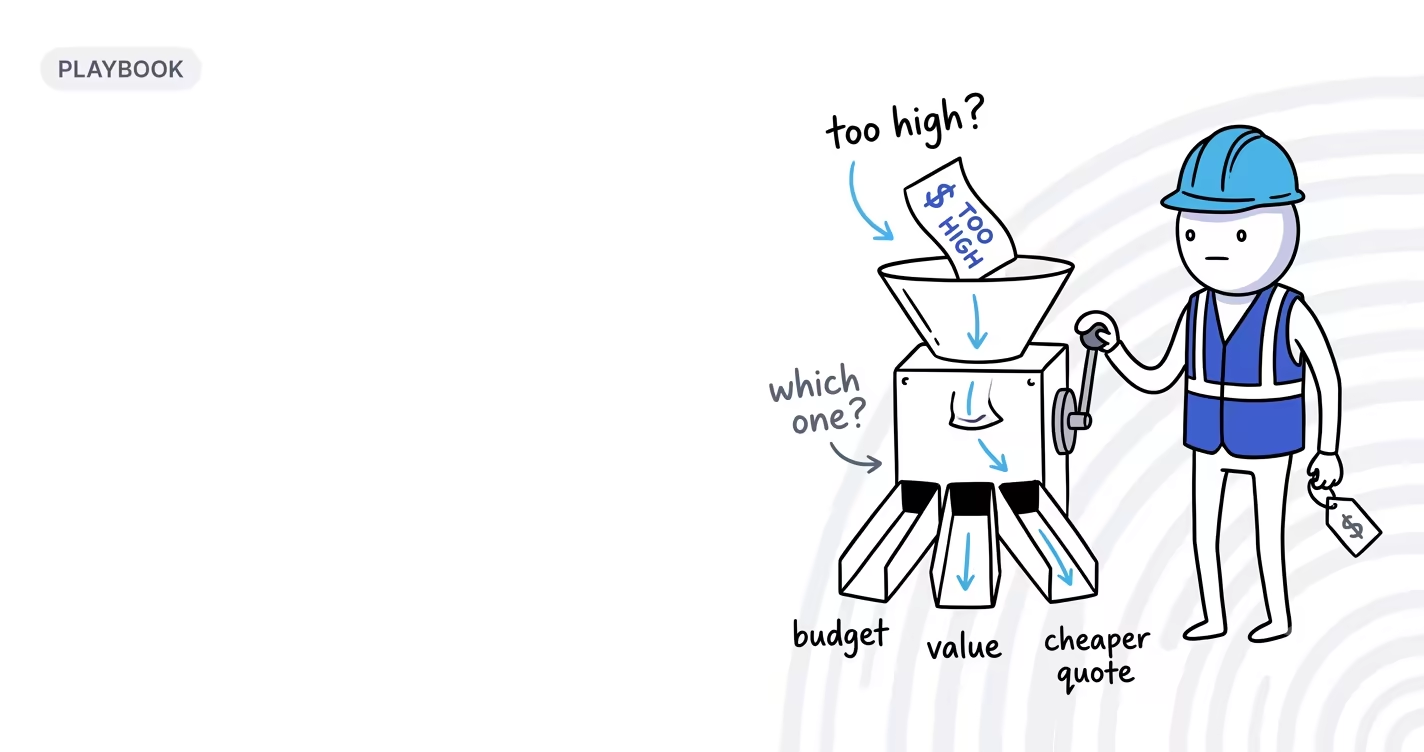
“Got it. Is the number more than you expected, outside the budget, or higher than another quote?”
Then stop talking. A customer who expected a lower number needs a different answer from one who can’t fund the job this month.
The first minute of the conversation
Forget the clever comeback. You’re trying to learn whether the customer needs information, a different scope, different payment timing, more confidence, or a polite exit.
- Listen. Let the customer finish without correcting them.
- Acknowledge. Confirm that you heard the concern without agreeing that your price is wrong.
- Clarify. Ask one or two questions to identify the actual comparison.
- Respond. Use the scope, evidence, or option that fits that concern.
- Ask for a decision. Agree on the next action instead of ending with more information and no commitment.
A neutral acknowledgment sounds like this:
“Absolutely. It’s a big number, and you should be clear on it before you decide.”
Avoid “I know it’s expensive.” That labels your own price before you know what the customer means.
Seven objections hiding behind the same sentence
| What “too high” means | Question to ask | Useful response |
|---|---|---|
| Sticker shock | ”Have you had this type of work done before, or is this your first quote?” | Explain the required work and the cost drivers without giving a lecture |
| Total budget is too low | ”What total were you trying to stay within?” | Re-scope, phase, or remove optional work and reprice it |
| Cash is not available now | ”Is the concern the total cost or when the payments are due?” | Discuss lawful payment timing or financing without changing the job price |
| Another quote is lower | ”Can we compare the written scope and specifications?” | Normalize both quotes before deciding whether to hold or revise |
| They do not trust the value | ”Which part of the proposal feels least clear or least justified?” | Show relevant proof, process, warranty terms, and responsibilities |
| The work is not urgent | ”Is the price the issue, or are you not ready to do the project yet?” | Confirm quote validity and agree on a follow-up date |
| A decision-maker is missing | ”Who else needs to be comfortable with the scope and price?” | Review the proposal when all decision-makers can participate |
A permanent discount won’t solve a cash-timing problem. Testimonials won’t fix the wrong scope. Diagnose first.
When the customer expected a lower price
Customer: “That’s a lot more than I expected.”
You: “Got it. Is this the first full quote you’ve had for this kind of work?”
Customer: “It’s the first. I thought it would be around $4,000.”
You: “That helps. The panel work, permit and inspection, and the damaged circuits are driving most of it. Let me show you those in the quote. Then we can see whether any optional work can wait.”
The response does not tell the customer their expectation is ridiculous. It replaces an unsupported expectation with a documented scope.
When the budget cannot cover the full job
Customer: “I can’t spend $12,000. I need it under $9,000.”
You: “I can’t do this same job for $9,000. We may be able to phase it or pull out something optional. What has to be done now?”
Customer: “The leak and damaged section have to be handled. The rest can wait.”
You: “Okay. I’ll price that as phase one and spell out what’s left for later.”
Don’t subtract $3,000 and improvise the smaller job afterward. Rewrite the deliverables, exclusions, schedule, and price together.
When the problem is payment timing
You: “Is the issue the total price or having the full amount available on this schedule?”
Customer: “The total is workable. I can’t pay that much this month.”
You: “Okay, so the total isn’t the problem. The timing is. Let’s look at the payment schedule and any financing available for this job.”
Only offer payment arrangements your business can support and that comply with applicable lending, contract, deposit, and consumer-protection rules. State fees, interest, milestones, and due dates in writing.
When another contractor quoted less
Suppose your HVAC replacement quote is $11,200 and the customer has another at $8,900. Maybe something is missing. Maybe not. Ask to compare the documents.
Customer: “You’re $2,300 higher than the other company.”
You: “That’s a real gap. Mind if we put the quotes side by side? I want to check the equipment, electrical work, permit, removal, startup, and warranty before I tell you they’re the same job.”
Compare only verifiable terms:
- Equipment or material manufacturer, model, quantity, and grade
- Required permit, inspection, license, and insurance
- Demolition, protection, removal, disposal, and cleanup
- Electrical, structural, finish, or restoration work
- Start assumptions, schedule, payment terms, and quote validity
- Parts and labor warranty, exclusions, and callback responsibility
- Allowances, alternates, exclusions, and change-order rules
If the scopes are comparable and the other company is simply cheaper, say so. Your next decision is whether to match, hold, re-scope, or walk, not how to discredit the competitor.
When the customer can’t see why you cost more
Generic claims such as “better quality” are not proof. Connect the price to something the customer can inspect.
Customer: “Why are you worth more?”
You: “Don’t pay more because I say we’re better. On this job, I can show you the material spec, the prep on pages two and three, the two-day plan, and the labor warranty. Which of those matters to you?”
Use photos of comparable completed work, relevant reviews, documented credentials, manufacturer specifications, a written process, and clear warranty terms. Predictions about a competing product failing, or guesses about another contractor’s credentials, aren’t evidence.
When the work isn’t a priority yet
Sometimes “too high” means “not now.”
You: “Is there a different price that would make you start now, or is the project not a priority yet?”
Customer: “Probably not until fall.”
You: “That’s helpful. This quote is valid through [date]. I can follow up in [month], and we can update the scope, cost, and availability then. Does that timing work?”
Once the customer makes the timing clear, stop selling urgency. Record the agreed follow-up date.
When a decision-maker is missing
Customer: “I need to talk to my partner. They’ll think this is too much.”
You: “Makes sense. Rather than make you relay all the technical details, let’s do a short review with both of you. When are you both free?”
Pressuring one person to approve a project that another person also has to accept rarely ends well. A shared review also reveals whether price is the real concern.
Sometimes the quote should change
Holding every price is no more disciplined than discounting every objection. Revise the quote when:
- You find an estimating or arithmetic error before an agreement is accepted.
- The customer changes the scope, material, schedule, allocation of responsibility, or payment terms.
- A verified cost changes and the quote terms allow or require an update.
- A deliberate concession still meets the required economics and has a documented business reason.
Any revised quote should show what changed. If nothing changed except the customer’s resistance, calculate the margin impact before offering the same work for less.
The lines that make things worse
- “You get what you pay for.” It insults the customer and proves nothing about your proposal.
- “The other contractor must be cutting corners.” You do not know that from a price alone.
- “This is our best price” before checking the concern. It ends a conversation that may not be about price.
- A long breakdown of your overhead. Customers need a clear scope and outcome, not your internal profit-and-loss statement.
- A surprise discount. It teaches the customer that the first number was negotiable without explaining why.
End with one next step
“Let me know” leaves the quote floating. Ask for the action that fits the conversation:
- “Would you like to approve the original scope or have me price the phased option?”
- “Can you send the written quote so we can compare it before Friday?”
- “Shall we review the payment schedule now?”
- “Should I close this quote, or follow up in September?”
If the customer does not decide, send one specific follow-up:
“Hi [Name], following up on the [project]. We talked about [main concern], and I sent [option or information]. The quote is good through [date]. Should I keep it moving, revise the scope, or close it for now?”
The customer can answer without restarting the entire sales conversation.
Frequently asked questions
Should I ever lower my price to win a job?
Lower the same-scope price only when a documented business reason and a fresh calculation still support the required economics. Otherwise, stage the work, change the timing, or trim the scope so the lower number reflects a real change in cost, risk, or deliverables.
What if I think they’re bluffing about a cheaper quote?
Do not argue about whether the other quote is real. Ask to compare the written scope, specifications, permit, warranty, exclusions, schedule, and payment terms. If no written quote exists, explain your own proposal and decline to negotiate against an unverifiable number.
How do I answer “that’s more than I expected” over text?
Reply: “Got it. Is the number more than you expected, outside the budget, or higher than another quote?” Use the answer to send the relevant scope or option. Move a complicated discussion to a call, then confirm the decision in writing.
Sources
- pricing
- price-objections
- sales-scripts
- estimates
- handling-objections



