How to Handle Severe Weather Closures in Illinois
Reporting-time pay, ODRISA rest-day limits, and weather that ranges from polar vortex to tornado season — Illinois employers need a policy for all of it.
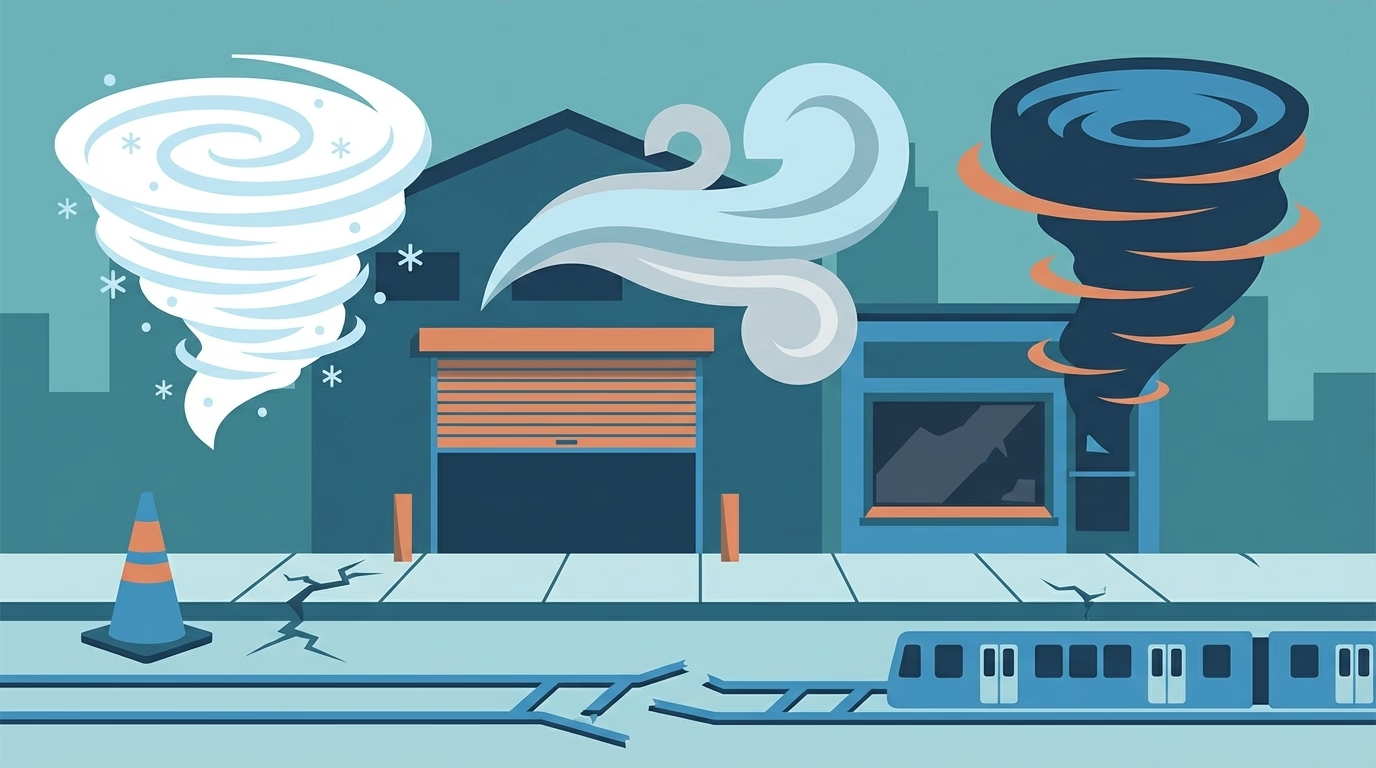
Illinois sits at a crossroads of weather extremes. Arctic air from Canada delivers polar vortex events with wind chills below -50°F. Lake-effect snow and nor’easters pile up feet of snow across the northern part of the state. Summer brings severe thunderstorms, tornadoes, and flooding. For employers managing shift-based teams, this range of hazards demands an inclement weather policy that covers more than just snow days.
Illinois also adds regulatory layers that states like Texas and Florida don’t have. Reporting-time pay provisions, the One Day Rest in Seven Act, the new Paid Leave for All Workers Act, and an active state OSHA program all intersect with weather closure decisions in ways that require careful planning.
Illinois Inclement Weather Laws: What Employers Must Know
Illinois occupies a middle ground between the minimal regulation of Texas and the extensive requirements of California and New York:
| Regulation | What it means for employers |
|---|---|
| Reporting-time pay applies in some situations | When an employer directs an employee to report and then sends them home, pay may be owed. The specifics depend on whether the employee was called in versus showing up for a regular shift. |
| One Day Rest in Seven Act (ODRISA) | Employers must provide 24 consecutive hours of rest every consecutive seven-day period. When weather disrupts the schedule and you try to compress work into fewer days, this law limits how far you can push. |
| Paid Leave for All Workers Act | Since January 2024, Illinois employees earn 40 hours of paid leave annually for any reason. This interacts with weather closures because employees can use it voluntarily, but employers can’t force it. |
| State OSHA plan (public sector only) | Illinois operates a state OSHA plan through the Illinois Department of Labor, but it covers only state and local government workers. Private-sector employers fall under federal OSHA, same as Texas and Florida. |
| Extreme weather diversity | Chicago and northern Illinois face brutal cold. Central Illinois deals with tornadoes and thunderstorms. Southern Illinois gets ice storms and occasional flooding from the Mississippi and Ohio rivers. A single-hazard policy won’t cover the state. |
Illinois Reporting Time Pay: Do You Have to Pay Employees Sent Home for Weather?
Illinois reporting-time pay rules are less straightforward than California’s or New York’s. The key provisions:
When Does Illinois Reporting Time Pay Apply?
Under Illinois law, if an employer calls an employee in to work (outside their regular schedule) and then sends them home, the employee is entitled to at least 4 hours of pay or half the scheduled shift, whichever is less. This is sometimes called “call-back pay” or “reporting pay.”
| Scenario | What you owe |
|---|---|
| Employee called in for an extra shift, sent home after 1 hour | 4 hours pay (or half the shift if less) |
| Employee reports for their regular scheduled shift, sent home | Hours worked only (see note below) |
| Employee notified before leaving home that shift is cancelled | Nothing |
| Employee’s regular shift is 6 hours, called in extra, sent home | 3 hours pay (half of 6-hour shift) |
Important note: The reporting-time pay obligation is strongest when the employer initiates the call-in. For regularly scheduled shifts that are cancelled after the employee arrives, the situation is less clear-cut under Illinois law. Many Illinois employment attorneys recommend paying at least 2–4 hours to avoid disputes, but the statutory language doesn’t create the same bright-line rule as California or New York.
How to Avoid Reporting Time Pay Disputes in Illinois
- Cancel shifts before employees leave home. This is the safest approach regardless of which legal interpretation applies.
- Set your decision deadline 90+ minutes before the earliest shift.
- Document the notification. Use a scheduling system that timestamps when cancellations are sent and read.
- When in doubt, pay something. The cost of 2–4 hours of pay per affected employee is almost always less than the cost of a wage claim or the morale damage of sending someone home with nothing after a dangerous commute.
Illinois One Day Rest in Seven Act: Can You Schedule Makeup Shifts After a Weather Closure?
The One Day Rest in Seven Act requires employers to provide at least 24 consecutive hours of rest in every consecutive seven-day period. This directly affects how you handle weather-related schedule compression.
Illinois ODRISA Rules: Rest Day and Meal Break Requirements
| Rule | Details |
|---|---|
| 24-hour rest requirement | Employers must provide 24 consecutive hours of rest per consecutive seven-day period |
| Voluntary waiver | Employees can voluntarily waive this requirement, but the waiver must be requested by the employee, not the employer |
| 7-day work permits | The Illinois Department of Labor can grant permits allowing employers to schedule 7-day workweeks for limited periods — but you need to apply in advance |
| Penalties | Up to $250 in damages to the employee + $250 penalty to the state per offense (under 25 employees); $500 + $500 for larger employers. The Illinois DOL actively investigates complaints. |
ODRISA Scheduling Trap After a Weather Closure
Scenario: A snow day cancels Monday shifts. The manager adds Saturday shifts to make up the hours. But two employees already worked last Saturday and are scheduled through next Friday — that’s 12 consecutive days without a rest day.
The fix: Before posting makeup schedules, check each employee’s last day off. If adding a makeup shift would push anyone past 7 consecutive days, either skip them for the makeup shift or get a voluntary written waiver (initiated by the employee, not the employer). Your scheduling system should flag this automatically.
How to Schedule Around ODRISA After a Weather Disruption
After a weather disruption, use your scheduling system to verify that every team member has at least one full day off in each 7-day period before posting makeup schedules. If someone volunteers to work through their rest day, get a written waiver.

How Should Illinois Employers Prepare for Extreme Cold and Polar Vortex Events?
Northern Illinois, and Chicago in particular, faces extreme cold events that are among the most dangerous weather conditions in the country. The January 2019 polar vortex drove Chicago wind chills to -50°F and caused the city to essentially shut down.
At What Wind Chill Should Illinois Employers Cancel Outdoor Work?
| Wind chill | Frostbite risk | Employer action |
|---|---|---|
| 0°F to -10°F | Low to moderate | Monitor conditions; provide warming breaks for outdoor workers |
| -10°F to -25°F | Moderate — frostbite in 30 minutes | Limit outdoor exposure; mandatory warming breaks every 30 minutes |
| -25°F to -45°F | High — frostbite in 10–15 minutes | Consider suspending outdoor operations; indoor warming required |
| Below -45°F | Extreme — frostbite in under 5 minutes | Suspend all outdoor operations; strongly consider full closure |
Illinois Employer Obligations for Workers in Extreme Cold
While Illinois doesn’t have a specific extreme cold workplace standard, the state OSHA program’s General Duty Clause covers recognized cold hazards:
| Obligation | Details |
|---|---|
| Warming areas | Outdoor workers must have access to heated vehicles, warming trailers, or indoor spaces. |
| Protective equipment | Insulated clothing, hand warmers, face protection, and non-slip footwear for icy surfaces. |
| Modified schedules | Shorter outdoor work periods with mandatory warming breaks. Track outdoor time through your time clock system to document compliance. |
| Commute safety | When road conditions make commuting dangerous, the practical and legal risk of requiring attendance is high. A team member injured during an employer-required commute in hazardous conditions may file a workers’ compensation claim, and the employer may face OSHA scrutiny. |
What Happens When CTA or Metra Shuts Down During a Storm in Chicago?
Chicago’s transit systems — the CTA and Metra — reduce or suspend service during extreme cold and heavy snow events. For employers in the Chicago metro area, transit disruptions affect a significant portion of the workforce. Your policy should:
| Action | Details |
|---|---|
| Define transit triggers | CTA/Metra service suspension as a trigger for modified schedules or closures |
| No attendance penalties | Do not penalize team members who can’t commute due to transit shutdowns |
| Separate tracking | Track transit-related absences separately from no-call/no-shows in your attendance system |
How Should Illinois Employers Handle Tornadoes and Severe Thunderstorms?
Illinois is in Tornado Alley’s eastern reach. Severe thunderstorms, tornadoes, and flash flooding are annual threats from April through September.
Tornado protocols for shift-based businesses:
- Designate shelter areas at each location (interior rooms, lowest floor, away from windows)
- Conduct annual tornado drills — especially for businesses with rotating shift staff who may not all be present during a single drill
- When the National Weather Service issues a tornado warning for your area, all outdoor work stops immediately
- After a tornado, assess structural damage before allowing anyone back into the building
Flash flooding:
- Low-lying locations may flood with little warning during summer storms
- Team members may face impassable roads even when your location is dry
- Treat flood-related commute failures as excused absences
Can Employees Use Illinois Paid Leave During a Weather Closure?
Since January 1, 2024, the Paid Leave for All Workers Act gives Illinois employees 40 hours of paid leave per year, usable for any reason. During weather events:
| Rule | Details |
|---|---|
| Employees can choose to use paid leave | During weather closures or when unable to commute |
| Employers cannot require paid leave | For employer-initiated closures |
| No documentation required | Employers cannot require documentation for why the leave is being used |
| Default is unpaid | If a team member doesn’t request paid leave during a weather closure, the time is unpaid for hourly workers |
This means your weather closure policy should clearly state that paid leave is available but not required during employer-directed closures.

Illinois Inclement Weather Policy Checklist for Employers
- Decision deadline: 90+ minutes before earliest shift to minimize reporting-time pay exposure
- Reporting-time pay rules documented (regular shifts vs. call-ins)
- ODRISA compliance verified — every team member gets 24 hours rest per consecutive seven-day period, including after schedule compression
- Paid Leave for All Workers Act notice posted — employees can use leave but aren’t required to
- Cold weather thresholds defined with corresponding actions (warming breaks, outdoor suspension, closure)
- CTA/Metra service suspension trigger defined for Chicago-area locations
- Tornado shelter locations identified and marked at each location
- Time tracking configured with weather-related exception codes
Do You Have to Pay Employees During a Weather Closure in Illinois?
| Employee type | Notified before reporting | Reported, sent home (regular shift) | Called in extra, sent home |
|---|---|---|---|
| Hourly (non-exempt) | No pay owed | Hours worked (consider voluntary 2–4 hr pay) | 4 hrs or half shift, whichever is less |
| Salaried (exempt) | Full salary if any work that week | Full salary if any work that week | Full salary if any work that week |
| Paid leave | Employee may choose to use | Employee may choose to use | Employee may choose to use |
Weather closure rules vary by state. See our guides for California, Florida, New York, and Texas, or read the complete guide to inclement weather policies.
More Illinois employer guides: Hiring as an IL sole proprietor | Closing a business in Illinois
Frequently Asked Questions
Can Your Employer Make You Come to Work During a Polar Vortex in Chicago?
There’s no specific law prohibiting it, but the risks are substantial. When wind chills reach -50°F and frostbite can occur in under 5 minutes of exposed skin, requiring commutes creates OSHA exposure and workers’ compensation liability. If CTA and Metra have reduced or suspended service, many team members physically can’t commute regardless. The practical answer is to close or operate with a skeleton crew of nearby volunteers.
How Should Central and Southern Illinois Employers Handle Tornado Season?
Downstate Illinois (Springfield, Champaign, the Metro East area) sits in active tornado territory. Every shift-based business needs designated shelter areas, annual tornado drills, and a plan for what happens if a tornado damages the workplace. When the National Weather Service issues a tornado warning for your area, all outdoor work stops immediately and employees move to shelter. After a tornado, do not reopen until a structural assessment confirms the building is safe.
How Should Illinois Employers Handle Ice Storms?
Ice storms are among the most dangerous winter weather events because they make roads extremely hazardous with little visual warning. A quarter-inch of ice accumulation can make commuting impossible. Southern and central Illinois are more prone to ice storms than the Chicago area. Treat ice storm advisories as closure triggers — the risk of team member injuries during commutes in icy conditions far outweighs the cost of a missed day. Use your scheduling platform to cancel shifts and communicate the closure before anyone leaves home.
- inclement-weather-policy
- illinois-labor-law
- reporting-time-pay
- one-day-rest
- extreme-cold
- polar-vortex
- shift-scheduling
- hourly-employees